

Baby's First-Month (Full Month) Celebration in Singapore
In this article
Reaching your baby's first month is a quiet kind of triumph. You have survived the blur of round-the-clock feeds, the recovery, and the first wave of visitors, and now there is a milestone worth marking. In Singapore, the baby's first-month celebration goes by many names depending on the family: the Chinese call it man yue or the full month, often written as 'full moon' on invitations. This guide walks you through what the tradition means, how different communities in Singapore mark early infancy, and how to plan a celebration that feels true to your family without burning you out as a new parent.
What the full month celebration means
The full month, or man yue, marks roughly 30 days since your baby was born. Historically the milestone carried real weight. In an era before modern medicine, the first month was the most fragile stretch of a newborn's life, so surviving it was genuinely worth celebrating. The full month became the moment a baby was formally welcomed into the extended family and wider community, and the point at which the mother's confinement period traditionally drew to a close.
Today the medical anxiety has largely faded, but the emotional meaning remains. It is a way of saying: this child belongs to us now, and here is the family and circle of friends who will help raise them. For many Singaporean families it is the first big gathering after the new arrival, and the first time grandparents, aunts, uncles and old friends meet the baby in person.
Chinese full month customs
Chinese man yue customs are the most visible in Singapore, partly because they involve the well-known red egg and ginger gift sets that circulate through offices and family WhatsApp chats. It helps to remember that practices vary a lot by dialect group (Hokkien, Teochew, Cantonese, Hakka, Hainanese and others) and by how traditional a family is. Few families do everything on this list, and that is completely normal.
Red eggs and their meaning
Hard-boiled eggs dyed red are the signature symbol of a Chinese full month. The egg's round shape suggests a harmonious, complete life cycle, while red is the colour of joy and good fortune. An even number of eggs is often given as a nod to good things coming in pairs. In modern Singapore the literal red eggs are frequently swapped for or paired with other treats, but they remain the emblem people associate with the occasion.
Ang ku kueh and other treats
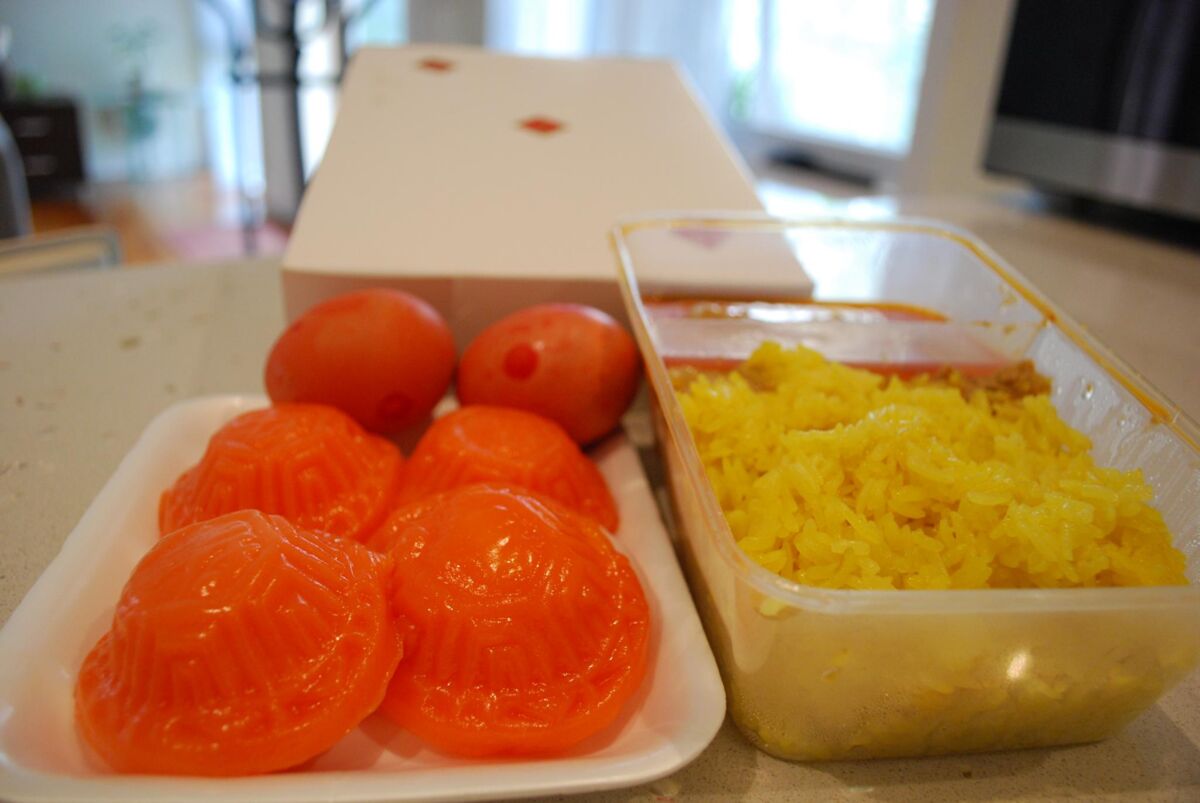
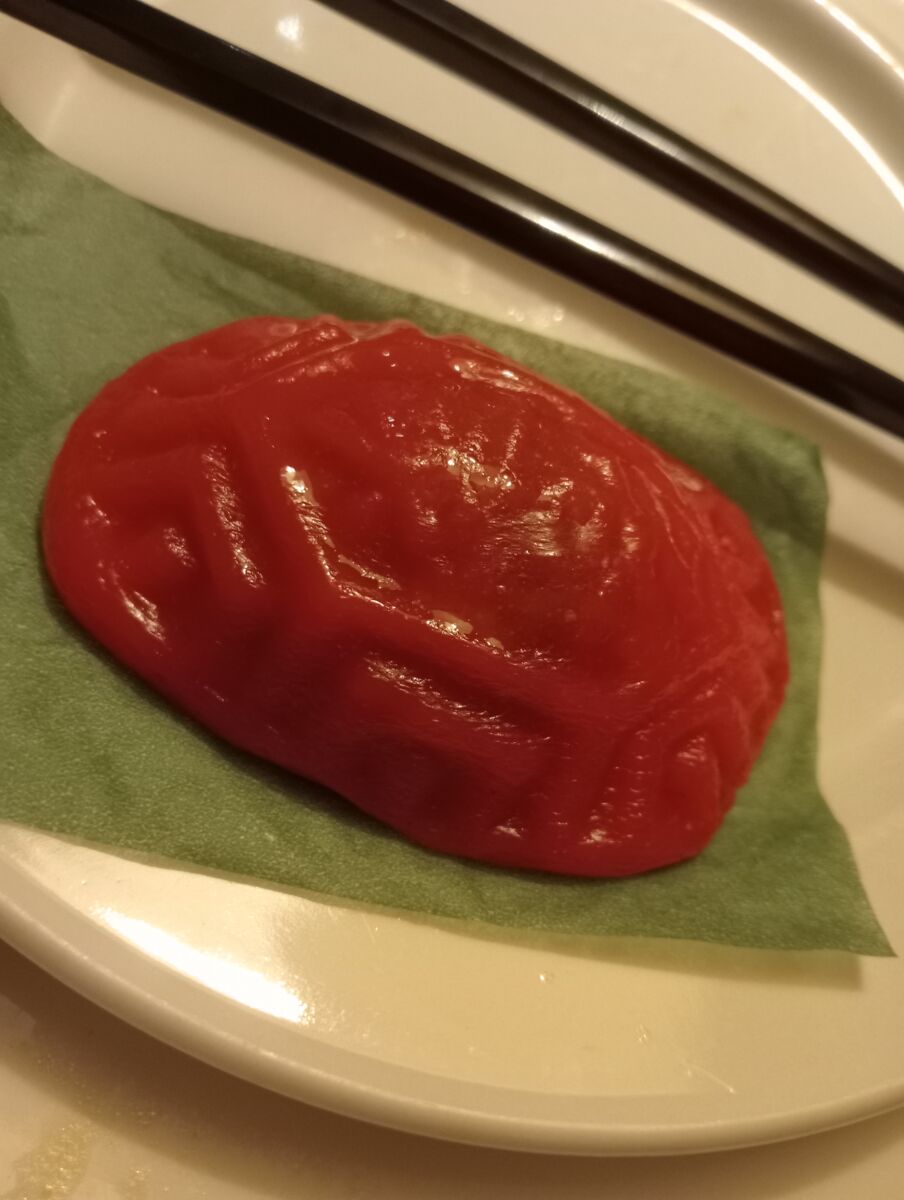
Ang ku kueh, the glutinous red tortoise-shaped cakes filled with sweet bean or peanut, are a classic full month gift, with the tortoise shape symbolising longevity. Depending on the family you might also see glutinous rice, sponge cakes, fried sesame balls, or roasted meats sent to close relatives. The exact spread differs by dialect group, so do not be surprised if your in-laws expect something your own family has never heard of.
The gift box you send out
Many Singaporean families announce the birth by sending out a full month gift box, sometimes called a celebration cake set, to relatives, friends, colleagues and neighbours. A typical box bundles several auspicious items together so recipients know a baby has arrived and can share in the joy. Common inclusions are:
- Red eggs, or a modern stand-in such as red-tinted glutinous rice
- Ang ku kueh and a sweet cake or sponge cake
- Glutinous rice, sometimes with chicken or mushrooms for savoury balance
- Cupcakes, cookies or brownies in contemporary boxes
- A small card noting the baby's name, and sometimes the birth date
Boxes range from simple traditional sets to elaborate modern hampers. Treat these as broad categories rather than a fixed shopping list, and choose what suits your budget and the people you are sending to.
Hair-shaving
Some families shave the baby's first hair around the full month, a custom shared across several Asian cultures. The idea is that shaving the fine birth hair encourages thicker, healthier hair to grow in, and symbolically lets the baby shed the old and start fresh. Plenty of modern parents skip this entirely or just trim a symbolic lock, especially if they would rather not put a razor near a newborn's scalp. There is no obligation either way.
Ang pao and the end of confinement
Guests at a full month celebration typically bring ang pao, red packets containing money, as a blessing for the baby. In return, families often send guests home with red eggs, ang ku kueh or a slice of cake. The full month also traditionally coincides with the end of the mother's confinement, the customary rest-and-recovery period that commonly runs about 28 to 30 days. If you had help during this time from a confinement nanny in Singapore, the full month is often when their engagement wraps up, so it can double as a thank-you and farewell.
How Malay and Indian families mark early infancy
Singapore is multicultural, and Chinese man yue is only one of several ways families honour a new baby. Malay and Indian communities have their own early-infancy milestones, and these deserve to be described accurately and respectfully. As with Chinese customs, practice varies widely by religion, region of origin, and individual family.
Malay customs: cukur jambul and aqiqah
In many Malay-Muslim families, a baby is welcomed with cukur jambul, a hair-cutting ceremony, often held alongside aqiqah, the practice of giving thanks for the child. Cukur jambul usually involves symbolically trimming or shaving the baby's hair, sometimes with family elders and guests each snipping a small lock. Aqiqah traditionally involves the sacrifice of livestock with the meat shared among family, friends and those in need, and is commonly observed in the early period after birth though families vary on timing. The baby's name may also be announced and blessings offered. These are religious observances, so the details follow Islamic guidance rather than a fixed calendar date.
Indian customs vary by community
Indian families in Singapore mark early infancy in different ways depending on community, region and faith. Some Hindu families hold a naming ceremony, sometimes called namakaranam, in the early weeks, where the baby is formally named on an auspicious day chosen with the family. A first hair-removal ceremony, often known as mundan or chooralam, is also observed by many families, though frequently later in infancy or toddlerhood rather than at one month. Because India's communities are so varied, there is no single template, and the right answer is whatever your own family and elders observe.
If you are choosing a name and want ideas that work well in Singapore's multilingual setting, our guides to baby names in Singapore and Chinese baby names are a good starting point.
Planning a modern full month celebration
Modern Singapore full month celebrations range from a quiet dinner with grandparents to a catered party for fifty. There is no correct size. What matters is matching the event to your energy, your space and your budget while you are still in the thick of newborn life.
Guest list and scale
Decide early whether you want an intimate gathering or a larger party, because almost every other decision flows from headcount. A small celebration might be immediate family only, perhaps eight to twelve people. A mid-size one adds close friends and extended relatives. A big one folds in colleagues and the wider circle. New parents are often surprised by how draining hosting is on little sleep, so it is perfectly reasonable to keep the in-person guest list small and send gift boxes more widely instead.
At home versus a restaurant
The two main formats are hosting at home, often with catering, or booking a restaurant. Each has trade-offs:
- At home: more relaxed, easier for the baby to nap and feed, no time limit, lower cost, but you handle setup, cleanup and space constraints in a typical HDB or condo unit.
- Restaurant: no cooking or cleaning, can seat larger groups, but usually pricier, noisier, with fixed timings and less privacy for nursing or settling a fussy baby.
- Catering at a function room in your condo or void deck can be a middle path, giving you space without hosting inside your own living room.
Catering and gift box options as categories
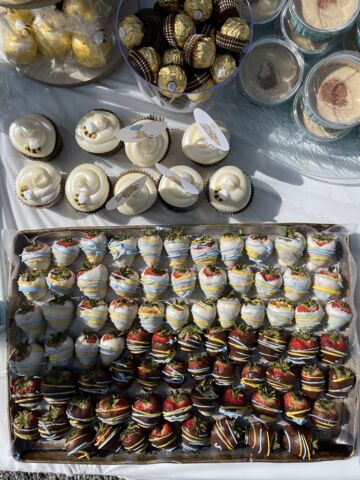
Rather than chase specific vendors, it helps to think in categories. For food, you might choose buffet catering, a sit-down restaurant menu, or a mix of light bites if it is a short afternoon gathering. For the gift boxes you send out, options broadly fall into traditional sets (red eggs, ang ku kueh, glutinous rice), modern dessert boxes (cupcakes, cookies, brownies), and hybrid hampers that combine both. Order gift boxes well ahead, as popular providers book out, and confirm quantities once your guest list firms up.
Virtual and hybrid options
Not every relative can attend in person, especially family overseas or those wary of crowding a newborn. A simple video call during the celebration, or a hybrid event where distant relatives join by screen, lets everyone share the moment. You can also mail or courier gift boxes to those who cannot come, which keeps the tradition of sharing the news alive even at a distance.
Photography
Many families capture the milestone with photos, whether a relaxed phone session at home or a booked shoot. If you want polished images, arranging this in advance is wise because good photographers fill up. Our guide to newborn photography in Singapore covers timing, what to expect, and how to keep a tiny baby comfortable during a session.
A simple planning checklist and timeline
Because the date is fixed roughly 30 days after birth and you may be planning while exhausted, a loose timeline keeps things manageable. Adjust freely to your situation.
During pregnancy or the first week
- Decide rough scale: intimate, mid-size or large
- Pick a tentative format: at home, restaurant, or function room
- Note any customs your family or in-laws expect, and ask elders early
Around two weeks before
- Confirm the guest list and send save-the-dates or a group message
- Book catering or a restaurant table
- Order gift boxes and confirm quantities
- Arrange photography if you want it
- Decide on hair-shaving or other customs, if any
The final week
- Reconfirm headcount, catering and gift box pickup or delivery
- Prepare return gifts for guests if you are giving them
- Plan a quiet space at the venue for feeding and nappy changes
- Have a wet-weather and a fussy-baby backup plan so you can step out without guilt
Etiquette for guests and gifts
If you are the one attending a full month, a little thoughtfulness goes a long way with sleep-deprived hosts.
- Bring an ang pao if attending a Chinese celebration; the amount is personal, and an even, auspicious figure is customary but never obligatory.
- Practical gifts are always welcome: diapers, wipes, baby clothes in larger sizes the baby will grow into, or vouchers.
- Follow the host's lead on holding the baby, and wash or sanitise your hands first. Do not visit if you are unwell.
- Keep visits short unless invited to linger, and let the parents rest.
- Accept the return gift of red eggs or cake graciously; it is part of the tradition of sharing joy.
Frequently Asked Questions
When exactly is the full month celebration held?
It is held around 30 days after the baby is born, which is where the name man yue, meaning full month, comes from. Some families pick the exact 30-day mark, others shift it to a nearby weekend so guests can attend, and some consult elders for an auspicious date. There is no single fixed rule.
Do we have to follow every traditional custom?
No. Customs vary enormously by dialect group, religion and family, and almost no one observes all of them. Choose what is meaningful to you, discuss expectations with elders early to avoid friction, and feel free to skip the rest. The celebration is about welcoming your baby, not ticking boxes.
What is in a typical full month gift box?
Traditional boxes commonly include red eggs, ang ku kueh and glutinous rice, while modern boxes lean toward cupcakes, cookies and other desserts. Many providers offer hybrid sets combining both. Treat these as general categories and pick what fits your budget and the people you are sending to.
How much should I put in an ang pao for a full month?
There is no set amount. It is a personal gesture of blessing, and many people choose an even, auspicious figure they are comfortable with. If you would rather give a practical gift such as diapers or baby clothes, that is equally welcome.
Is hair-shaving necessary?
It is optional. Some Chinese, Malay and Indian families shave or trim the baby's first hair as a symbolic fresh start or to encourage thicker hair, while many parents skip it or just snip a small lock. There is no obligation, and timing varies, with some communities doing it well after one month.
Can we celebrate if we are not Chinese?
Absolutely. Malay families often mark early infancy with cukur jambul and aqiqah, and Indian families with naming and hair ceremonies, each on their own terms. Many Singaporean families also blend traditions or simply host a relaxed welcome gathering. Whatever honours your child and your family is the right approach.
For more on celebrating life's milestones with little ones in Singapore, browse the rest of our family guides over on the Fussy Mama blog.
Planning a Baby Shower in Singapore
A warm, practical guide to planning a baby shower in Singapore: timing, venues, themes, food, games, gifts and etiquette...
10 min read
Children's Day Singapore: When It Is and How to Celebrate with Kids
Children's Day in Singapore is the first Friday of October, a primary-school holiday. When it is, why, and warm, low-cos...
9 min read
Children's Theatre in Singapore: A Family Guide to Kids' Shows
A Singapore parent's guide to children's theatre and kids' shows: who stages them, picking by age, relaxed performances,...
11 min read