

Pocket money for kids in Singapore: how much and how to start
In this article
There's no official amount of pocket money for kids in Singapore, so you build it from what your child pays for. For most primary school children that's recess food, plus a little to save. Pay it on a fixed day and check the amount each school term. If your family qualifies for MOE's Financial Assistance Scheme, it pays for 7 school meals a week, which shrinks the sum.
How to set pocket money, step by step
- List what the money has to cover. For most primary school children that's recess food and maybe a drink. Leave out anything you pay for yourself, such as a school bus.
- Find out what your child's canteen charges. MOE says most schools still have individual stallholders, so prices differ from school to school.
- Do the sum for one school week: meal price times school days, plus any drink. The worked example below shows the arithmetic.
- Put transport on the travel card and leave it out of the sum. SimplyGo says children under 7 who are 0.9m or taller ride basic buses and trains free with a Child Concession Card.
- Check if you qualify for MOE's Financial Assistance Scheme (FAS): household income up to $4,000 a month, or up to $1,000 per person. At primary level, MOE says FAS pays for 7 meals per school week.
- Pay on a fixed day. MoneySense suggests weekly pocket money from around Primary 3, so daily money suits the first two years.
- Let your child keep a record. One notebook page a week is enough to show what came in and what went out.
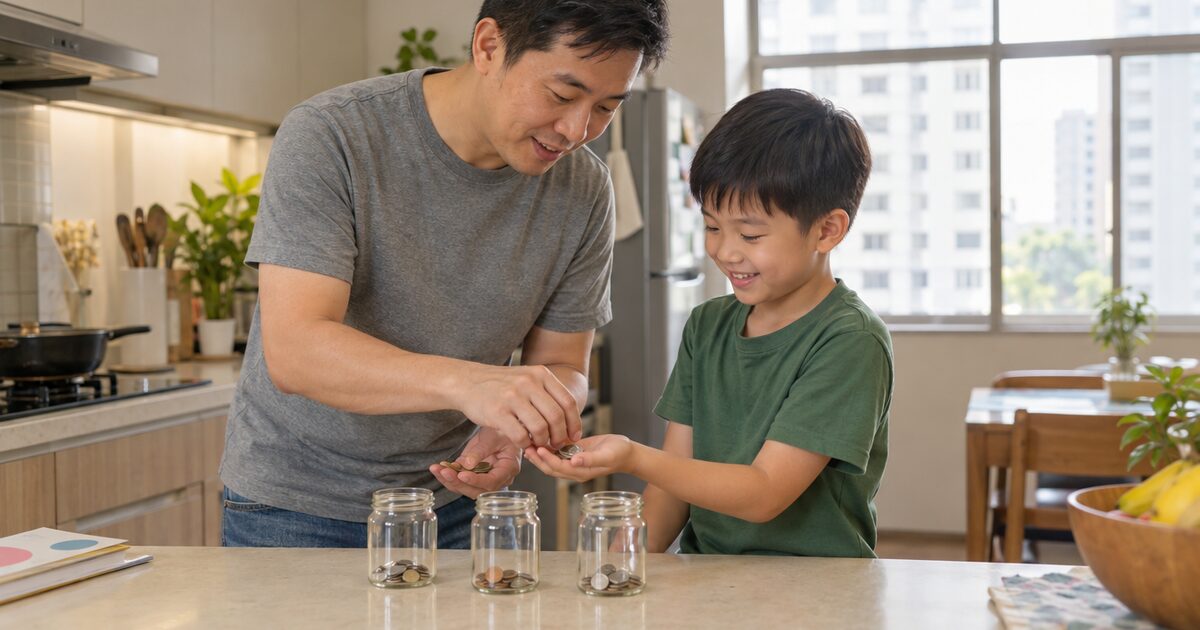
- Add a savings goal. MoneySense suggests saving first, as soon as the money arrives, in a clear jar so your child sees it grow.
- Keep to the amount if the money runs out early. MoneySense suggests letting your child miss a snack or two rather than handing over extra.
- Review the amount with your child each school term. Change it when what it covers changes.
A worked example for one school week
This example is a Primary 1 child who buys one meal at recess and takes a public bus to school. The $2.70 meal is an MOE figure: the central kitchens MOE is adding to 13 more schools from 2026 must offer at least one full meal at no more than $2.70 in primary schools. Swap in your own canteen's prices. The 5 school days and the $2.00 saved are example figures too.
| Cost line | Example sum |
|---|---|
| Recess meal | 5 days x $2.70 = $13.50 |
| Savings, your choice | $2.00 a week |
| Pocket money for the week | $13.50 + $2.00 = $15.50 |
| Primary bus pass on the School Smart Card | $24.00 a month, paid separately |
| The same bus pass on FAS | $24.00 - $21.00 = $3.00 a month |
For primary pupils, SimplyGo lists the Bus Concession Pass at $24.00 a month and the Train Concession Pass at $21.00. A Hybrid pass for both costs $39.00. Without a pass, the School Smart Card still pays concession fares. At a government or government-aided school, your child gets the card from the school and you top it up before first use.
On FAS, the sum shrinks. FAS pays for 7 meals per school week, which covers one meal on each school day, so the meal line drops out. It also gives $21 a month for public transport: the $24.00 bus pass minus $21.00 leaves $3.00. For a school bus, FAS pays 70% of the monthly fare, and our school bus fee calculator works out the full fare.
Pocket money and money lessons by age
What you teach at home can match what school teaches. MOE says primary pupils learn to tell needs from wants and the value of thrift and savings. MOE also suggests setting a weekly budget with your child and talking through how much goes to each day.
| Stage | How pocket money works | What to teach |
|---|---|---|
| Preschool, under 7 | None for school yet. Let your child pay at the shop with you. | How money works and how to count change (MoneySense) |
| Primary 1 and 2 | Daily, enough for that day's recess | Needs and wants, as taught in primary school (MOE) |
| Primary 3 and 4 | Weekly, as MoneySense suggests from around Primary 3 | Saving first, with jars for savings, spending and charity (MoneySense) |
| Primary 5 and 6 | Weekly, with a plan for each day (MOE) | The value of thrift and savings (MOE) |
Kids debit cards and children's savings accounts
Before you open a bank account or a debit card for your child, run through MoneySense's checks.
- Ask about fees. MoneySense says a debit card may have an annual fee and a fee to replace a lost card, plus fees for withdrawals abroad.
- Check the spending limit. A debit card takes money straight from the account, so your child can't spend more than what's in it.
- Find out the minimum deposit and minimum balance, and the charge if the balance falls below it.
- Check who controls the account. In a joint-alternate account, either of you can withdraw money or close it alone. In a joint-all account, every holder has to give the instruction.
- Ask about withdrawal limits at a branch or ATM.
- Find out the bank's age limits for the account and for the card.
- Turn on transaction alerts, and teach your child to keep the PIN secret and away from the card.
The CDA can't hold pocket money. LifeSG says CDA funds can only be used at Approved Institutions, for costs like preschool fees and medical bills, and can't be withdrawn as cash. Our CDA guide covers what it pays for.
Ang bao, treats and starting Primary 1
Festive money gets its own plan in our guide to ang bao money for kids. For treats and gifts outside pocket money, see how to avoid spoiling your child. Starting school soon? The Primary 1 preparation checklist covers the rest of the list, and our P1 registration guide explains the phases and balloting.
When to get help
- If money is short this month, call MSF's ComCare Hotline on 1800 222 0000. Our guide to financial help for families sets out the other schemes.
- For help with school costs, apply for MOE FAS online through the Student Finance System with Singpass. If you don't qualify, MOE says your child's school will consider its own help, with no separate application.
- For a Child Concession Card or School Smart Card, call the SimplyGo Hotline on 6883 5048. If your child is under 7 and not starting primary school that year, SimplyGo asks you to call at least three months before the card expires.
- Lost your child's debit card? Tell the card issuer straight away. MoneySense says to make a police report as well when a card is stolen.
Frequently asked questions
How much pocket money for primary school should I give?
There's no official figure, so work from your child's own costs. Add up a week of recess food, then a savings amount you choose. In the example above, a $2.70 meal on 5 school days plus $2.00 saved comes to $15.50 a week. Check it again each term.
How much pocket money for Primary 1?
Start with one day's recess money, given daily, priced from your school's canteen. Daily money keeps the amount small while your child learns to pay at the stall and count change. At a government or government-aided school, the School Smart Card comes from the school, so top it up before the first bus ride.
What should I check on a kids debit card in Singapore?
MoneySense says a debit card spends only what's in the account, so your child can't overspend. Ask about its fees, and who on the account can withdraw money or close it. Turn on transaction alerts, and teach the PIN rule: never shared, never kept with the card.
Is a children savings account in Singapore the same as the CDA?
No. LifeSG says the CDA can only pay Approved Institutions and can't be withdrawn as cash. The Child Savings Account is a joint account with a parent, opened at the same time as the CDA. Before you use any savings account for pocket money, check the minimum balance and fees, as MoneySense advises.
How do I teach kids about money in Singapore?
Let your child handle small, real amounts. MoneySense suggests letting young children pay and count change. From around Primary 3, it suggests weekly money and a jar for each use, one of them for charity. MOE teaches needs and wants in primary school, so ask what your child learned and use it at the shops.
- MOE, MOE Financial Assistance Scheme (FAS) factsheet (read 6 Nov 2026)
- MOE, How school canteens offer healthy and affordable meals for every student (read 6 Nov 2026)
- MOE, Key concepts of financial literacy incorporated in school curricula (read 6 Nov 2026)
- LifeSG, Baby Bonus Child Development Account (CDA) (read 6 Nov 2026)
- MoneySense, 3 things you did not know about teaching your child about money (read 6 Nov 2026)
- MoneySense, Understanding debit cards (read 6 Nov 2026)
- MoneySense, Understanding bank accounts (read 6 Nov 2026)
- SimplyGo, School Smart Card / Non-MOE School Smart Card (read 6 Nov 2026)

10 Questions to Ask when Choosing an Infant Care Centre for your Baby in Singapore
The 10 questions to ask when choosing an infant care centre in Singapore, what a good answer sounds like, and the red fl...
9 min read
Ang bao money for kids: what to do with it in Singapore
What to do with ang bao money for kids in Singapore: put it in the CDA for the Government's dollar-for-dollar match, che...
8 min read
Apps for new parents in Singapore: what to set up first
Apps for new parents in Singapore, in set-up order: Singpass, LifeSG for the birth and Baby Bonus, HealthHub for vaccina...
8 min read