

Labour positions: what to try in early labour, in the delivery room and with an epidural
In this article
The best labour positions are the ones you find comfortable, as long as you avoid lying flat on your back. In early labour, walking, swaying and leaning forward over a bed or your partner usually help most, and KKH's doctors suggest keeping active while the pain is bearable. In the delivery room you will usually have a drip and continuous baby monitoring, so positions on or beside the bed work best: upright sitting, kneeling, all fours, or lying on your side. With an epidural, side-lying and propped-up sitting are the usual choices, and the UK's NICE guideline says lying on your side may raise the chance of a vaginal birth without forceps. At KKH you can ask for a particular birthing position, such as squatting, if it is safe for you and your baby and workable for the midwife.
Why your position in labour matters
Moving and changing position does two things: it can ease the pain, and it can help your baby turn and move down. NICE, the UK body that sets labour guidelines, says to support women in whatever positions they find most comfortable throughout labour, except lying flat on the back. Lying flat can lower your blood pressure and may reduce blood flow to the placenta. Without an epidural, NICE says upright positions and keeping mobile may help by reducing problems with the baby's heart rate and the number of episiotomies.
Most women move through several positions, and what helps in early labour at home is often different from what works on the delivery bed.
Labour positions at a glance
| Position | Good for | With a drip and CTG monitoring | With an epidural |
|---|---|---|---|
| Walking, standing, swaying | Early labour, coping with contractions, helping baby move down | Before monitoring starts, or standing beside the bed | Usually not, unless your hospital offers a mobile epidural |
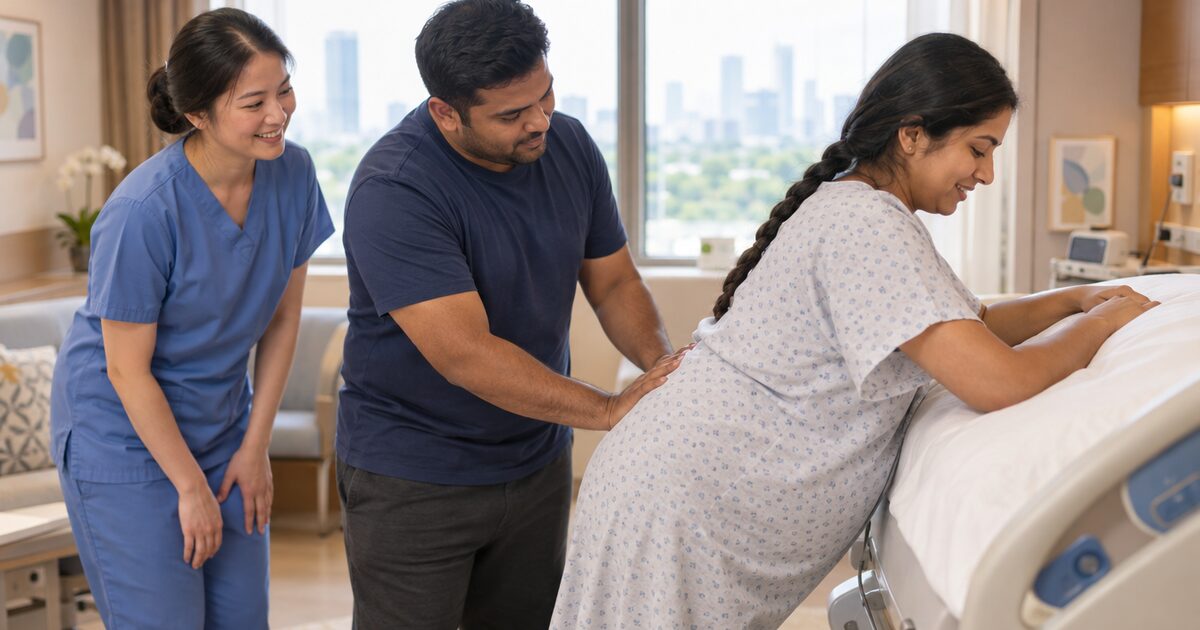
| Leaning forward over the bed, a table or your partner | Back pain; lets your partner rub your lower back | Yes, standing or kneeling at the bed | Sitting and leaning forward, with help |
| Sitting upright or on a birth ball | Resting while staying upright | Yes, with the bed raised; ask if a ball is available | Upright in bed, propped with pillows |
| Kneeling or on all fours | Back pain, and possibly less severe tearing | Yes, on the bed | Hard with heavy legs; possible with help |
| Lying on your side | Resting, and possibly less severe tearing | Yes | Yes, the usual choice; may help a vaginal birth |
| Squatting | Pushing, if you are used to squatting | Possible with support | No |
| Semi-sitting, propped up in bed | Pushing with support | Yes | Yes |
| In water | Pain relief in labour | Not at KKH; Thomson says it is the only hospital here offering water birth | No |
The position-by-position advice comes from the UK's NHS, NICE and RCOG, because Singapore hospital pages say little about positions themselves. The Singapore rules about monitoring and epidurals below come from KKH, SGH, NUH and SingHealth.
Positions for early labour at home
Early labour can last many hours, and this is when you have the most freedom to move.
- Keep walking and stay active between and through contractions. KKH's doctors recommend staying active and walking a lot if the pains are bearable.
- Stand and sway, or rock your hips, during contractions.
- Lean forward onto a kitchen counter, the back of a sofa or your partner's shoulders, and let your bump hang.
- Sit on a chair facing backwards, leaning on the backrest, so your partner can rub your lower back. SingHealth says gentle back massage from your partner can ease the discomfort.
- Rest on your side between contractions, with a pillow between your knees.
A warm shower on your lower back helps many women in early labour too. Our contraction timer shows when your contractions are settling into the pattern that means it is time to go.
Positions in a Singapore delivery room
Once you are admitted, the set-up shapes what you can do. KKH says you will have a drip in your arm and your baby will be monitored continuously with cardiotocography (CTG), two belts round your bump that track the heartbeat and contractions, and its CTG is watched centrally by the team. SGH attaches CTG once you are admitted in established labour, and NUH says you and your baby are monitored continuously. The NHS notes that electronic monitoring can limit how much you move.
That still leaves plenty of options on and beside the bed: kneeling up and leaning over the raised head of the bed, on all fours, sitting upright, standing at the bedside, or lying on your side. Ask the midwife to adjust the bed rather than lying back flat. KKH's doctors say midwives help you find a suitable position as your baby moves down and your backache gets worse.
Asking for a particular birthing position
KKH's answer to whether you can choose a position, such as squatting, is that it must be safe for you and your baby and should not put undue strain on the doctor or midwife delivering your baby, so discuss it with your doctor beforehand. The NHS lists sitting, lying on your side, standing, kneeling and squatting as positions to give birth in, and adds that squatting can be hard if you are not used to it. Put your preferences in your birth plan, and ask about birthing balls, stools or squat bars on the ward tour, because availability varies.
Labour positions with an epidural
While the epidural goes in, you sit bent forward or curl up on your side and keep still. SingHealth says that once the catheter is taped down, you are free to move. Your legs may feel heavy or weak, usually not severely, and the weakness wears off with the drug. That limits standing and kneeling, but not changing position in bed.
- Lie on your side, and switch sides every so often. NICE says that in the pushing stage with an epidural, lying on your side may make a vaginal birth without forceps or vacuum more likely.
- Sit propped up rather than flat, with the bed raised and pillows behind you.
- Get help to move. NICE says women with an epidural can move with assistance once their leg strength has been checked.
- Change position if your blood pressure drops. SingHealth says positioning and medicine treat this easily.
SGH lets the second stage start with a passive phase of one to two hours, in which contractions move your baby down before you start pushing, to cut tiredness and possibly instrument deliveries. The NHS says walking with an epidural needs your baby monitored remotely, which many hospitals cannot do, so ask your hospital before you count on it. Our epidural guide covers the types and side effects.
Positions for pushing and protecting your perineum
When you reach the pushing stage, the RCOG says kneeling, all fours or lying on your side may reduce the severity of tearing. Semi-sitting, propped up with your knees pulled back, also works with an epidural and monitoring. If pushing stalls, NICE suggests changing position, emptying your bladder, and support and encouragement before anything else. Our guide on how to push during labour covers breathing and pushing technique, and our episiotomy and perineal tears guide explains tears and stitches.
Where to practise labour positions in Singapore
Antenatal classes teach positions hands-on. Gleneagles lists childbirth and birthing positions in its parentcraft classes, and SGH's antenatal programme includes a physiotherapy session on pelvic floor exercises and effective pushing technique. Practise with your partner in the last weeks so the moves feel familiar on the day. Our guide to antenatal classes in Singapore compares hospital courses.
Frequently asked questions
What is the best position to give birth in?
The one that is comfortable and safe for you. NICE says any comfortable position except lying flat on your back. Without an epidural, upright positions may help. With one, try lying on your side.
Can I choose my birthing position in a Singapore hospital?
You can ask. KKH says the position must be safe for you and your baby and workable for the doctor or midwife, so discuss it with your doctor before labour and write it in your birth plan.
Can I move around with an epidural?
You can change position in bed once the catheter is taped down, and NICE says you can move with help once your leg strength is checked. Walking with an epidural needs remote monitoring, so ask your hospital.
Which labour position helps back pain?
Leaning forward, kneeling or getting on all fours, with your partner pressing or rubbing your lower back. The NHS suggests all fours if you have a lot of backache.
Why should I not lie flat on my back in labour?
NICE says lying flat on your back can lower your blood pressure and may reduce blood flow to the placenta. Lie on your side or sit propped up instead.
- KKH, Giving birth FAQs: birthing position, water birth (read 11 October 2026)
- KKH, Labour and delivery: drip and CTG monitoring (read 11 October 2026)
- HealthXchange (KKH), Pregnancy week 34: preparing for the 3 stages of labour (read 11 October 2026)
- HealthXchange (KKH O&G), Braxton Hicks vs real contractions (read 11 October 2026)
- SGH, Going into labour (read 11 October 2026)
- SGH, Antenatal classes (read 11 October 2026)
- NUH, Obstetrics (read 11 October 2026)
- SingHealth, Pain relief options for women in labour (read 11 October 2026)
- SingHealth, Pregnancy pain relief in labour (read 11 October 2026)
- Thomson Medical, Water birth (read 11 October 2026)
- Gleneagles Hospital, Antenatal classes (read 11 October 2026)
- NICE (UK), Intrapartum care NG235 (read 11 October 2026)
- NHS (UK), The stages of labour and birth (read 11 October 2026)
- NHS (UK), Pain relief in labour (read 11 October 2026)
- RCOG (UK), Reducing your risk of perineal tears (read 11 October 2026)

Antenatal classes in Singapore: what each hospital's class covers, fees and when to book
Antenatal classes in Singapore compared: KKH, NUH, SGH, Mount Alvernia and other hospitals, what each covers, fees read ...
6 min read
Back pain during pregnancy: what helps and when it needs a doctor
Back pain during pregnancy: why it starts in the second trimester, KKH's relief tips, which painkillers are safe, shoes ...
5 min read
Writing a birth plan in Singapore: what to include, how to raise it with your gynae, and what hospitals can and cannot do
How to write a birth plan in Singapore, when to go through it with your gynae, and what KKH, NUH, SGH and private hospit...
13 min read