

Natural pain relief for labour: what helps, what the evidence says, and what Singapore hospitals allow
In this article
- Natural pain relief methods at a glance
- Breathing, sound and staying calm
- Moving, positions and a birth ball
- Warm water: a shower, a bath or a pool
- Touch: massage, counter-pressure, warm packs and acupressure
- TENS machines
- A birth partner or doula
- What to try before an epidural, and when to stop trying
- Frequently asked questions
Natural pain relief for labour means getting through contractions without drugs: slow breathing, moving and changing position, warm water, massage and counter-pressure, warm packs, a TENS machine, acupressure, music and a steady birth partner. Be realistic about what they do. KKH's head of women's anaesthesia says these methods vary in how well they work, most have not been proven by studies, and some help in a short labour. They work best in early labour, and you can stack them and still ask for gas or an epidural later. Here is how each one works, what the evidence says, and what Singapore hospitals let you use.
Natural pain relief methods at a glance
| Method | How you do it | What the evidence says | In a Singapore hospital |
|---|---|---|---|
| Breathing and relaxation | Slow breaths, a long out-breath, low sounds | NICE: may reduce pain in early labour | Taught in antenatal classes; use it anywhere |
| Moving and upright positions | Walk, sway, lean forward, use a birth ball | NICE: help women stay mobile and change position often | Yes, until monitoring or an epidural limits you |
| Warm shower or bath | Water on your lower back or bump | NICE: a shower or bath may reduce pain in early labour | KKH delivery rooms have an attached bathroom |
| Labouring in a birth pool | Sit or kneel in warm water | NICE offers it for pain relief | Thomson says it is the only hospital offering water birth |
| Massage and counter-pressure | Firm pressure on your lower back | Cochrane: may help, very low-quality evidence | Yes, from your partner or doula |
| Warm packs | Heat pack on your lower back or belly | Cochrane: linked to less pain in the first stage, very low-quality evidence | KKH lists heat or cold as a drug-free option |
| TENS | Pads on your back, you control the pulses | HealthHub: takes 30 minutes to work and does not help in the pushing stage | Not on KKH's list; bring your own and ask your doctor first |
| Acupressure | Firm pressure on set points | Cochrane: may relieve pain, but not by much | Your partner does it; learn beforehand |
| Hypnosis or hypnobirthing | Relaxation and visualisation scripts | KKH: studies have not proven it | Courses run in Singapore |
| Music and aromatherapy | Your own playlist; oils with no flame | NICE supports music of your choice | KKH allows quiet music and aromatherapy with no fire or smoke |
Breathing, sound and staying calm
Breathing is the method you always have with you. SingHealth says that when the pain starts, concentrating on your breath and breathing out loud may help you relax, and that many mothers move on to other pain relief as contractions get stronger. NICE, the UK guideline body, says breathing exercises may reduce pain in the early (latent) stage.
A simple pattern to practise from 36 weeks:
- As a contraction starts, breathe in through your nose for a count of four.
- Breathe out slowly through your mouth for a count of six to eight, and let your shoulders drop.
- Keep the out-breath low. Hannah Loke, a first-time mother interviewed in an SGH news story, found low sounds helped her relax, while high-pitched sounds tensed her muscles.
- Between contractions, rest, sip water and let your jaw go loose.
Fear makes pain harder to bear, so preparation counts. Our guide to fear of giving birth covers antenatal classes and where to get support, and our hypnobirthing guide explains what those courses teach and cost.
Moving, positions and a birth ball
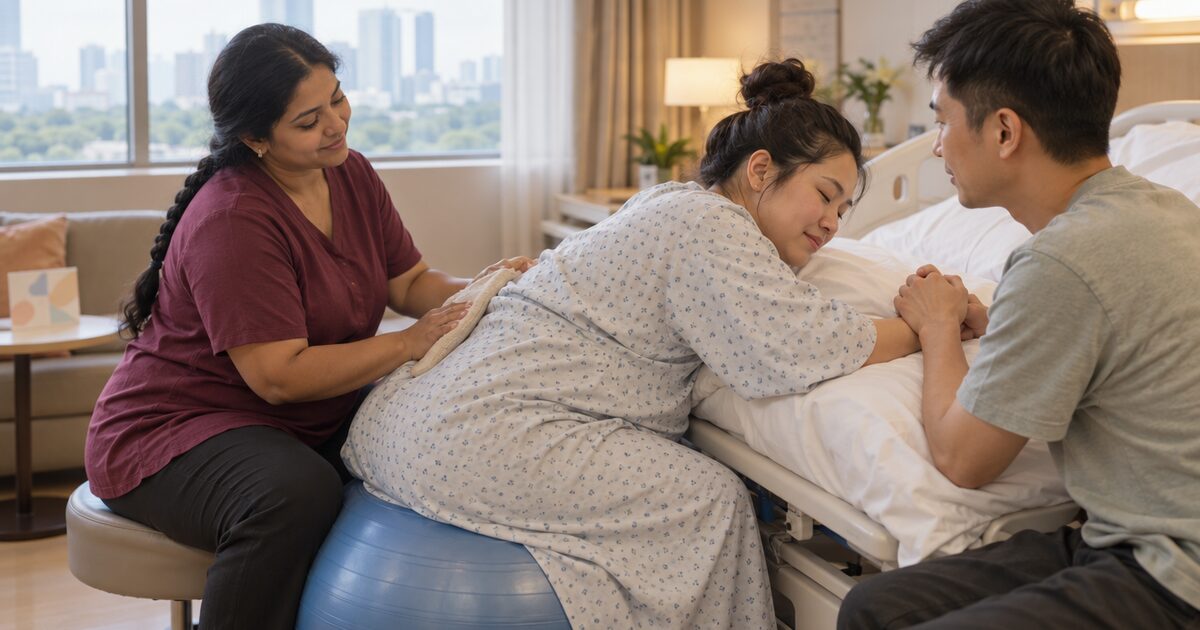
NICE's fetal monitoring guideline tells midwives to encourage women to be as mobile as possible, to find comfortable positions and to change position as often as they wish. In practice that means walking the corridor at home, swaying with your arms around your partner's neck, or kneeling over a beanbag or rocking on a birth ball. Leaning forward takes the weight of your baby off your back.
You lose some of this once you are on continuous monitoring or have an epidural. Our labour positions guide shows what still works with a drip and the CTG belts, and our guide to what happens in the delivery room covers what you can ask about monitoring.
Warm water: a shower, a bath or a pool
NICE says a shower or bath may reduce pain in early labour, and it tells UK hospitals to offer women the chance to labour in water. It also says not to get into a pool within two hours of an opioid injection, or if you feel drowsy, and to keep the water no warmer than 37.5C.
In Singapore, a long warm shower at home is the easiest version. KKH's 28 delivery rooms each have an attached bathroom, so ask the midwife whether you can use the shower between checks. A birth pool is rarer, and Thomson Medical Centre says it is the only hospital here offering water birth. Our water birth guide covers who qualifies.
Touch: massage, counter-pressure, warm packs and acupressure
Touch is the one your partner can learn. SingHealth says a partner's gentle back massage may relieve discomfort, and many mothers find it enough in early labour. A Cochrane review of 10 trials with 1,055 women found that massage and warm packs may help with labour pain in the first stage, but the quality of the evidence was very low.
Ways to use touch:
- Counter-pressure: your partner presses the heel of a hand firmly into your lower back, just above your bottom, through each contraction.
- Hip squeeze: with you on all fours or leaning forward, your partner presses both hips inward.
- Warm pack: a wrapped heat pack on your lower back or low on your bump. KKH lists local heat or cold as a drug-free option. Check the temperature on your partner's wrist first.
- Cool cloth: on your face and neck, which many women want once the room feels hot.
Acupressure uses firm finger pressure on set points. A Cochrane review of 28 trials with 3,960 women found acupressure may help relieve pain in labour, although the reduction may not be large. UCI Health, a US university hospital that teaches it in classes, says the main points are on the shoulders, hands, legs and lower back, with pressure held for 30 seconds to two minutes, and suggests starting only once you reach full term. Learn the points from a trained practitioner or class before labour, not from a video in the delivery room. NICE says hospitals should not offer acupressure or acupuncture but should support women who choose them.
TENS machines
A TENS machine sends mild electrical pulses through pads taped to your back, and you control the strength with a handset. HealthHub says it is easy to use but takes 30 minutes to take effect, and that it does not work once contractions become longer and more intense in the pushing stage. NICE says there is very little evidence it works in established labour, but no evidence of harm, and that other pain relief can be used alongside it.
KKH's list of labour pain relief does not include TENS, so plan to bring your own. Ms Loke borrowed one from her doula and called it her "last line of defence". If you want one, check with your doctor first, as HealthHub advises, and start it early in labour.
A birth partner or doula
Continuous support is one of the better-tested drug-free options. A Cochrane review of 26 studies with more than 15,000 women found that women with continuous one-to-one support in labour may be less likely to use pain medicine or have a caesarean, and may have shorter labours. The benefit looked clearest when the support came from a trained person there only to support you, such as a doula. KKH encourages your husband to stay with you in the Delivery Suite. Our doula guide covers fees and which hospitals accept doulas.
What to try before an epidural, and when to stop trying
Most women work through the list in order: breathing and moving at home, warm water, then touch and a TENS machine in early labour. When contractions are strong and close together, the drug-free methods often stop being enough, and that is a normal point to move on.
KKH offers three medical options: Entonox (laughing gas), a pain relief injection, and an epidural or combined spinal-epidural. Entonox is a common next step: SingHealth says the gas takes 20 to 30 seconds to work and does not build up in your body or your baby's. Ask about the injection early, because KKH's anaesthetists say pethidine is not given close to delivery. An epidural takes time to set up, so ask before you reach the end of your tether. Our epidural guide explains each option and its cost.
Tell your doctor or midwife about your plans in advance, and write them into your birth plan. Put down the point at which you want to be offered something stronger, too. Use our contraction timer at home to see when contractions are close enough to go in.
Frequently asked questions
What is the most effective natural pain relief for labour?
There is no single winner. NICE backs breathing, a warm shower or bath and massage in early labour, and offers labouring in water. Cochrane reviews found continuous support from a trained companion may reduce the need for pain medicine. Most women combine several methods.
Can I use a TENS machine in a Singapore hospital?
Probably only your own: KKH's list of labour pain relief does not include TENS, so ask your hospital. HealthHub says TENS is generally considered safe but to check with your doctor, and that it takes 30 minutes to work and does not help in the pushing stage.
Do acupressure points really work in labour?
Possibly a little. A Cochrane review found acupressure may relieve labour pain, but the reduction may not be large, and the evidence was limited. Learn the points from a trained practitioner before labour.
Can I play music or use essential oils in the delivery room?
At KKH, yes: you may play your own music at low volume, and aromatherapy that does not need a flame or give off smoke is allowed. Ask your own hospital if you deliver elsewhere.
Is it a failure to ask for an epidural after trying natural methods?
No. SingHealth says using pain relief in labour is not a sign of failure. Drug-free methods help most in early labour, and many women move on to Entonox or an epidural as contractions build.
- HealthXchange (KKH Women's Anaesthesia), Pregnancy: how to minimise labour pain (read 11 October 2026)
- HealthXchange (KKH), Is a painless childbirth possible? (read 11 October 2026)
- SingHealth, Pregnancy pain relief in labour (read 11 October 2026)
- HealthHub, Labour and delivery: what to expect (read 11 October 2026)
- KKH, Labour and delivery (read 11 October 2026)
- KKH, Giving birth FAQs (read 11 October 2026)
- SGH, I was curious to see if I could bear labour pain without medication (read 11 October 2026)
- Thomson Medical, Water birth (read 11 October 2026)
- SGH, Going into labour (read 11 October 2026)
- HealthXchange (KKH), Pregnancy week 31: how labour affects your baby (read 11 October 2026)
- NICE NG235, Intrapartum care: recommendations (read 11 October 2026)
- NICE NG229, Fetal monitoring in labour: recommendations (read 11 October 2026)
- Cochrane, Acupuncture or acupressure for relieving pain during labour (read 11 October 2026)
- Cochrane, Massage, reflexology and other manual methods for managing pain in labour (read 11 October 2026)
- Cochrane, Continuous support for women during childbirth (read 11 October 2026)
- UCI Health, Acupressure can ease childbirth pain (read 11 October 2026)

Antenatal classes in Singapore: what each hospital's class covers, fees and when to book
Antenatal classes in Singapore compared: KKH, NUH, SGH, Mount Alvernia and other hospitals, what each covers, fees read ...
6 min read
Back pain during pregnancy: what helps and when it needs a doctor
Back pain during pregnancy: why it starts in the second trimester, KKH's relief tips, which painkillers are safe, shoes ...
5 min read
Writing a birth plan in Singapore: what to include, how to raise it with your gynae, and what hospitals can and cannot do
How to write a birth plan in Singapore, when to go through it with your gynae, and what KKH, NUH, SGH and private hospit...
13 min read