

Thomson Nature Park: A Family Guide to Singapore's Forest Ruins
In this article
- What Thomson Nature Park is, in plain terms
- The Hainan village story kids can actually see
- The five trails and how to pick one for your kids
- Wildlife: look, do not feed
- Stroller-friendliness, best age range and accessibility
- Getting there
- What to bring and the best time to visit
- Where to eat nearby
- Frequently asked questions
Tucked between Upper Thomson Road and Old Upper Thomson Road, Thomson Nature Park is one of the few green spaces in Singapore where a family walk doubles as a history lesson. It is a rustic forest park built around the conserved ruins of a former Hainanese village, threaded with quiet trails through secondary rainforest. This guide is best for families with kids who can walk on their own two feet (roughly age four and up), parents who want a low-cost morning out, and anyone curious about the real kampong story hiding in the trees. It is less suited to stroller-bound babies and toddlers, for reasons we explain below.
What Thomson Nature Park is, in plain terms
The park covers about 50 hectares on the eastern edge of the Central Catchment Nature Reserve and opened in October 2019. It was deliberately kept wild rather than landscaped with fountains and play structures, which is the whole point: this is a place to slow down, look closely, and let kids discover things instead of being handed them. Two things make it special for families. First, the heritage, a former village whose foundations, walls, wells and staircases are still visible in the forest. Second, the wildlife, headlined by one of the rarest primates in Singapore. You get both in a single, easy outing.
There is no admission charge and no booking needed, so a visit costs you nothing but petrol or a bus fare. That makes it an easy backup plan or a regular habit rather than a once-a-year treat. Always confirm current details on the official NParks Thomson Nature Park page before you go, since hours and access can change.
The Hainan village story kids can actually see
From the 1930s until the 1980s, this slope was home to a kampong where Hainanese, Teochew, Hokkien, Cantonese, Malay and Eurasian families lived side by side, farming and running small businesses among the rubber and fruit trees. When the last residents moved out in the 1980s, nature crept back over the road network and the houses. Rather than clear it all away, NParks chose to conserve the ruins and add interpretive panels, so today you walk through a village that the forest is slowly reclaiming.
For older children this is a far stronger way to make Singapore history stick than any textbook. Stand beside a moss-covered house platform, peer down an old well, trace the line of a buried staircase, and the abstract idea of a kampong suddenly has walls and floors. Several sites are marked with the original addresses and family details, so you can turn the walk into a treasure hunt: find the numbered heritage markers, read who lived there, and imagine the daily routine. One former resident's family later founded a bakery brand many Singapore parents will recognise, a nice detail to share once the kids are old enough to care. To stretch the outing into a proper mini-lesson on local history and the natural world, pair it with our learn hub.
The five trails and how to pick one for your kids
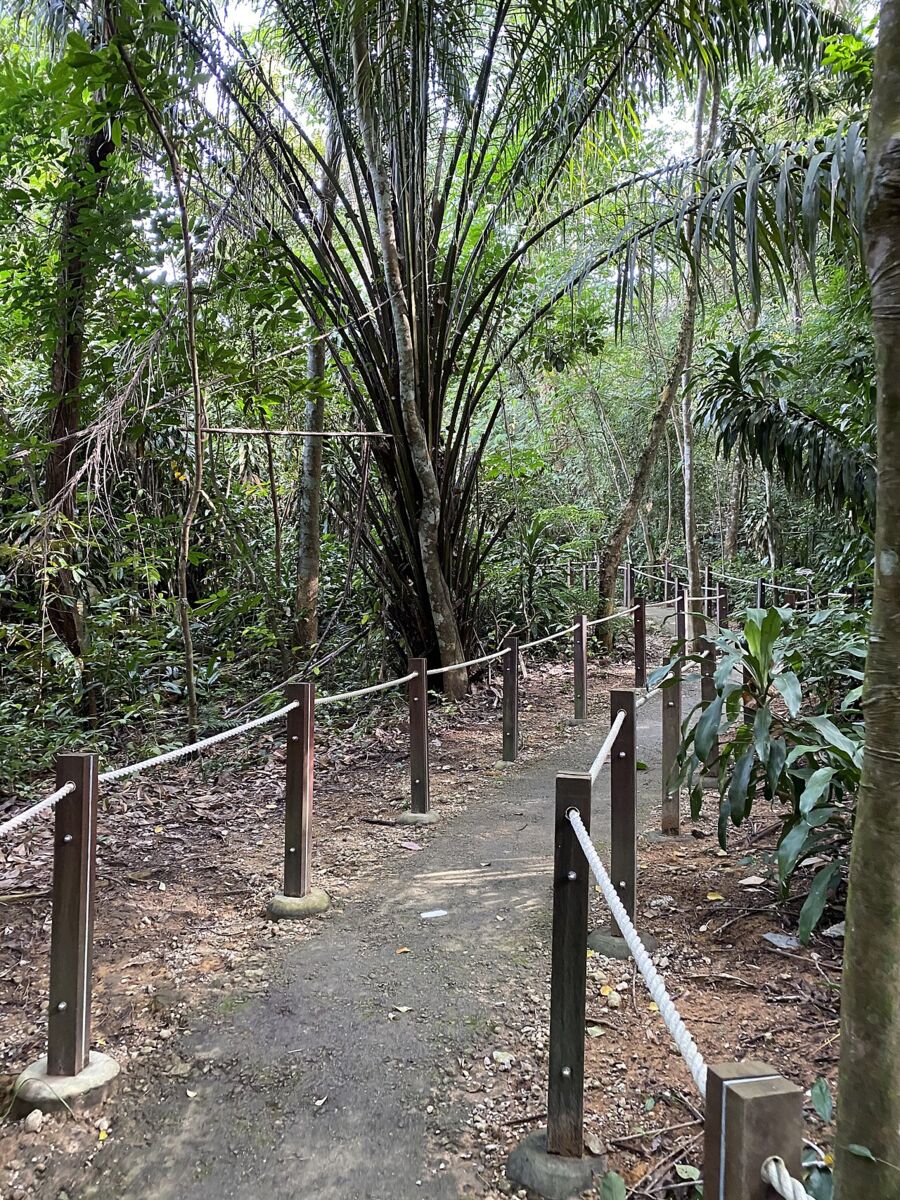
There are five short trails that together cover roughly 3.8km, looping around the old village road network and through the forest. They are mostly gentle, with some slopes and uneven natural ground, and most families finish a sensible chunk of them in one to two hours depending on how often you stop. You do not have to walk them all. The smart move with children is to choose one main loop and treat the rest as optional.
- Ruins and Figs Trail (about 1.5km): the longest loop and the one to do with kids if you only do one. It passes the most heritage sites and village ruins, so it carries the strongest story.
- Stream and Ferns Trail (about 1.4km): shadier and cooler, following a forest stream. A good pick on a warm day or when you want greenery over ruins.
- Rambutan Trail (about 0.4km): a short walk past former plantation and residence sites, easy to tack on or use as a warm-up.
- Macaque Trail (about 0.35km): a short trail named after the long-tailed macaque, which also doubles as an alternative entry point from the Old Upper Thomson side.
- Langur Trail (about 0.15km): the shortest loop, named for the park's rare primate, and another back entrance for those coming on foot or by bike to the park connector.
A short boardwalk near the main entrance leads to a small lookout deck and a ruin, a gentle, firm-surfaced introduction before the dirt trails begin. Beyond hunting heritage markers, kids tend to enjoy spotting birds and butterflies, listening for rustling in the canopy, and looking (never climbing) into the old wells under close supervision. For more outdoor ideas across the island, browse our play section, and if your crew likes forest walks, our Bukit Timah Nature Reserve family guide is a natural next trip.
Wildlife: look, do not feed
Thomson Nature Park was developed partly to protect the critically endangered Raffles' banded langur, a shy native primate that lives in the surrounding Central Catchment forest. Conservation work has helped the small Singapore population recover over the past decade, but it still numbers only a few dozen individuals, so a sighting is genuinely rare and a real treat rather than something to expect. For the latest population figures and conservation updates, see Mandai Nature or the official NParks page. Far more commonly seen are families of long-tailed macaques, plus birds such as the coppersmith barbet and straw-headed bulbul, squirrels, the occasional lesser mouse-deer, and plenty of insects.
If you see anyone feeding the monkeys, or food dumped along the park fringe, you can report it to NParks. Keeping the langurs and macaques wild and wary of people is a big part of what protects them, and it keeps your family safe too.
Stroller-friendliness, best age range and accessibility
This is the question most parents really want answered, and competitors tend to skip it. Honest verdict: only the entrance node and boardwalk are wheelchair and stroller accessible. The five main trails have slopes, steps, tree roots and natural uneven ground, so a stroller is not practical once you leave the entrance area. A baby carrier is far more comfortable for under-threes, and the park genuinely shines for kids who can walk independently, roughly four years and up. Sure-footed primary schoolers will get the most out of the heritage hunt and the longer loops.
Be realistic about facilities. Toilets and the main amenities sit at the entrance node, and there are no shops, cafes or vending machines deep in the trails. There is no dedicated nursing room, so plan feeds and diaper changes around the entrance before you set off, and treat the forest as a no-facilities zone once you are walking. None of this is a dealbreaker, it just rewards a little preparation.
Getting there
The main entrance is along Upper Thomson Road. Public transport takes a bit of planning, since the park is not right beside an MRT station, so factor that in with young kids.
- By bus (most practical with kids): buses such as 138, 167, 169, 860 and 980 run along Upper Thomson Road. Alight near the Tagore Drive stops and walk the short distance to the main entrance.
- By MRT plus a walk or bus: the nearest station is Lentor on the Thomson-East Coast Line, but it is around a 2.3km walk to the main entrance, which is a lot for little legs. Upper Thomson station works too if you pair it with a short bus ride along Upper Thomson Road. Either way, expect to combine train and bus rather than walk straight from the platform.
- By car: there is a small car park at the main entrance with around 34 car lots, plus motorcycle lots and an accessible lot. It fills up fast on weekends, so arrive early. Parking charges apply, so check current rates and gantry hours on the official NParks page before you go.
Note that bicycles, skateboards, motorised personal devices, fishing and pets are not allowed in the park, so leave the scooters and the family dog at home. The park is open daily from 7am to 7pm and closes overnight to give the wildlife some peace, but always confirm the latest opening hours, car park details and any trail closures on the official NParks Thomson Nature Park page before heading out.
What to bring and the best time to visit
Pack as you would for a proper forest walk, not a mall stroll. The trails are shaded but humid, and this is real rainforest, so mosquitoes are part of the deal.
- A full water bottle for everyone, plus a hat and sunscreen for the open entrance area.
- Insect repellent, applied before you start and reapplied if you linger near the stream.
- Covered, grippy walking shoes rather than slippery sandals, especially after rain.
- A light raincoat or a small umbrella in case of a sudden shower.
- Light snacks kept sealed inside your bag, well away from the macaques.
- Wet wipes and a small bag for rubbish, since you should carry everything out with you.
Early morning is the sweet spot. It is cooler, wildlife is more active, and the car park is emptier, all of which make for a calmer outing with kids. The wetter months around November to January can leave trails muddy and slippery, so choose footwear accordingly and skip the visit right after heavy rain. If the forecast turns against you, treat it as a rain-check day and save the trip, our Bedok Reservoir Park family guide and Bishan-Ang Mo Kio Park family guide offer flatter, more stroller-friendly green spaces for younger kids on days when a forest trail is too much.
Where to eat nearby
There is no food inside the park, but you have landed in one of Singapore's best-loved makan stretches. After your walk, drive or grab a ride to the eateries, coffee shops and cafes along Upper Thomson Road and around Thomson Plaza, where you will find everything from prata and local kopitiam fare to brunch spots. It is the perfect way to refuel hungry, muddy kids. For specific ideas, see our eat guides.
Frequently asked questions
Is Thomson Nature Park suitable for young children?
It is best for kids who can walk independently, roughly age four and up. Toddlers can manage the short entrance boardwalk, but the main trails have slopes and uneven ground, so a baby carrier suits little ones far better than a stroller.
Is the park stroller-friendly?
Only the entrance node and boardwalk are stroller or wheelchair accessible. The five trails are natural surfaces with slopes and steps, so a stroller will not get far. Bring a baby carrier instead if you are travelling with a baby.
How long does it take to walk the trails?
Most families spend about one to two hours. The full network is around 3.8km, but you can pick a single loop like the roughly 1.5km Ruins and Figs Trail and turn back whenever the kids have had enough.
Will we definitely see monkeys?
Long-tailed macaques are commonly seen, especially early in the morning. The rare Raffles' banded langur is shy and only occasionally spotted, so treat any sighting as a bonus. Either way, watch from a distance and never feed them.
Is there an entrance fee?
No, entry is free and no booking is needed. You only pay for parking if you drive. Confirm current parking charges and opening hours on the official NParks page before you go.
Are there toilets and food inside?
Toilets are at the entrance node, but there are no shops or cafes along the trails. Sort out toilet trips, snacks and water before you head onto the trails, and plan to eat at the nearby Upper Thomson eateries afterwards.
Admiralty Park Family Guide: Singapore's Playground With the Most Slides
Family guide to Admiralty Park, the Singapore playground with the most slides. Play zones by age, inclusive swings, mang...
11 min read
Archery in Singapore: A Family Guide to Beginner Sessions for Kids
Archery in Singapore for families: how beginner sessions work, suitable ages for kids, indoor vs outdoor ranges, safety ...
9 min read
ArtScience Museum Family Guide: Future World, Tickets and Tips for Singapore Parents
A Singapore parent's guide to the ArtScience Museum: Future World with kids, tickets, the Family Friday free-child deal,...
9 min read