

Montessori preschool in Singapore: fees from ECDA data, what to look for and how it compares
In this article
A Montessori preschool in Singapore usually means mixed-age classes, long stretches of child-chosen work with hands-on materials, and a teacher who guides more than lectures. In ECDA's data, 75 of the 1,837 preschools in our preschool directory have Montessori in their name, about 4%, and eight of them are SPARK certified. For K1 and K2, their listed full-day fees run from $650 to $2,320 a month (median $1,800) before subsidies and GST, and half-day fees from $490 to $1,860. ECDA licenses every preschool, but its licence checks a developmentally appropriate programme, not whether a centre follows Montessori, so it's worth checking the markers yourself.
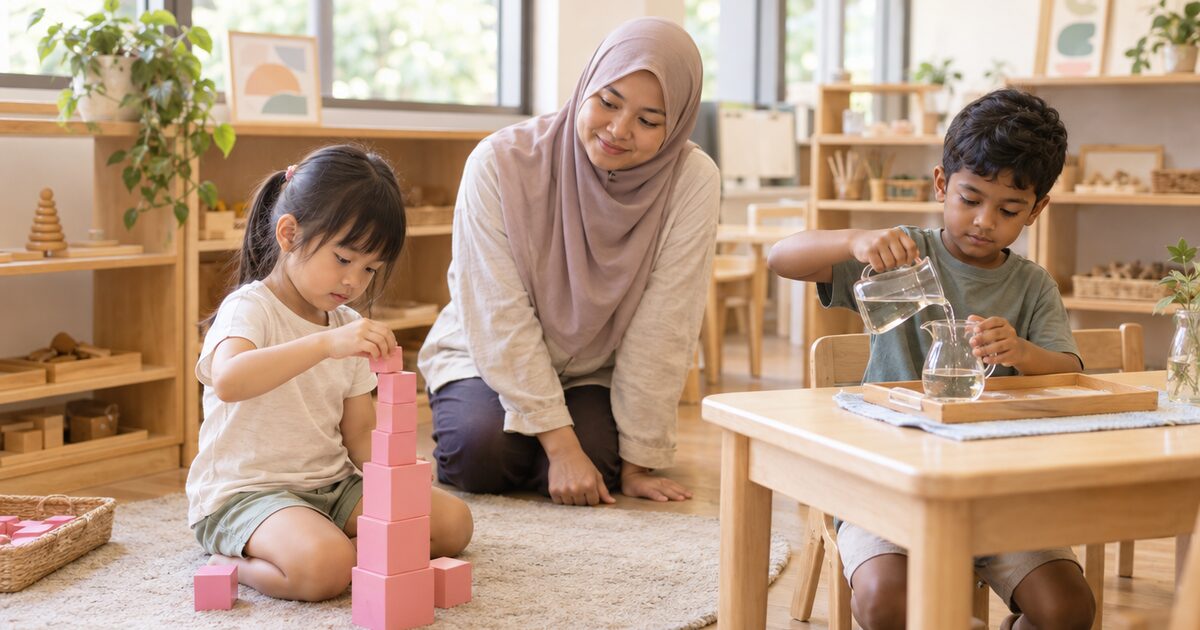
What a Montessori classroom looks like
The Association Montessori Internationale (AMI), the body Maria Montessori founded, sets these standards for its 3 to 6 class, called Primary:
- Mixed ages, from about 2.5 or 3 to 6 years, in one class of 24 to 35 children.
- One teacher per class holding an AMI diploma for that age, with a second overlapping trained teacher in all-day classes.
- Three-hour uninterrupted work periods five mornings a week.
- A complete set of Montessori materials in every classroom.
Few centres anywhere meet every point, and the name alone doesn't tell you which ones do. We didn't find an AMI list of recognised Singapore schools, so ask each centre about its teachers' training and its daily routine.
Montessori preschool fees in Singapore
These are our counts from ECDA's data, as centres list their fees with ECDA, before subsidies and GST. 26 of the 75 Montessori-named centres are GST-registered, so GST is added on top of their fees.
| Level and session | Lowest | Median | Highest |
|---|---|---|---|
| K1 and K2, full day (monthly, citizens) | $650 | $1,800 | $2,320 |
| K1 and K2, half day (monthly, citizens) | $490 | $1,430 | $1,860 |
| All levels including infant care, full day | $650 | $1,800 | $2,700 |
Some examples from the directory: Little Kinder Montessori @ Marymount, a Partner Operator centre in Bishan, lists $650 a month full day for citizens and $1,580 for PRs. Character Montessori Jurong sits at the median, $1,800 full day. Brighton Montessori River Valley lists $2,320 full day for K1 and K2, and House on the Hill Montessori Pre-School lists $1,860 half day.
24 of the 75 centres, mostly kindergarten-licensed, list fees per "session" instead of per month, so you can't compare them directly. Ask what a session covers and how many you pay for in a term. To see what a childcare fee becomes after subsidies, try our childcare subsidy calculator, and for kindergarten fee help, our KiFAS calculator.
Montessori, MOE Kindergarten and Reggio compared
| Montessori (AMI standard) | MOE Kindergarten | Reggio Emilia | |
|---|---|---|---|
| How children learn | Child-chosen work with Montessori materials, in long work periods | Purposeful play and quality interactions, guided by MOE's Nurturing Early Learners framework | Through "the hundred languages", in relation with others |
| Class | Mixed ages 3 to 6, 24 to 35 children | Up to 20 children per class | Groups shaped by projects |
| Language | Depends on the centre; some add Mandarin, Japanese, Arabic or Malay | Bilingual in English and a Mother Tongue | Depends on the centre |
| Day | Three-hour morning work period | 4-hour K1 and K2 sessions, with KCare for full day | Depends on the centre |
| Notable | Full set of materials in every room | Family activities instead of worksheet homework | The environment as educator; documentation of learning |
Bilingual and faith-based Montessori centres exist too. House on the Hill offers Mandarin and Japanese lessons, and HANIS says it has run Arabic and Malay Montessori programmes in Singapore since 1999. Our guides to MOE Kindergarten and free play versus structured play go deeper on the alternatives.
What the research says
The best-known study is a 2017 lottery study in a high-poverty US city. It followed 141 children from age 3 to 6, half of whom won places at two high-fidelity public Montessori schools. Over time the Montessori children did better on academic achievement, social understanding and mastery orientation. The schools followed AMI standards closely, so the results may not carry over to any centre using the name, and the authors call for a larger study. A 2023 systematic review in Campbell Systematic Reviews has also looked at Montessori outcomes.
What ECDA checks, and what it doesn't
Any paid service that regularly cares for or teaches five or more children under 7 needs an ECDA licence: Class A for infant care, B for childcare and C for kindergarten. Licences last 6, 12, 24 or 36 months depending on how well a centre meets the rules, new centres start on 12 months, and ECDA also makes unannounced visits. Its licensing looks at things like a developmentally appropriate programme plan and responsive staff, not whether the programme is Montessori.
SPARK is ECDA's voluntary accreditation above licensing, with two tiers, Certification and Commendation. Eight of the 75 Montessori-named centres are SPARK certified in ECDA's data. You can check a centre's licence tenure in the LifeSG app's Preschool Search, or see licence class and SPARK status on each centre's page in our directory.
Questions to ask on a school visit
- What Montessori training do the teachers have, and from which body?
- Are the classes mixed-age, and what ages are in my child's room?
- How long is the uninterrupted work period each day?
- Does every classroom have a full set of Montessori materials? Can I see them in use?
- What's the licence tenure, and is the centre SPARK certified?
- Which fees are monthly, which are per session, and is GST added?
- How do you prepare children for Primary 1?
Our guide to choosing a preschool covers the wider checklist, and our pre-nursery guide helps if your child is younger than three.
Frequently asked questions
How much does a Montessori preschool cost in Singapore?
For K1 and K2, Montessori-named centres list full-day fees of $650 to $2,320 a month in ECDA's data, with a median of $1,800, and half-day fees of $490 to $1,860, all before subsidies and GST.
How many Montessori preschools are there in Singapore?
75 of the 1,837 centres in ECDA's data have Montessori in their name, about 4%. Other centres may use Montessori methods without the name.
Is Montessori regulated in Singapore?
Every preschool must be licensed by ECDA, but the licence checks things like a developmentally appropriate programme and staff interactions, not the Montessori method. Ask centres about teacher training and materials.
Is Montessori better than MOE Kindergarten?
They suit different children and families. Montessori centres use mixed ages and child-chosen work; MOE Kindergartens use purposeful play in classes of up to 20 with English and a Mother Tongue, at lower fees.
Can I get subsidies at a Montessori preschool?
Childcare subsidies apply to licensed childcare centres, Montessori or not, and KiFAS helps eligible families with kindergarten fees. Partner Operator centres also have fee caps.
- ECDA - Understanding your child's preschool's licence (read 11 October 2026)
- ECDA - SPARK framework (read 11 October 2026)
- ECDA - SPARK accreditation (read 11 October 2026)
- ECDA Listing of Centres, data.gov.sg, via the Fussy Mama preschool directory (downloaded 11 October 2026)
- MOE - MOE Kindergarten curriculum and programmes (read 11 October 2026)
- AMI/USA - AMI standards (read 11 October 2026)
- Reggio Children - The Reggio Emilia approach (read 11 October 2026)
- Lillard et al. (2017), Montessori preschool elevates and equalizes child outcomes, Frontiers in Psychology
How to Choose the Best Preschool in Singapore: A Parent's Guide
How to choose the best preschool in Singapore for your child: centre types, curriculum, fee ranges, ECDA subsidies, wait...
11 min read
Childcare Centres in Singapore: A Parent's Guide to Infant Care, Subsidies and Choosing the Right One
How childcare centres in Singapore work: infant care vs full-day childcare, ECDA operators, subsidies, waitlists, fees a...
10 min read
Children's Libraries in Singapore: A Parent's Guide to NLB
A parent's guide to NLB children's libraries in Singapore: kids' sections, story times, free membership, the NLB app, Li...
11 min read