

Potty training readiness signs: how to tell your toddler is ready, a step-by-step start, and timing with childcare in Singapore
In this article
The main potty training readiness signs are a toddler who can tell you they need to go, stays dry for a couple of hours or wakes dry from a nap, shows they are about to pee or poo, can pull their pants down, and can follow simple two-step instructions. Singapore's hospital milestone guides put most of these around age two: HealthXchange (SingHealth) says a two-year-old can usually say they need the toilet, and SGH lists fully undressing and following two-step instructions at 24 months. By three, HealthXchange expects daytime bowel and bladder control in many children, while night dryness often comes later. Start when you see several signs together, not on a birthday, and agree the plan with your childcare centre so home and school do the same thing.
Potty training readiness signs: a checklist
No single sign means your child is ready. Look for several together over a week or two. The ones linked to Singapore milestone guides are marked; the rest come from the American Academy of Pediatrics (AAP).
Potty training readiness checklist
Body
Communication
Independence
Interest
What age to start potty training
There is no fixed age. The AAP says children in general show signs of bladder and bowel control between 18 and 24 months, and the average US child starts between 2 and 3 years and is trained by 4. Singapore's hospital milestone guides fit the same picture.
| Age | What the guides say | What it means for potty training |
|---|---|---|
| 18 to 24 months | Signs of bladder and bowel control usually appear (AAP) | Talk about the toilet, read potty books, let them sit on the potty dressed |
| Around 2 years | Can say they need the toilet and follow two-step instructions; better at taking clothes off than putting them on (HealthXchange, SGH) | Many children are ready to start |
| Around 3 years | Many have daytime bowel and bladder control; some are dry at night (HealthXchange) | Most children are trained by day |
| After 5 years | Wetting at night only counts as bedwetting after five (SingHealth) | Night dryness can lag; see our night-time guide |
Wait if there is a big change at home. HealthHub warns that training too early, or a new baby in the family, can disrupt a child's bowel habits, and the AAP suggests holding off during a move, a new baby or a family crisis.
How to start potty training, step by step
The method below follows AAP advice, with HealthHub's points on avoiding constipation.
- Get the kit. A potty with your child's feet flat on the floor (the AAP's tip), or a trainer seat on the toilet plus a step stool, and a few pairs of underwear.
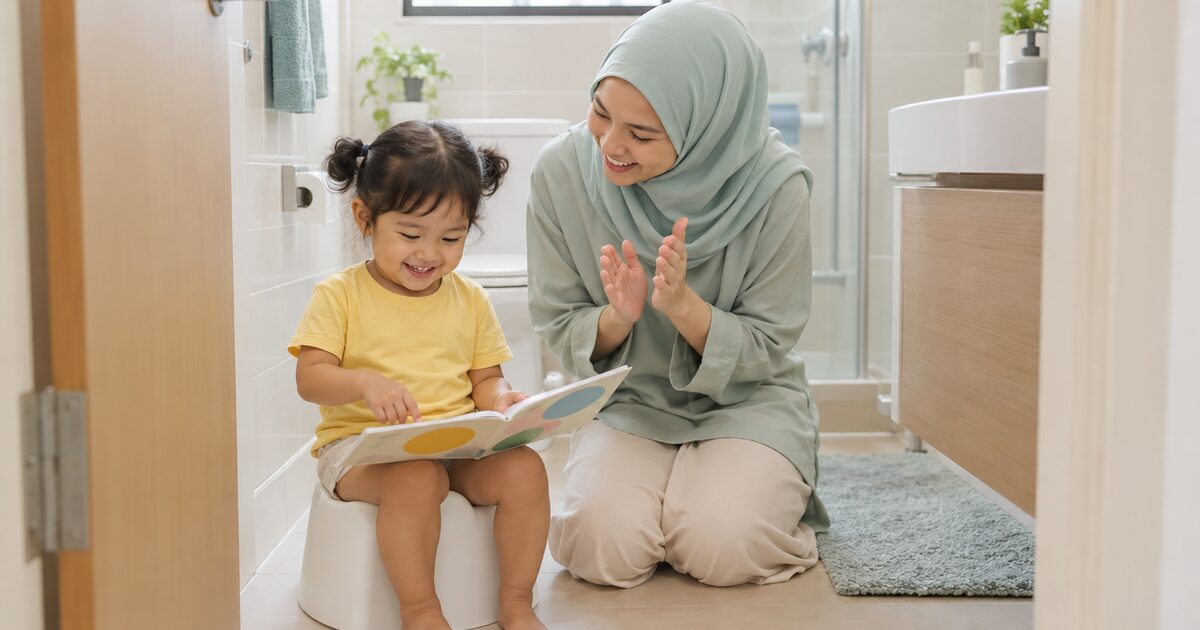
- Practise sitting. Let your child sit on the potty, dressed at first, every morning and after meals, for a few minutes. Read a book together.
- Watch for the signals and the rhythm. Offer the potty when you see the grunt or squat, and after meals.
- Switch to underwear by day once you start, the AAP says, so your child feels wet. Keep diapers or pull-ups for naps and night at first.
- Praise effort and success, calmly. HealthHub says to reward a successful bowel movement and never punish a child who has soiled their underwear. The AAP prefers praise over treats, so keep any reward small.
- Expect accidents, and clean up without fuss or blame.
- Teach hygiene. HealthHub (NUH) advises teaching girls to wipe from front to back, and building regular toilet habits. Wash hands every time.
- Pause if it becomes a battle. A week or two off, then try again, beats a power struggle that leads to stool-holding.
Potty training gear and prices in Singapore
Mothercare SG listed these on its own site when we checked on 11 October 2026:
| Item | Price |
|---|---|
| Mothercare High Back Potty | S$16.90 |
| BabyBjorn Potty Chair | S$69.00 |
| Ity by Ingenuity Flip and Sit Potty Seat (toilet trainer seat) | S$12.90 |
| Mothercare Toddler Step Stool | S$12.90 |
A basic potty and a step stool are enough to start. Trainer seats suit HDB and condo toilets if you have no space for a separate potty.
Potty training and childcare in Singapore
In Singapore, infant care takes children from 2 to 18 months and childcare from 18 months to 6 years, ECDA says, so most children start potty training while they are in a centre.
- Ask how the centre trains. If the class has set toilet times, copy them at home on weekends.
- Use the same words and the same approach. The AAP says to keep your approach consistent with your child's other caregivers, which in Singapore often means the centre, grandparents and a helper.
- Pack spare clothes. Send two or three sets of clothes and underwear every day in the first weeks.
- Know the rules. ECDA's Code of Practice requires childcare and kindergarten centres to have at least two child-sized toilets, and lists denying a child's request to go to the toilet as a deprivation of a basic need that centres must not do.
Our guides to childcare centres in Singapore and diaper rash cover the rest of the toddler years.
Common problems, and when to see a doctor
Holding in poo is the most common problem. HealthHub says children may not want to stop playing, may be uncomfortable pooing outside their own home, or may be afraid after an earlier painful poo. Hard, painful stools make them hold on even more. Offer water and high-fibre food, keep toilet time relaxed, and do not push.
Wetting again after months of being dry can follow stress or a big change, SingHealth notes, but it is worth a check to rule out infection. For nights, see our guide to night-time potty training.
Frequently asked questions
What are the signs a toddler is ready for potty training?
They can tell you they need to go, stay dry for about 2 hours or after naps, show signs before they pee or poo, can pull their pants down, follow simple two-step instructions and dislike a wet diaper. Several together, usually around age two, mean it is worth starting.
What is the best age to potty train?
There is no single best age. The AAP says signs of control usually appear between 18 and 24 months, and Singapore's milestone guides expect daytime control in many children by three.
How long does potty training take?
It varies from child to child. Accidents are normal in the early weeks, and night dryness often comes much later: SingHealth only counts night wetting as bedwetting after age five.
Will my child's childcare centre help with potty training?
Most do. Ask about their toilet times and approach, use the same words at home, and pack spare clothes. ECDA's rules say centres must not deny a child's request to use the toilet.
Should I use rewards for potty training?
HealthHub suggests rewarding successful bowel movements and never punishing accidents; the AAP prefers praise to treats. Calm praise works for most children.
- HealthXchange (SingHealth), Child development milestones: 2 years (read 11 October 2026)
- HealthXchange (SingHealth), Child development milestones: 3 years (read 11 October 2026)
- SGH Neonatal and Developmental Medicine, Developmental milestones 18 to 24 months (read 11 October 2026)
- HealthHub, Constipation in children (read 11 October 2026)
- HealthHub (NUH), Urinary tract infection in children (read 11 October 2026)
- SingHealth, Bedwetting (read 11 October 2026)
- ECDA, Infant and childcare subsidy scheme overview (read 11 October 2026)
- ECDA, Code of Practice for early childhood development centres (read 11 October 2026)
- Mothercare SG, Potties (prices read 11 October 2026)
- AAP HealthyChildren, The right age to toilet train (read 11 October 2026)
- AAP HealthyChildren, Creating a toilet training plan (read 11 October 2026)
Baby Choking First Aid: What Every Singapore Parent Should Know
Baby choking first aid in Singapore: spot true choking, do infant back blows and chest thrusts, know when to call 995, a...
11 min read
Baby colic, reflux and gripe water: what Singapore doctors advise and when to worry
Baby colic and reflux in Singapore: what KKH, NUH and HealthHub say about gripe water and gas drops, how to soothe cryin...
8 min read
Baby Eczema in Singapore: Calm Skin in a Hot, Humid Climate
A calm, practical guide to baby eczema in Singapore: hot, humid-climate triggers, soak-and-seal moisturising, managing t...
11 min read