

What to eat while breastfeeding: calories, kopi, alcohol, fish and spicy food, with Singapore food examples
In this article
- What breastfeeding asks of your diet
- Water and other drinks
- Coffee, kopi and teh
- Alcohol, rice wine and confinement tonics
- Fish: eat it, but go easy on the big ones
- Spicy food, garlic and strong flavours
- Foods traditionally linked to milk supply
- Quick answers: what's fine, what to limit
- Frequently asked questions
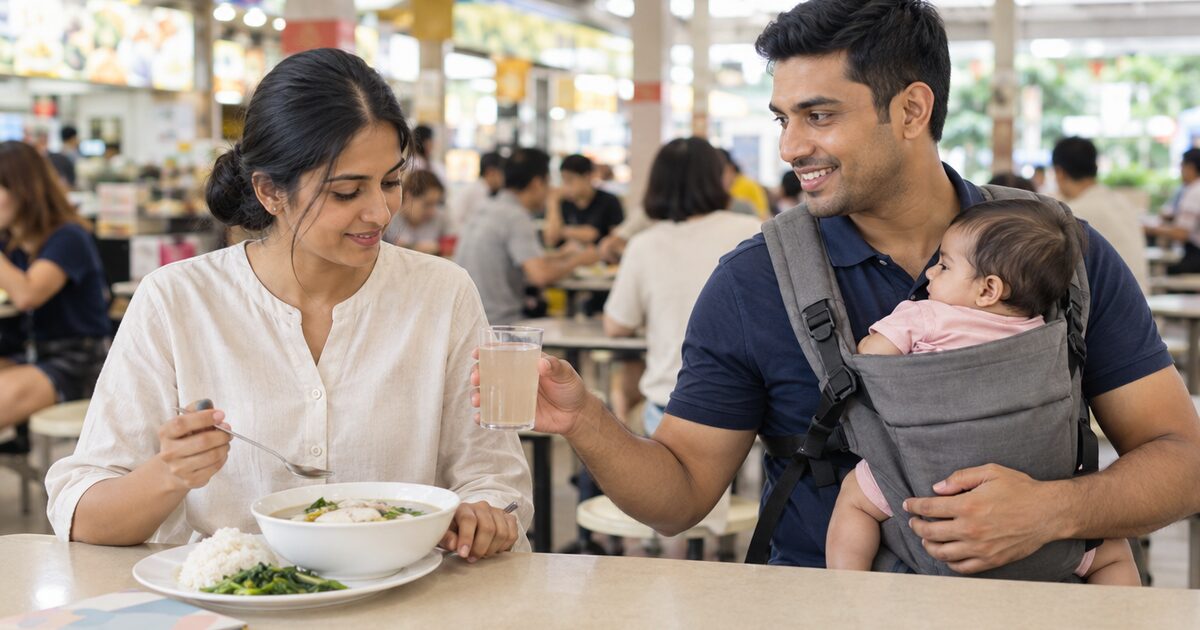
What to eat while breastfeeding is mostly what you ate before, plus a little more. HealthHub says a well-nourished breastfeeding mother needs an extra 330 to 400 kcal a day, about 2,000 to 2,800 kcal in total, and at least 1.5 to 2 litres of water. KKH's dietitians say 2 cups of coffee or tea a day is fine, alcohol should wait until the second week, and after that up to 30 ml a day with a 3-hour gap before you feed. You don't need to cut out chilli, eggs, peanuts or shellfish unless your baby clearly reacts. Here's how that works at a hawker centre, with a confinement menu and at home.
What breastfeeding asks of your diet
Making milk uses energy, so eat to your hunger and don't diet hard. HealthHub suggests one extra serving from each food group of My Healthy Plate, and a diet that includes protein, iron-rich foods, oily fish, dairy and wholegrains. KKH's dietitians suggest three balanced meals and two to three snacks a day. Weight comes off slowly while you breastfeed, and KKH says losing 1 to 2 kg a month is healthy.
A day of eating in Singapore might look like this:
| Meal | An easy local option | Why it helps |
|---|---|---|
| Breakfast | Wholemeal toast with eggs, or oats, and a cup of teh | Protein and wholegrains; one of your two cups of tea or coffee |
| Mid-morning | Fruit and a tub of yoghurt, or a handful of nuts | Calcium and the extra calories without much effort |
| Lunch | Sliced fish soup with rice or bee hoon, or yong tau foo with plenty of vegetables | Fish and vegetables; ask for less salt in the soup |
| Afternoon | Unsweetened soya milk, or red date tea | Fluids and protein |
| Dinner | Steamed fish, a vegetable dish and brown rice; or a confinement meal | Oily fish and fibre |
| Night feed | A glass of water and a slice of bread | Fluids and a little energy when you're up anyway |
Eating out is fine. HealthXchange's hawker guide, written with KKH's dietitians, suggests easy swaps such as asking for more cucumber and removing visible fat from roast meats.
Water and other drinks
Breast milk is mostly water, and HealthHub says to aim for at least 1.5 to 2 litres of water a day. KKH's dietitians suggest 8 to 10 glasses of fluids, and red date tea, ginger water, soup and milk all count. A glass of water at every feed is an easy way to keep up.
Drinking extra cow's milk won't make more breast milk. HealthHub says so directly. Supply depends on how often milk is removed, which our milk supply guide explains.
Coffee, kopi and teh
KKH's dietitians say to keep to 2 cups of coffee or tea a day, because caffeine passes into breast milk and may disturb your baby's sleep. HealthXchange gives the limit as 300 mg of caffeine a day for breastfeeding women.
Two local details matter:
- Local kopi is stronger than chain coffee. HealthXchange says kopi uses Robusta beans, which have twice as much caffeine as the Arabica beans used in most coffee chains.
- Tea has about half the caffeine of coffee, so two cups of teh leave more room than two cups of kopi.
Newborns, and premature babies especially, clear caffeine slowly, the US CDC notes, so keep it lower in the first weeks. Our guide to coffee in pregnancy covers bubble tea and other hidden sources.
Alcohol, rice wine and confinement tonics
KKH's dietitians set out the rules plainly:
- No alcohol in the week after delivery, while your milk supply is being established.
- From the second week, up to 30 ml of alcohol a day, about 2 tablespoons.
- Wait at least 3 hours after a drink before you breastfeed. SingHealth suggests feeding your baby before you drink.
Confinement cooking is the common question. KKH says dishes cooked with wine are fine if they are simmered for at least 30 minutes with the lid off, so the alcohol vaporises. HealthHub is stricter: it says to avoid foods containing alcohol, or to cook them well enough for the alcohol to evaporate. Herbal tonic wines are a different matter, because they are drunk, not cooked off. HealthXchange warns that alcohol and other substances from confinement foods can pass into breast milk and may worsen jaundice in a newborn who already has it.
Our guides to foods to avoid during confinement and confinement herbs go through the common tonics one by one, and postpartum recovery foods has a 7-day meal plan.
Fish: eat it, but go easy on the big ones
Fish is one of the best foods for a breastfeeding mum. HealthHub lists oily fish in a nutritious breastfeeding diet, and HealthXchange names salmon, Spanish mackerel (tenggiri papan), longtail shad (terubok), tuna and sardines as fatty fish that provide omega-3 fat. The Health Promotion Board recommends two or more servings of fish a week, with one serving being 90 g of cooked fish.
The one caution is mercury, which the CDC says can pass from mother to baby through breast milk. Singapore's pages don't list fish to limit while breastfeeding, so here is the UK's NHS advice: no more than 1 portion a week of shark, swordfish or marlin, and no more than 2 portions of oily fish a week. If your Indian confinement menu includes shark, which HealthXchange lists among traditional dishes, keep it to once a week.
Papaya fish soup is a confinement favourite for a reason: SingHealth notes unripe papaya and fish are traditionally linked to milk supply, and our confinement soup recipes include a version you can cook at home.
Spicy food, garlic and strong flavours
There is no Singapore guidance telling breastfeeding mums to avoid chilli. KKH's dietitians give a simple test instead: if you think garlic, onions or another strongly flavoured food is upsetting your baby, leave it out for several days and see if it helps, then add it back if nothing changes.
Two confinement beliefs also get checked here:
- Ginger and sesame oil: KKH's dietitians say there is no evidence that ginger, sesame oil or yellow foods such as lentils and lemons cause jaundice in babies.
- Allergens: KKH says cutting out eggs, milk, fish, peanuts or shellfish while breastfeeding does not lower your baby's allergy risk, so eat them in moderation.
Foods traditionally linked to milk supply
SingHealth lists oatmeal, barley, salmon, asparagus, spinach, garlic, almonds and fennel seeds as foods linked to milk production, alongside papaya and fish. KKH's dietitians describe fenugreek tea: 3 teaspoons of seeds in a glass of hot water, up to four times a day, with a warning that too much can cause loose stools. None of these replace frequent feeding or pumping, and our milk supply guide explains why.
Quick answers: what's fine, what to limit
| Food or drink | What the guidance says | Source |
|---|---|---|
| Kopi, teh, coffee | Up to 2 cups a day; kopi is stronger than chain coffee | KKH dietitians, HealthXchange |
| Alcohol | None in week 1; from week 2 up to 30 ml a day, then wait 3 hours to feed | KKH dietitians |
| Rice wine in cooking | Fine if simmered at least 30 minutes with the lid off | KKH dietitians |
| Salmon, mackerel, sardines | Good sources of omega-3; 2 or more servings of fish a week | HealthXchange, HPB |
| Shark, swordfish, marlin | No more than 1 portion a week | NHS (UK) |
| Chilli, garlic, onions | Fine unless your baby seems upset; then pause for a few days | KKH dietitians |
| Eggs, peanuts, shellfish, milk | No need to avoid; eat in moderation | KKH dietitians |
| Ginger and sesame oil | No evidence they cause jaundice | KKH dietitians |
| Extra cow's milk | Doesn't increase breast milk | HealthHub |
| Over-the-counter medicines | Don't self-medicate; ask a doctor or pharmacist | HealthHub |
Frequently asked questions
How many extra calories do I need while breastfeeding?
HealthHub says an extra 330 to 400 kcal a day, which puts most breastfeeding mothers at about 2,000 to 2,800 kcal a day. An extra serving from each food group covers it.
Can I drink kopi while breastfeeding?
Yes, up to 2 cups of coffee or tea a day, as KKH's dietitians advise. Local kopi is made with Robusta beans, which have about twice the caffeine of chain coffee, so a cup of kopi counts for more than a latte.
How long after drinking alcohol can I breastfeed?
KKH's dietitians say to wait at least 3 hours, and to keep to 30 ml a day from the second week after birth. Avoid alcohol completely in the first week.
Can I eat spicy food while breastfeeding?
Yes. No Singapore guidance asks you to avoid chilli. If you think a strongly flavoured food is upsetting your baby, KKH suggests leaving it out for several days to see if it helps.
Which fish should I avoid while breastfeeding?
Limit shark, swordfish and marlin to one portion a week, as the UK's NHS advises, because of mercury. Most other fish, including salmon, tenggiri and sardines, are good choices.
- HealthHub (HPB), What to eat while breastfeeding (read 11 October 2026)
- HealthXchange (KKH dietitian), Breastfeeding diet: what can you drink? (read 11 October 2026)
- HealthXchange (KKH dietitian), Food tips for breastfeeding mums (read 11 October 2026)
- HealthXchange, Caffeine: what women should know (read 11 October 2026)
- HealthXchange, How to buy and cook fish to boost your health (read 11 October 2026)
- HealthXchange (KKH), Best and worst Singapore hawker Chinese food (read 11 October 2026)
- HealthXchange, Confinement after pregnancy: myths and facts (read 11 October 2026)
- HealthXchange, Confinement food in Chinese, Malay and Indian cultures (read 11 October 2026)
- SingHealth, Breastfeeding: commonly asked questions (read 11 October 2026)
- NHS (UK), Breastfeeding and diet (read 11 October 2026)
- CDC (US), Maternal diet and breastfeeding (read 11 October 2026)
Baby Choking First Aid: What Every Singapore Parent Should Know
Baby choking first aid in Singapore: spot true choking, do infant back blows and chest thrusts, know when to call 995, a...
11 min read
Baby colic, reflux and gripe water: what Singapore doctors advise and when to worry
Baby colic and reflux in Singapore: what KKH, NUH and HealthHub say about gripe water and gas drops, how to soothe cryin...
8 min read
Baby Eczema in Singapore: Calm Skin in a Hot, Humid Climate
A calm, practical guide to baby eczema in Singapore: hot, humid-climate triggers, soak-and-seal moisturising, managing t...
11 min read