

Baby Milestones Month by Month: A Singapore Parent's Guide (0 to 12 Months)

In this article
One of the loveliest and most nerve-wracking parts of the first year is watching your baby change almost weekly. A wobbly head one week, a gummy grin the next, then a little person who sits up and surprises you both. If you have found yourself scrolling at 2am wondering whether your baby is on track, you are in very good company. This guide gives Singapore parents a calm, month-by-month picture of how babies grow from birth to 12 months, gentle ways to support each stage, and the few signs worth raising with your doctor, across the four areas paediatricians watch: movement (motor), language and communication, social and emotional, and thinking and learning (cognitive).

Before anything else, hold on to this one idea: milestones are ranges, not deadlines. A perfectly healthy baby might roll at four months or six months, and walk at ten months or fifteen months. Widely used checklists like the US CDC's Learn the Signs. Act Early. guides describe skills that most babies can do by a given age, which usually means about three in every four. So if your baby has not done something yet, it rarely means anything is wrong, just that they sit in the slightly later, completely normal part of the range. Singapore's own Child Health Booklet says the same in plainer words: there is a normal range for every milestone, and no two children develop in exactly the same way. The bigger pattern over time matters far more than any single skill on an exact week, which is what a doctor sees across several visits.
0 to 3 months: settling in
The newborn weeks are mostly about feeding, sleeping and getting used to a noisy, bright new world. Around six weeks, many babies offer their first real social smile, the one clearly aimed at your face rather than caused by wind. By three months your baby may coo, track your face as it moves, and hold their head a little steadier during tummy time.
- Motor: lifts and briefly holds the head up during tummy time; opens and shuts the hands; moves more smoothly
- Language: makes cooing and gurgling sounds; quietens or turns towards familiar voices and sudden noises
- Social and emotional: begins to smile at people; settles when comforted or held
- Cognitive: watches a face or high-contrast object for a few seconds; follows movement with the eyes
How to support this stage: tummy time is the quiet hero of these months. Keep sessions short, frequent and always supervised while your baby is awake, building the neck and shoulder strength needed for everything later. Talk and sing through nappy changes, hold your baby close to study your face, and answer coos with your own sounds, the very first conversation before words even exist.
4 to 6 months: reaching out
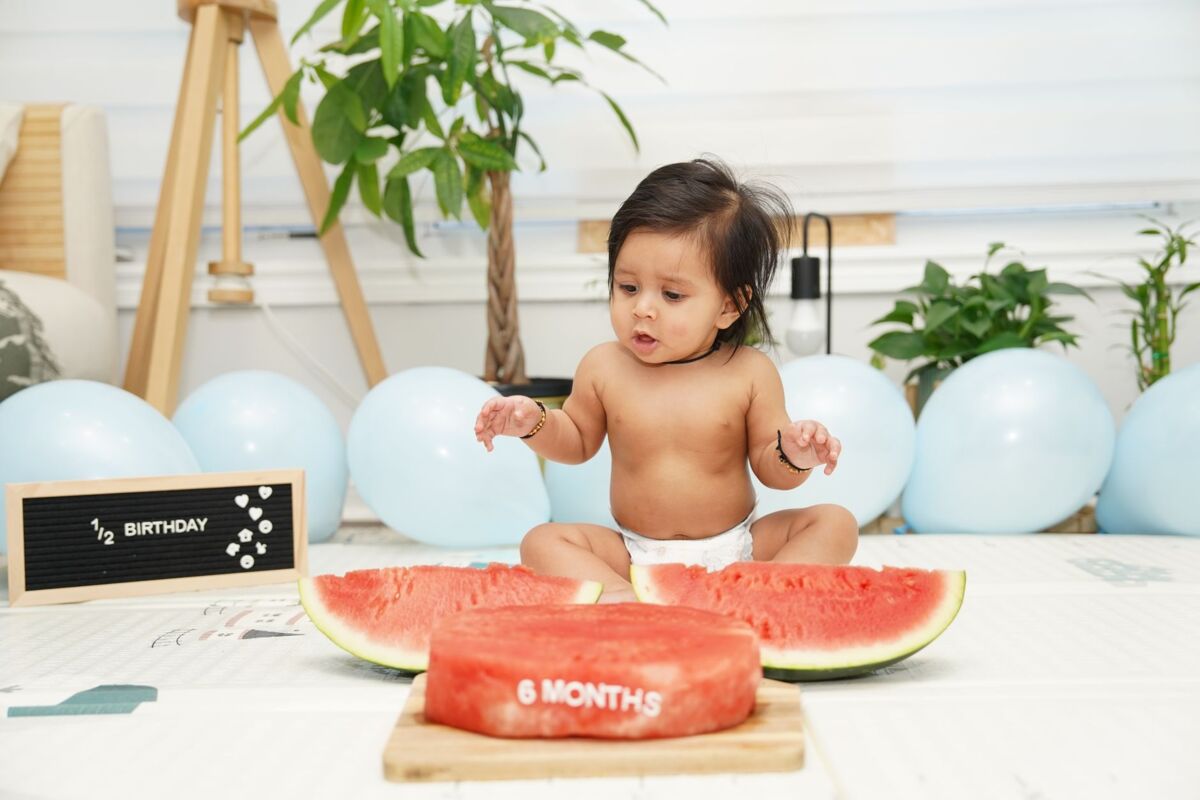
This is often when parenting starts to feel gloriously interactive. Your baby laughs out loud, babbles, blows raspberries, and reaches for toys (and your hair, and your dinner). Many babies roll over in this window, push up on straight arms, and some begin to sit with support by six months.

- Motor: rolls in at least one direction; pushes up on arms during tummy time; brings objects to the mouth; may sit propped with support
- Language: babbles strings like "ba-ba" or "ga-ga"; takes turns making noises with you; squeals and experiments with pitch
- Social and emotional: laughs; enjoys faces and mirrors; lets you know clearly when happy or upset
- Cognitive: reaches for and grabs toys; mouths objects to explore them; eyes things just out of reach
How to support this stage: give your baby safe things to reach for and mouth, name what they are looking at, and read simple board books even before they can follow the story. Around six months many Singapore families also start thinking about solids; if you are weighing up timing and amounts, our guide to starting solids in Singapore is a good place to begin, with your doctor or a lactation consultant to help you tailor it.
7 to 9 months: on the move
Get ready to babyproof in earnest. In this stretch many babies learn to sit without support, start to crawl (or shuffle on their bottom, or commando-scoot on their tummy, all of which count), and begin pulling up against the sofa. Plenty of babies never crawl in the classic hands-and-knees way, and a few skip it entirely on the way to walking, usually nothing to worry about on its own.
- Motor: sits steadily without support; passes objects hand to hand; begins crawling, scooting or shuffling; may pull up to stand
- Language: babbles longer, varied sounds; strings repeated syllables like "mama-mama" without meaning yet; copies sounds and gestures
- Social and emotional: may show stranger wariness and separation anxiety; has clear favourites; lifts arms to be picked up; plays peekaboo
- Cognitive: looks for a toy after it is hidden or dropped; explores by banging, dropping and shaking things
How to support this stage: separation anxiety often peaks around now and can feel like a step backwards, but it is actually a sign of healthy attachment. Play peekaboo, keep answering babble as if it were real talk, and create safe floor space for crawling. With a newly mobile baby, choking risks grow too, so it is worth knowing your baby choking first aid basics before you need them.
10 to 12 months: first words, first steps
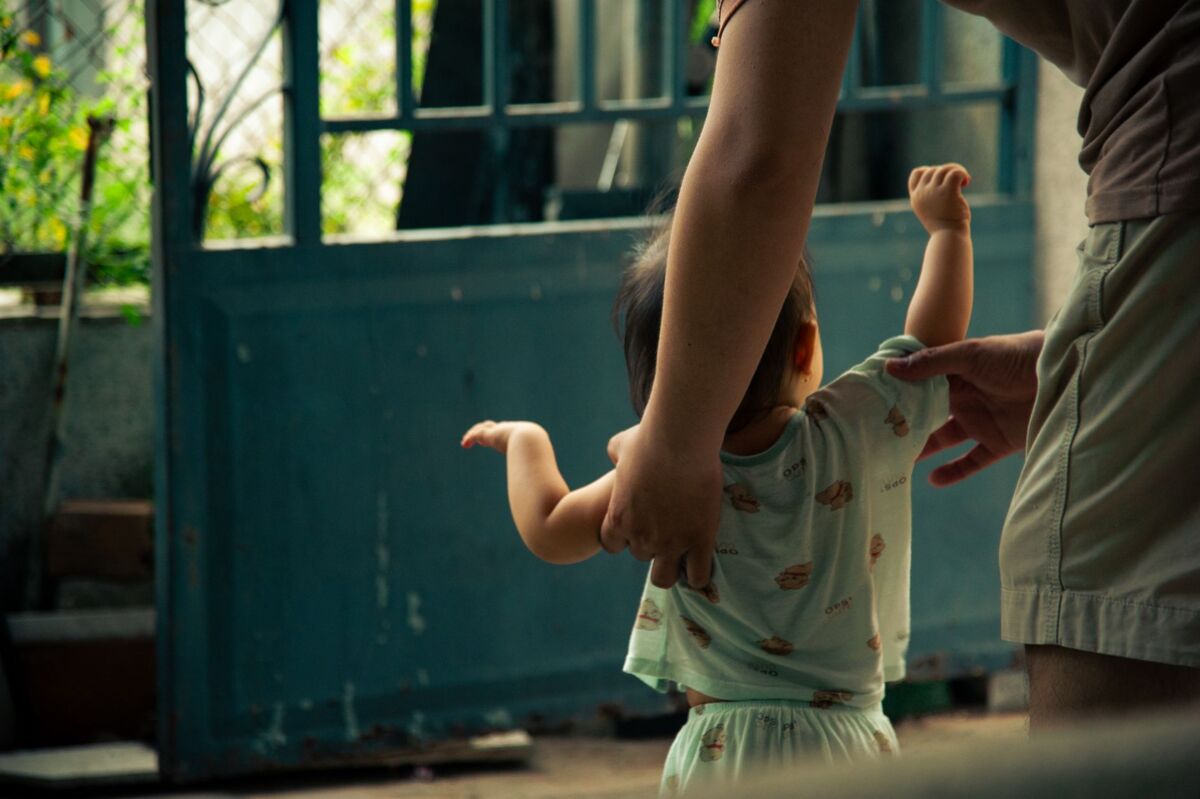
As the first year closes, your baby is becoming a small person with strong opinions. Many start cruising (walking sideways while holding furniture), pull to stand confidently, and develop a neat pincer grasp, picking up tiny crumbs between thumb and forefinger. A few take their first independent steps around the first birthday, though many healthy babies do not walk until well into the second year. You may also hear a first meaningful word like "mama" or "dada" for the right person.

- Motor: pulls to stand and cruises furniture; uses a pincer grasp for small items; may stand alone briefly or take first steps
- Language: says one or two words with meaning; understands "no"; points, reaches and waves; follows a simple instruction like "come here"
- Social and emotional: waves bye-bye; plays interactive games; offers a toy then takes it back; copies your actions
- Cognitive: looks for hidden objects in the right place; puts things into a container and tips them out; bangs two objects together
How to support this stage: talk through your day out loud, name objects as you point, and pause to give your baby a turn to respond. Let your baby practise standing and cruising at a safe height, and resist the urge to compare: the early walker and the late walker usually end up at the same playground together.
Using Singapore's well-baby system instead of Google
Singapore makes it genuinely easy to keep an eye on development without guessing alone. Every baby born here receives a Child Health Booklet, the little book the hospital hands you after birth, part of the system since 1984. Inside are developmental checklists, growth charts and immunisation records, with recommended developmental screening touchpoints built into well-baby visits, including around four weeks, three to four months, six months and twelve months in the first year.
Fill in the relevant checklist before each visit and bring it along, so your doctor has a real record over time rather than a snapshot, with milestones reviewed alongside vaccinations and growth (there is also a Digital Health Booklet if you prefer your phone). If your baby's jabs and checks feel like a blur, our overview of baby vaccinations under the NCIS lays out the schedule these reviews sit within.
When should I raise a concern?
Because the ranges are wide, try not to panic over a single skill running a little late, but do trust your instincts: if something feels off, a conversation with your doctor is always worth it. KKH paediatricians advise speaking to your doctor if your child is not developing according to the general pattern, and the CDC adds the rule of thumb not to wait if a child has lost skills they once had. A few gentle signs worth flagging sooner rather than later:
- No social smile by around three months, or no reaction to loud sounds and voices
- Not following objects or faces with the eyes, or not holding the head up during tummy time, by around three to four months
- Not babbling or making sounds back to you by around six to nine months
- Not sitting without support by around nine to ten months
- No pointing, waving or other gestures by around nine to twelve months, and no words by around twelve to fifteen months
- Not bearing weight on the legs when held, persistent floppiness or stiffness, or a strong preference for using only one side of the body
- Persistent feeding difficulties, or losing a skill your baby clearly had before, at any age
None of these signs is a diagnosis, and seeing one does not mean something is wrong. It simply means a chat with a professional is the right next step, rather than self-diagnosing online. If you do not yet have a regular doctor, your nearest polyclinic is a good first stop.
Where to go if you need more support
If your doctor shares a concern, they can refer your child for a fuller developmental assessment. In Singapore the two main public services are the Department of Child Development at KK Women's and Children's Hospital (KKH) and the Child Development Unit at the National University Hospital (NUH). These teams assess developmental delay, speech and language, movement and behaviour, and guide families towards early intervention where it helps. Referrals through polyclinics and CHAS clinics may come with subsidies, so ask about cost, eligibility and referral steps directly, since these details can change.
Try to remember that early support is exactly that, support, not a verdict on your child or your parenting. Many children referred for assessment turn out to be developing typically, and for those who do need a hand, the earlier the help, the bigger the head start. Related reading: our guides to baby sleep training and a first birthday and zhuazhou.
Frequently Asked Questions
Is it normal for my baby to skip crawling?
Yes, this happens fairly often. Some babies bottom-shuffle, some commando-crawl, and a few go straight from sitting to pulling up and cruising. What matters more is that your baby is moving, getting stronger and finding ways to get around. If your baby is not moving on their own by their first birthday, or is not bearing weight on their legs when held, mention it to your doctor.
My friend's baby is doing more than mine the same age. Should I worry?
Comparison is the thief of joy in the first year. Two babies born on the same day can sit, babble and walk weeks or months apart and both be completely healthy, because milestones are ranges rather than fixed dates. Focus on whether your baby is steadily gaining new skills over time, and if you ever feel uneasy, bring it up at the next well-baby visit.
Should I use my premature baby's actual age or corrected age?
Use corrected age, which counts from your baby's due date rather than the birth date, until around two years old. A baby born two months early is usually expected to reach milestones about two months later than their actual age suggests. Your paediatrician tracks development using corrected age, and our baby age calculator can work out both figures.
How often should my baby's development be checked in Singapore?
Development is reviewed at the well-baby visits set out in your Child Health Booklet, with several touchpoints across the first year alongside immunisations and growth checks. Complete the relevant checklist before each visit and bring it along, so your doctor sees how your baby is progressing over time rather than just on the day.
For more on the early months, browse our newborn care basics, and remember that the best milestone tracker is a parent who knows their baby and a doctor who knows your family. Your baby is on their own timeline, exactly as it should be.
- CDC - Learn the Signs. Act Early. (Developmental Milestones)
- HealthHub Singapore - Child Health Booklet
- HealthHub Singapore - Parent Hub: Growth and Development (0-2 Years)
- KKH - Department of Child Development
- HealthXchange (SingHealth/KKH) - Child Development Milestones: Newborn to Six Years
- Cleveland Clinic - Baby Development Milestones and Safety

Baby Choking First Aid: What Every Singapore Parent Should Know
Baby choking first aid in Singapore: spot true choking, do infant back blows and chest thrusts, know when to call 995, a...
11 min read
Colic vs Reflux in Babies: A Singapore Parent's Guide to Soothing and Knowing When to Worry
Tell baby colic, reflux and wind apart in Singapore: what's normal, soothing tips that help, safe-sleep rules and the re...
10 min read
Baby Eczema in Singapore: Calm Skin in a Hot, Humid Climate
A calm, practical guide to baby eczema in Singapore: hot, humid-climate triggers, soak-and-seal moisturising, managing t...
11 min read