

Baby sleep while travelling: flights, hotel cots and jet lag
In this article
Baby sleep while travelling goes best when only the clock changes. Keep the same safe sleep space and the same bedtime routine as at home. Offer a feed at take-off and landing for the ears. Once you land, switch to local time and get outside in daylight. SingHealth's sleep doctors say the body clock catches up at roughly one day per hour of time difference. So Japan takes about a day, and London a week or more.
How to help your baby sleep while travelling, step by step
- Start shifting sleep times 2 to 3 days before you fly, as the AAP suggests. Go a little later for Europe, a little earlier for Sydney.
- Book flights for when your baby naturally sleeps, if you can. That's the AAP's tip. Ask for a bassinet seat too; airline age rules are in our travel after giving birth guide.
- Feed at take-off and landing. The AAP says the breast, a bottle or a pacifier can ease ear pain from the pressure change. Breastfeeding on the go covers feeding on board.
- Keep plane sleep flat and clear. The AAP says a bassinet should be firm and flat, with no blankets, pillows or soft toys. If your baby sleeps on your lap, stay awake and keep their face uncovered.
- Leave sleepy medicines at home. The CDC says antihistamines shouldn't be given under 1 year old. The AAP warns some children get more alert on diphenhydramine.
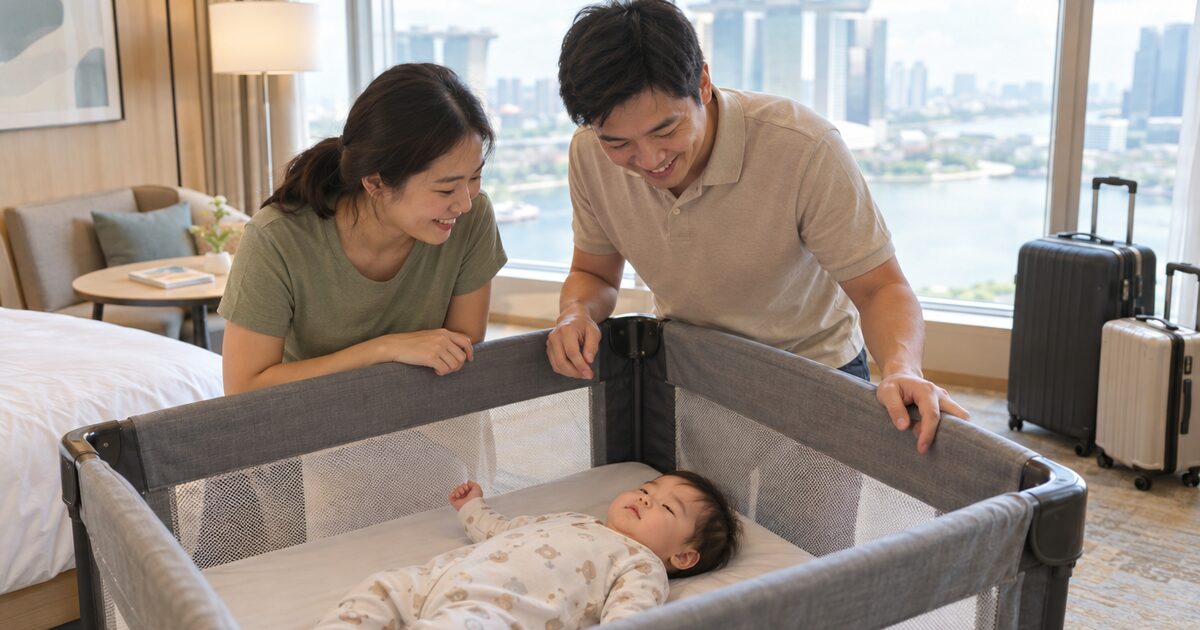
- Check the hotel cot before the first nap. The AAP warns hotel cots may not meet current safety standards. Look for a firm, flat mattress with no gaps at the sides, as the Lullaby Trust advises.
- Switch to local time from day one. SingHealth's sleep doctors suggest eating and staying awake when the locals do. Keep naps short.
- Get outside in daylight. The AAP says outdoor time or bright rooms help children adjust. At night, keep it dark and quiet: HealthHub notes that darkness and light signal the sleep-wake cycle to the brain.
- Give it about a day per hour of time difference. That's SingHealth's rule of thumb, so keep the first days after a long-haul flight gentle.
Baby jet lag by route from Singapore
The table shows how far common holiday spots sit from Singapore time. We worked the gaps out from timeanddate's time zone tables. Days to settle use SingHealth's one-day-per-hour rule. That rule is for people in general, and none of the sources we checked gives a separate rate for babies, so treat the days as a rough guide rather than a deadline.
| Trip type | Common routes and time difference | How to handle sleep |
|---|---|---|
| Short haul, up to 2 hours | Perth: same time. Japan and South Korea: 1 hour ahead. Sydney outside Australian daylight saving: 2 hours ahead. | Go straight to local time when you land. Expect a day or two to settle. |
| Medium, 3 to 5 hours | Sydney during Australian daylight saving: 3 hours ahead. | Bring bedtime a little earlier for 2 to 3 days before you go. Expect about 3 days. |
| Long haul, 6 hours or more | London: 8 hours behind, or 7 in British Summer Time. France, Germany, Italy and Spain: 7 hours behind, or 6 in their summer time. | Push bedtime later for 2 to 3 days before you fly, then go fully local. Expect about a week each way, and a harder trip home. |
Sydney sits in two rows. Australian daylight saving moves it from 2 to 3 hours ahead of us. Europe works the other way round: closer to Singapore in its summer, further away in its winter.
Why the flight home from Europe is often the hard one
SingHealth's sleep doctors say jet lag is worse going east than west, because it's easier for the body clock to stretch a day than to shorten it. From Singapore, Europe is a westward trip. Out there, the usual problem is a baby who wakes far too early.
The flight home runs east. That's when the other problem shows up: trouble falling asleep at bedtime. Say you're back from London in the UK winter. At a usual 8pm bedtime in Singapore, your baby's body clock still says it's about midday. Keep the bedtime routine as it was. Get some morning daylight, and keep the first week home quiet if you can. Sydney flips this round. The late bedtimes come on arrival there, and the early mornings once you're back.
Once you're home, our sleep schedule by age helps you rebuild naps. For the trip itself, the baby travel packing list covers what to bring. Changi Airport with kids lists play areas and nursing rooms by terminal. Passport steps are in how to apply for a baby passport.
Safe sleep in hotel cots, travel cots and on the plane
The basics don't change on holiday. HealthHub's advice is to put your baby on their back for every sleep. Use a firm mattress with a well-fitted sheet, and nothing loose in the cot. The full version is in safe sleep for babies in Singapore. The CDC asks families to plan a safe sleep space for babies on any overseas trip.
- Travel cots: the Lullaby Trust says thin travel cot mattresses are fine if they're firm, flat and in good condition. Don't add folded blankets or a quilt underneath.
- Hotel cots: many hotels provide cots that don't always follow safer sleep guidelines, the Lullaby Trust says. Call ahead. Check for gaps and bumpers when you arrive.
- Where the cot goes: away from windows and the aircon, says the Lullaby Trust. That keeps your baby at a comfortable temperature.
- Car seats: use them only for transport, the Lullaby Trust says. Move a sleeping baby to a flat cot when you get in.
- Cold places: HealthHub's guide is the layers you're wearing, plus one. No loose blankets. There's more in how to dress a newborn in Singapore.
- Hotel beds: share a room, not a bed, is HealthHub's advice. Bring your baby into your bed only for a feed or a cuddle. Then put them back in the cot.
When to get help
See a doctor if your child has a fever, diarrhoea, vomiting, a rash or jaundice after a trip. KKH's Children's Travel Clinic asks children with these symptoms to come back for a check. It treats travel-related infections at Clinic M, Children's Tower Level 1. Your GP or polyclinic can see your child too. Tell them where you went. The CDC notes that malaria can look like a common childhood fever at first.
Is sleep still off well past the one-day-per-hour mark? Raise it with your polyclinic or GP. Pre-trip vaccines are in travel vaccinations for kids.
Frequently asked questions
How long does baby jet lag last?
SingHealth's sleep doctors say roughly one day per hour of time difference. Japan or Korea is 1 hour ahead of Singapore, so expect about a day. London is 7 or 8 hours behind, so a week or more. The flight home is often the harder one.
How do I help my toddler with jet lag?
Use the same steps as for a baby. SingHealth suggests local meal times and short naps. Daylight in the day helps too, the AAP says. Keep the bedtime routine the same as at home. Our toddler sleep guide covers routines and night waking.
How can I get my baby to sleep on a plane?
Pick a flight at a time your baby naturally sleeps. That's the AAP's tip. Ask for a bassinet seat, and feed at take-off and landing for the ears. Use the settling steps from how to get your baby to sleep. Keep the bassinet firm, flat and clear.
Is a hotel cot or travel cot safe for my baby?
It can be, once you've checked it. The AAP warns hotel cots may not meet current safety standards. The Lullaby Trust says to look for a firm, flat mattress with no gaps and no bumpers. A thin travel cot mattress is fine if it's firm and in good condition.
Can I give my baby something to help them sleep on the flight?
Not without your doctor. The CDC says antihistamines shouldn't be given under 1 year old. The AAP warns diphenhydramine can have serious side effects, especially with several doses on a long flight. Some children get more alert on it.
- SingHealth Duke-NUS Sleep Centre, Circadian rhythm sleep disorders (read 6 Nov 2026)
- KK Women's and Children's Hospital (SingHealth), Travelling and the Children's Travel Clinic (read 6 Nov 2026)
- HealthHub, Parent Hub: baby sleep and 7 safe sleeping tips (read 6 Nov 2026)
- American Academy of Pediatrics (HealthyChildren.org), Flying with baby (read 6 Nov 2026)
- American Academy of Pediatrics (HealthyChildren.org), Travel safety tips (read 6 Nov 2026)
- CDC Yellow Book, Traveling safely with infants and children (read 6 Nov 2026)
- The Lullaby Trust, Safer sleep on holiday (read 6 Nov 2026)
- timeanddate.com, Time zone abbreviations: SGT, JST, KST, AWST, AEST, AEDT, GMT, BST, CET, CEST (read 6 Nov 2026)

Babymoon from Singapore: the best weeks to go, airline cut-offs, nearby destinations and how to travel safely
Babymoon destinations from Singapore: the best weeks to travel, airline pregnancy cut-offs, short trips like Langkawi or...
8 min read
Bali With Kids: A Family Holiday Guide From Singapore
Planning Bali with kids from Singapore? The short flight, entry rules, best family areas, things to do, and real parent ...
11 min read
Batam With Kids: A Family Getaway Just a Ferry Ride From Singapore
Planning Batam with kids? Our family guide covers the short ferry from Singapore, resorts with pools, things to do, mone...
11 min read