

Toddler sleep from 1 to 6: how much they need, when naps stop, and how to settle them step by step
In this article
Your toddler needs 11 to 14 hours of sleep a day at ages 1 and 2, naps included, by Singapore's national sleep guidelines. That drops to 10 to 13 hours from 3 to 5, and 9 to 11 hours at 6. To get there, keep the same wake time every day, run a short bedtime routine, switch screens off an hour before bed and walk your child calmly back to bed when they get up.
How to help your toddler sleep, step by step
- Pick one wake time and keep it every day, weekends included. The Singapore guidelines ask for a consistent wake-up time and the same bedtime on weekdays and weekends.
- Count back from that wake time to set bedtime. Aim for 11 to 14 hours a day at 1 to 2 years, 10 to 13 at 3 to 5 and 9 to 11 at 6, naps included. The kids bedtime calculator does the sum from the same guidelines.
- End naps by about 3.30pm to 4pm. HealthXchange (SingHealth) says later naps can affect night sleep.
- Switch off screens an hour before bed. That's MOH's advice for ages 18 months to 6, and the Singapore guidelines don't recommend screens at all under 18 months.
- Give a 10-minute warning before the routine starts, as KKH suggests.
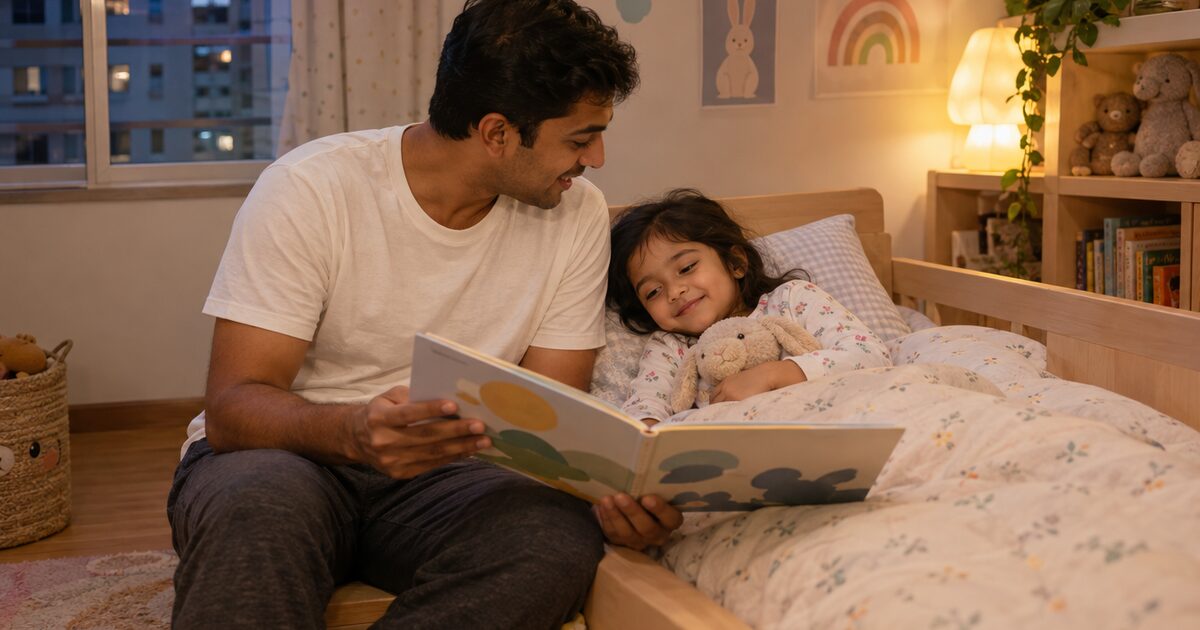
- Run 3 to 5 calm steps in the same order every night, such as a bath, milk, toilet and teeth, then one story in bed. HealthXchange says to keep it to 20 to 30 minutes.
- Keep the room dark, quiet and at a comfortable temperature, as the guidelines put it. A small night light or white noise is fine, HealthXchange says.
- Let your child take one favourite toy or blanket to bed. Then say goodnight, turn the lights down and leave the room, as KKH describes.
- Walk them calmly back to bed each time they get up, with as little fuss as you can. KKH suggests praising them the next morning for staying in bed.
- If they call out in the night, wait a few seconds before you answer, and a little longer each time. When you check, KKH says to leave the light off and not to pick them up or play.
How much sleep toddlers need, by age
The hours below come from the Singapore Integrated 24-Hour Activity Guidelines for Early Childhood, first published in January 2022 by the College of Paediatrics and Child Health and shared by KKH. Each total covers the whole day, so naps count.
| Age | Sleep a day | Naps | Example: asleep by, for a 7am wake |
|---|---|---|---|
| 1 to 2 years | 11 to 14 hours | 1 or 2; usually 1 nap of 1 to 3 hours from about 18 months | 8pm with a 1.5-hour nap, or 8.30pm with a 2-hour nap |
| 3 to 5 years | 10 to 13 hours | 0 or 1; many stop by age 5 | 8pm with no nap, or 8.30pm with a 1-hour nap |
| 6 years | 9 to 11 hours | May not need one if night sleep is enough | 8pm to 9pm, no nap |
The last column is our worked example, not a rule. We picked a total inside each range, took off the nap and counted back from 7am. It lines up with KKH's advice that most children aged 2 to 5 should have a bedtime around 8pm to 9pm. For a different wake time, use the kids bedtime calculator. Babies under 1 have their own baby sleep schedule by age.
When toddlers stop napping
KKH says most toddlers go down to one nap a day at about 18 months, and that nap usually lasts one to three hours. HealthXchange's table gives 0 or 1 nap from 3 to 5. Many children give up the daytime nap by 5, KKH says, and the Singapore guidelines say an older preschooler may not need one if they sleep enough at night.
Before you drop the nap, try shortening it or moving it earlier. KKH says naps too close to bedtime can delay sleep at night. A child who no longer sleeps in the day can still have quiet time with books after lunch.
At childcare, ask the teacher when nap time runs and how long your child sleeps, then keep weekend naps near that time. Our daily routine for preschoolers has sample days for childcare, kindergarten and weekends.
Why your toddler won't sleep, or keeps waking
Night waking and bedtime battles are very common in young children, HealthXchange says. The causes it lists include sleep associations, where a child needs the same help to fall asleep each time, a schedule that doesn't fit, hunger, and medical or sleep problems. For bedtime battles it adds naps that are too long or too short, irregular bedtimes, screens before bed, a lively routine, separation anxiety, night-time fears, big changes and unclear limits.
KKH says a child who's held, rocked or fed to sleep will expect the same each time they wake in the night. Pick one way of settling and stick with it. HealthXchange says there's no best method, and consistency is what makes any of them work. Our sleep training guide compares the methods.
Nightmares can wake a child even with good habits, because active dreaming starts in the toddler years, KKH says. Comfort them, then help them back to sleep in their own bed. For screaming episodes, see night terrors vs nightmares.
On screens, the 2022 guidelines ask for none in the 30 minutes before bed under age 3, and none in the hour before sleep from 3. MOH's screen advice asks for an hour from 18 months, so keeping to the hour covers both. Our screen time guide covers the daily limits.
Climbing out of the cot? See moving from cot to bed. Sharing your bed and want them in their own? See co-sleeping. Wet nights belong in night-time potty training, and bedtime meltdowns in managing toddler tantrums.
Why sleep matters for young children
KKH says children need plenty of sleep to rest and repair the body, that sleep helps learning, and that growth hormone levels peak during sleep. The Singapore guidelines link a regular bedtime and routine to longer, better sleep for toddlers, and say enough sleep may help prevent obesity.
Short sleep shows up in the day. KKH links too little sleep to weaker learning, memory, attention, concentration and mood, and to weight gain and poorer immunity. HealthHub's signs in preschoolers include crankiness or fussiness, especially in the late afternoon, extra clinginess, and waking up groggy.
KKH also cites a Singapore study that found preschoolers here sleep significantly less than recommended and have poor sleep habits.
Sleep in a Singapore home
- If siblings share a room, put the younger one down first and keep the older child's wind-down outside the room until lights out.
- If you hear the corridor or the neighbours through the wall, white noise is fine, HealthXchange says.
- The guidelines ask for a room of comfortable temperature without giving a number. Dress your child lightly and set the fan or aircon so the room feels comfortable to you.
- If a grandparent or helper does bedtime, write the routine down in order. HealthXchange's advice is the same activities in the same order every night.
- If bedtime has drifted late, move it earlier bit by bit. The NHS suggests bringing the routine forward by 5 to 10 minutes each week until you reach the bedtime you want.
- A baby under 1 in the same room still needs a bare cot: no pillows, loose blankets, soft toys or bumpers, HealthXchange says. The nursery set-up checklist covers the rest.
When to get help
Start with your GP or polyclinic. KKH and HealthXchange say to see a doctor if your child:
- Snores often, especially with gasping or choking (HealthXchange)
- Snores loudly and regularly. KKH says this is often abnormal in an otherwise healthy child, and the doctor may refer you to a sleep disorders centre
- Still has trouble falling asleep, or wakes often, after you've tried the steps above (HealthXchange)
- Has trouble falling or staying asleep along with daytime sleepiness or behaviour problems (KKH)
- Has night-time fears that come with anxiety in the day (HealthXchange)
- Sleeps so badly that it's causing problems for you too (HealthXchange)
KKH says about 1 to 3% of children snore and also have breathing problems in their sleep, such as obstructive sleep apnoea, where breathing is interrupted. Our toddler snoring guide covers the signs, and our sleep consultant guide lists the KKH and NUH children's sleep clinics. Ask the doctor before you give any sleep aid; melatonin for kids explains why.
Frequently asked questions
How much sleep does a toddler need?
By the Singapore guidelines, 11 to 14 hours a day at 1 to 2 years, 10 to 13 hours at 3 to 5 and 9 to 11 hours at 6. Naps count towards the total. The kids bedtime calculator turns those hours into a bedtime for your child's wake time.
Why won't my toddler sleep at night?
HealthXchange lists naps that are too long or too short, irregular bedtimes, screens before bed, a routine that's too lively, separation anxiety and night-time fears. Check the nap first. Then fix the wake time and bedtime, and keep them the same every day.
Why does my toddler keep waking up at night?
If they've learned to fall asleep with help, like a feed or rocking, KKH says they'll want the same each time they wake. Nightmares, hunger or feeling unwell can wake them too. KKH suggests waiting a few seconds before you answer, keeping the light off, and praising them in the morning for staying in bed.
When do toddlers stop napping?
Most go down to one nap at about 18 months, KKH says, and many stop napping by age 5. The Singapore guidelines say an older preschooler may not need a nap if they sleep enough at night. If the nap pushes bedtime late, shorten it or move it earlier first.
What's a good bedtime for kids by age?
KKH says most children aged 2 to 5 should have a bedtime around 8pm to 9pm. With a 7am wake, that fits the guideline hours at every age from 1 to 6. For other wake times, use the kids bedtime calculator.
Why is sleep important for children?
KKH says sleep lets the body rest and repair, helps learning, and is when growth hormone is highest. Too little sleep is linked to poorer memory, attention and mood, and to weight gain and poorer immunity. HealthHub's signs of a short-slept preschooler include crankiness, clinginess and waking up groggy.
- KKH, Summary of the Singapore Integrated 24-Hour Activity Guidelines for Early Childhood (read 6 Nov 2026)
- KKH, Good sleep habits for children (read 6 Nov 2026)
- KKH, Sleep: growing up (read 6 Nov 2026)
- KKH, Snoring in children (read 6 Nov 2026)
- HealthXchange (SingHealth), How to cultivate good sleep habits in children (read 6 Nov 2026)
- HealthHub (Health Promotion Board), Parent Hub 3-6 years: Good sleep with Captain Sleep (read 6 Nov 2026)
- MOH, Guidance on screen use in children: no screens one hour before bedtime from 18 months to 6 years (read 6 Nov 2026)
- NHS, Sleep and young children (read 6 Nov 2026)

Melatonin for kids in Singapore: what to try first, and when to ask a doctor
Melatonin for kids in Singapore: what KKH and HSA say, why doctors start with sleep habits, how to store gummies, and wh...
7 min read
Night terrors vs nightmares: how to tell them apart and what to do
Night terrors vs nightmares: how to tell them apart, what to do during an episode, sleepwalking safety in a Singapore fl...
7 min read
Toddler snoring: what's normal, what to do and when to see a doctor
Toddler snoring with a cold is common. Loud snoring most nights, gasps or pauses need a doctor. Steps to take, sleep apn...
8 min read