

Breech baby in Singapore: ECV, a planned C-section or a vaginal breech birth
In this article
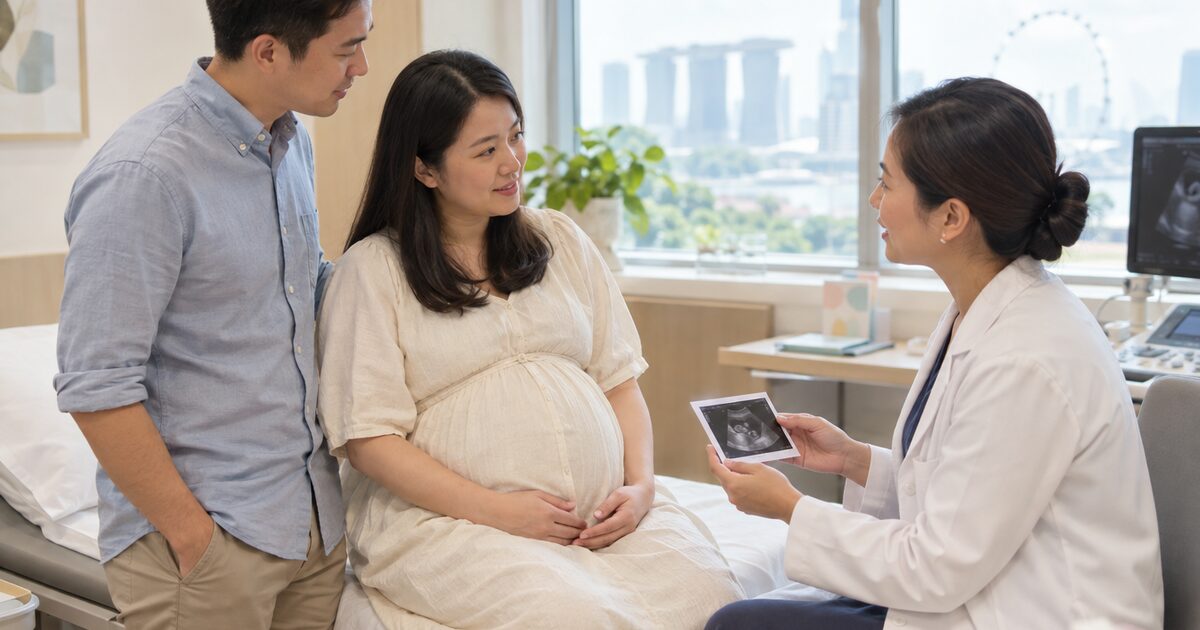
A breech baby lies bottom first or feet first instead of head down. In Singapore, NUH says only 3 to 5% of babies are still breech at term. Its practice is to try turning your baby first, with a procedure called external cephalic version (ECV), at around 36 to 37 weeks. If that doesn't work, or you'd rather not try, NUH recommends a caesarean.
What to do about a breech baby, step by step
- Check your baby's position at your 36-week visit. RCOG says that if your baby is breech at 36 weeks, your team will talk you through your options.
- Ask your gynae if ECV suits you. NUH does it at around 36 to 37 weeks, and KKH lists ECV among its Maternal Fetal Medicine services.
- Tell your gynae if you've had bleeding or leaking fluid, or if you're carrying twins. RCOG says ECV isn't done after recent vaginal bleeding, once your waters have broken, or with more than one baby.
- Ask what happens if labour starts before your caesarean date. RCOG says the team will check if it's safe to go ahead, and a vaginal breech birth may be safer if your baby is nearly born.
- Save your hospital's route in your phone. KKH sends you to its Delivery Suite, Level 2 of Women's Tower, from 22 weeks. SGH sends you to Labour Ward 52A from 20 weeks.
- Decide how to give birth if your baby stays breech. Talk through a planned caesarean or a vaginal breech birth, then add it to your birth plan.
- Compare costs early. Our maternity packages guide lists each hospital's rates, and the delivery cost calculator does the sums.
- Pack your bag early. If you and your baby are well, KKH says you go home about two to three days after a caesarean. Our hospital bag checklist has the full list.
- Keep track of kicks with the kick counter. If your baby is moving less than usual, KKH says go to the Delivery Suite. Don't wait for your next check-up.
What breech means and when babies turn
Lots of babies lie bottom first for part of pregnancy. RCOG says breech is very common early on, and by 36 to 37 weeks most babies turn head-first on their own. By the end of pregnancy, only 3 to 4 in every 100 babies are still breech.
RCOG names three breech positions:
- Extended or frank breech: bottom first, thighs against the chest, feet up by the ears. Most breech babies lie like this.
- Flexed breech: bottom first, knees bent, feet right next to the bottom.
- Footling breech: one or both feet below the bottom.
A breech baby doesn't usually mean you or your baby have a problem, RCOG says. It can just be chance. NUH says breech is more likely with twins, a low-lying placenta, or a structural problem in the baby or the womb. RCOG adds a first pregnancy and too much or too little fluid around the baby.
Your baby's position is checked on the third-trimester scan. HealthXchange, in a page from KKH's HELMS team, says where your baby and placenta lie shapes how you're likely to deliver. RCOG says a scan confirms your baby is breech before any ECV.
How ECV works
In an ECV, the doctor presses on your tummy with one or both hands to help your baby roll head-down. RCOG describes the steps. You have a scan to confirm the position, and your pulse and blood pressure are checked. Your baby's heart rate is monitored before and after. You may get an injection first to relax your womb, which RCOG says improves the chances of turning.
It can be uncomfortable, and for some women painful. RCOG says the doctor will stop if you're in pain and, with your consent, try again on another day. Most women go home the same day. If your blood group is rhesus D negative, you'll be advised to have an anti-D injection afterwards.
RCOG says ECV works for about 1 in 2 women, and more often if you've had a vaginal birth before. Fewer than 5 in 100 turned babies go back to breech. Straight after an ECV there's a 1 in 200 chance of needing an emergency caesarean. RCOG says it should be done in a hospital where an emergency caesarean is possible.
ECV doesn't suit everyone. RCOG lists recent vaginal bleeding, waters that have broken, an abnormal heart trace (CTG) and a twin pregnancy. It's also skipped if you need a caesarean for another reason, such as a low-lying placenta. RCOG says ECV can be offered to most women who've had one caesarean before, so ask what your hospital does.
ECV, caesarean or breech birth: your choices side by side
| Choice | What happens | What the sources say |
|---|---|---|
| ECV | The doctor turns your baby through your tummy at about 36 to 37 weeks (NUH) | Works for about 1 in 2 women; 1 in 200 need an emergency caesarean straight after (RCOG) |
| Planned caesarean | A booked operation; home about two to three days later at KKH | NUH's recommended route if ECV fails or you decline it; safer for your baby, RCOG says |
| Vaginal breech birth | Labour with a team trained in breech births; KKH lists breech deliveries among its services | 4 in 10 women who plan one end up with a caesarean (RCOG) |
RCOG gives the numbers behind "safer". The risk of a breech baby dying is 1 per 2000 births with a planned caesarean and 4 per 2000 with a planned vaginal breech birth. For a head-first baby born vaginally, it's 2 per 2000. RCOG also says planned vaginal breech birth hasn't been shown to cause long-term problems in childhood, while a caesarean can raise the chance of problems in later pregnancies.
For a vaginal breech birth, RCOG says you need a team trained in breech births. Induction of labour isn't usually recommended, and our induction guide covers when it is used. Your team may advise against a vaginal birth if a foot is below the bottom, your baby is larger or smaller than average, or you have a low-lying placenta or pre-eclampsia.
For the general trade-offs, see C-section vs normal delivery. Our C-section guide covers the day itself and the weeks after. If your baby turns, natural birth in Singapore picks up from there.
Positions, moxibustion and other home tips
RCOG says there's no scientific evidence that lying or sitting in a particular position helps your baby turn. There is some evidence that moxibustion, burning a Chinese herb called mugwort, at 33 to 35 weeks may help. RCOG says it should be done under the direction of a registered healthcare practitioner. If you want to try it, tell your gynae first.
If labour starts early or you've had a caesarean before
If labour starts before 37 weeks, RCOG says the balance of risks between a caesarean and a vaginal birth changes. Your team will talk it through with you. Our premature labour guide lists the signs and where to go.
If you're having twins and the first baby is breech, RCOG says a planned caesarean is usually recommended. If you've had a caesarean before, our VBAC guide covers what a breech baby means for a trial of labour.
When to see a doctor
Go to your delivery hospital, or call your gynae's clinic, if you have any of these:
- Your waters break, as a sudden gush or a steady trickle (KKH). SGH says go straight to hospital because of the risk of infection for you and your baby.
- Vaginal bleeding (KKH). SGH says go straight in if a show is as heavy as your period.
- Your baby is moving less than usual (KKH). Go in rather than waiting for your next check-up.
- Strong, regular contractions (KKH).
- Fever, a severe headache, changes in your vision or tummy pain (KKH).
- Bleeding, tummy pain, contractions or a change in your baby's movements after an ECV (RCOG).
At KKH, go to the Delivery Suite on Level 2 of Women's Tower if you're 22 weeks or more, or the Urgent O&G Centre in Basement 1 before 22 weeks. At SGH, Labour Ward 52A at Block 5 Level 2 is open 24 hours, and you can call its midwife on 6321 4520. At NUH or a private hospital, call your gynae or the hospital's delivery suite. Tell the staff your baby is breech when you arrive. For an emergency, NUH says call 995.
Frequently asked questions
When does baby turn head down?
Most babies turn on their own by 36 to 37 weeks, RCOG says. Breech is common earlier in pregnancy, so an earlier breech scan isn't the final word. NUH says only 3 to 5% of babies are still breech at term.
How do I turn a breech baby at home?
No position has been shown to work, RCOG says, though moxibustion at 33 to 35 weeks has some evidence behind it when a registered healthcare practitioner directs it. The medical way is ECV, which your gynae arranges at the hospital.
Can I get ECV in Singapore at a public hospital?
Yes. NUH's practice is to try ECV at around 36 to 37 weeks, and KKH lists external cephalic version among its Maternal Fetal Medicine services. Ask your gynae whether you're suitable and where it would be done.
Does external cephalic version hurt, and is it safe?
It can be uncomfortable. RCOG says the doctor stops if you're in pain, and calls ECV generally safe with a very low complication rate. About 1 in 200 women need an emergency caesarean straight after; most go home the same day.
Is a breech C-section planned or done as an emergency?
Usually planned. KKH lists a breech baby among the reasons for a planned caesarean, and NUH recommends one if ECV doesn't work. If labour starts first, RCOG says the team checks whether to go ahead, and a vaginal breech birth may be safer if your baby is nearly born.
Does breech position mean something is wrong with my baby?
Usually not. RCOG says a breech baby doesn't usually mean you or your baby have a problem. Very rarely it's linked to a problem with the baby, which may show up at the 20-week scan.
- NUH, Multiple and breech pregnancies (read 6 Nov 2026)
- KKH, Maternal Fetal Medicine: range of services (read 6 Nov 2026)
- KKH, Planned delivery via caesarean section (read 6 Nov 2026)
- KKH, About your pregnancy: when to seek medical help (read 6 Nov 2026)
- HealthXchange (KKH HELMS), Screening during pregnancy (read 6 Nov 2026)
- SGH, Going into labour (read 6 Nov 2026)
- NUH, Visiting the Emergency Medicine Department (read 6 Nov 2026)
- RCOG (UK), Breech baby at the end of pregnancy (read 6 Nov 2026)

Alcohol and smoking during pregnancy: the risks to your baby, secondhand smoke, and where to get help to quit in Singapore
Alcohol and smoking during pregnancy: what each does to your baby, secondhand smoke, drinking before you knew, and Singa...
6 min read
Antenatal classes in Singapore: what each hospital's class covers, fees and when to book
Antenatal classes in Singapore compared: KKH, NUH, SGH, Mount Alvernia and other hospitals, what each covers, fees read ...
6 min read
Antidepressants in pregnancy and breastfeeding: how Singapore doctors weigh the risks, which medicines come up, and how to get a referral
Antidepressants in pregnancy and breastfeeding: what KKH and SingHealth say about the risks, SSRIs, timing by trimester,...
7 min read