

How to sterilise baby bottles and clean them first: steps, methods and how long to keep going
In this article
- How to clean and sterilise baby bottles, step by step
- Boiling, steam or cold water: which method to use
- How long you need to keep sterilising
- Drying, storing and the dishwasher
- BPA-free baby bottles: what SFA says
- When a helper or grandparent does the bottles
- Sterilising bottles when you travel
- When to see a doctor
- Frequently asked questions
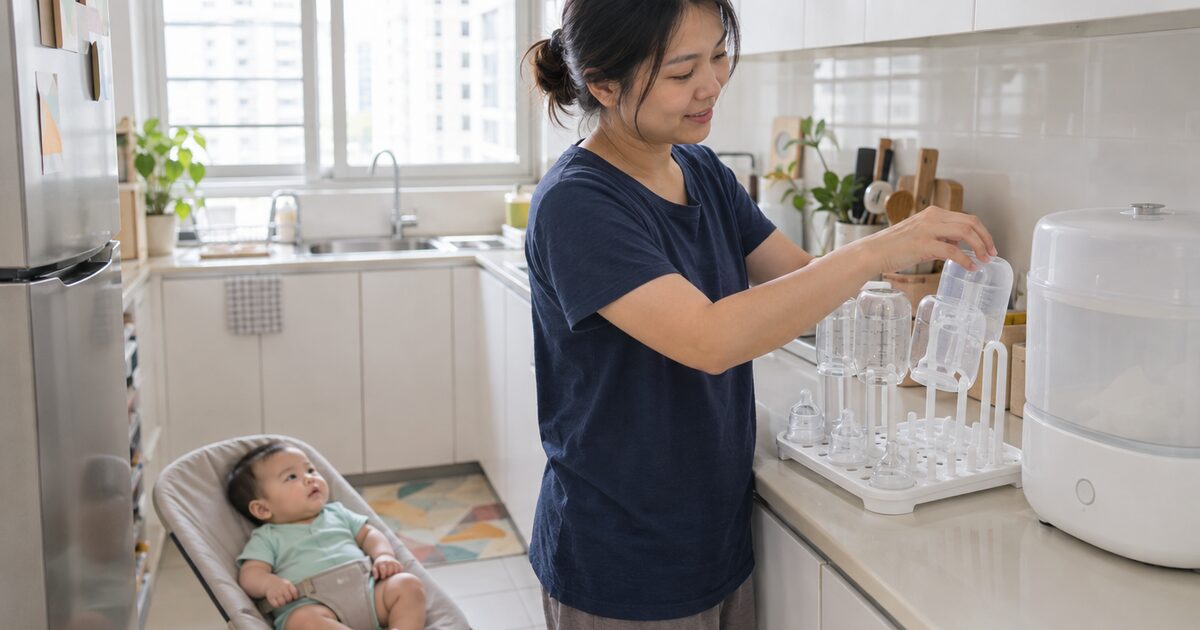
To sterilise baby bottles, you wash them in hot, soapy water, rinse them, then boil them, steam them or soak them in a cold-water sterilising solution. The NHS says to keep this up until your baby is at least 12 months old. If your baby has formula, NUH advises sterilising bottles before each use. For the feed itself, see how to prepare formula milk safely. Here's how to sterilise baby bottles, and how to clean them first, one step at a time.
How to clean and sterilise baby bottles, step by step
- Wash your hands with soap and water before you start. The CDC says to scrub for 20 seconds.
- Take the bottle apart soon after the feed: bottle, teat, ring, cap and any valve. Pour away leftover milk, since HealthHub says not to reheat a half-finished bottle.
- Rinse each part under running water, then wash it in hot, soapy water. Use a basin kept for baby things, not the sink, which the CDC says can hold germs.
- Scrub the bottle with a bottle-only brush and the teat with a small teat brush, then squeeze water through the hole. The NHS says not to use salt on teats.
- Check each teat and bottle for tears or cracks. Throw away anything damaged.
- Rinse everything in clean, cold running water, as the NHS advises.
- Sterilise with one method. The NHS says boil for at least 10 minutes, steam as the maker says, or soak in cold-water solution for at least 30 minutes.
- Leave the bottles in the steriliser or pan until you need them. If you take one out, put the teat and lid on straight away.
- Put bottles together on a clean surface or the upturned steriliser lid, using clean, dry hands or sterile tongs.
Using a breast pump? Our guide to pumping and storing breast milk covers pump parts. Warming the milk is in do you need a bottle warmer, and the timing for a first bottle is in when to introduce a bottle.
Boiling, steam or cold water: which method to use
All three do the job. The NHS lists cold-water solution, steam and boiling, and HealthHub's advice is to boil or steam bottles often. Pick the one that suits your kitchen and your week.
| Method | How long | Good for | Watch for |
|---|---|---|---|
| Boiling in a pan | At least 10 minutes, everything under the water (NHS) | No extra kit; a backup if the steriliser breaks | Teats wear out faster. Set a timer, and check each item is safe to boil (NHS). |
| Electric or microwave steam steriliser | As the maker's instructions say (NHS) | Everyday use at home | Raising Children warns that bottles can melt in a microwave without a steriliser unit. |
| Cold-water solution (tablets or liquid) | At least 30 minutes, with fresh solution every 24 hours (NHS) | Travel, or when there's no power | Use a plastic or glass tub, as the solution eats metal. Shake items off and don't rinse them (Raising Children). |
| UV steriliser | No official time | Not covered by official guidance | Raising Children says there are no national or international guidelines for UV sterilisers. |
| Dishwasher | A normal hot cycle | Cleaning only | The NHS says it cleans bottles but does not sterilise them. |
Bottles made of polycarbonate plastic need one extra step. It's in the BPA section below.
How long you need to keep sterilising
The sources don't all give the same answer. Here's what each one says.
- NHS (UK): sterilise bottles and teats until your baby is at least 12 months old. It protects against infections, in particular diarrhoea and vomiting.
- Raising Children Network (Australia): until 12 months, because a baby's immune system isn't strong enough to fight off some infections.
- NUH (Singapore): if you use formula, sterilise bottles before each use.
- SGH (Singapore): its baby care advice from the COVID-19 period says to sterilise milk bottles before each use.
- CDC (US): sanitise at least daily if your baby is under 2 months old, was born early or has a weak immune system. It says daily sanitising may not be needed for older, healthy babies whose bottles are cleaned well.
One routine fits all five: sterilise before each use until your baby turns one. If your baby was born early or gets sick often, ask your paediatrician how long to carry on.
Drying, storing and the dishwasher
Let washed parts air-dry on a clean, unused dish towel or paper towel. The CDC says not to rub or pat them dry with a towel, as that can move germs back on. It also says drying racks can trap moisture and let mould grow. If you use one, keep it for baby things only and wash it every few days, or daily for a baby under 2 months.
Once everything is dry, put the bottles together and keep them in a closed cupboard used only for clean dishes, the CDC says. Raising Children suggests a clean container in the fridge for sterilised items you won't use straight away. With a steam steriliser, the maker's instructions say how long items stay sterile inside.
A dishwasher is fine for the washing part. The NHS says it cleans but does not sterilise. Stand bottles, lids and teats facing down, and wash teats by hand if you want them spotless. The CDC suggests a closed-top basket or mesh laundry bag for small parts. It counts a hot wash with a heated drying cycle or sanitising setting as sanitising. The NHS doesn't, so add a sterilising step while your baby is under 12 months.
BPA-free baby bottles: what SFA says
BPA (bisphenol A) is a chemical that can pass out of polycarbonate plastic into the drink inside. The Singapore Food Agency (SFA) says hot water makes BPA migrate out of the bottle faster. Its advice for polycarbonate baby bottles:
- Don't pour boiling water into the bottle.
- Cool boiled water to lukewarm in a container that isn't polycarbonate, then pour it in.
- Sterilise the bottle as the formula label says, and let it cool before you add formula.
- If you're concerned, glass bottles are an alternative.
SFA says Singapore's Food Regulations require food packaging imported for use here not to pass harmful substances into food. It also runs safety assessments on plastic packaging and containers sold here. For reusable plastic food containers, its advice is to replace them once they turn cloudy or discoloured, or show cracks or heavy scratches.
When a helper or grandparent does the bottles
If someone else washes up, show them the routine once and then watch them do it. Stick the numbered steps above near the sink, so everyone uses the same method.
These points are worth saying out loud:
- Everyone washes their hands before touching bottles. SGH's hand-washing advice covers every person in the home.
- No salt on teats. The NHS says it can be dangerous for your baby.
- No drying with a tea towel. The CDC says to let parts air-dry.
- Pour any leftover milk away, because HealthHub says not to give milk that's been at room temperature for more than 2 hours, or to reheat a half-finished bottle.
- Sterilising tablets and solution stay out of children's reach, as Raising Children advises.
Still deciding who will help? Our guide to infant care, a helper or grandparents compares the options, and our helper interview questions include feeding.
Sterilising bottles when you travel
SingHealth's travel advice for babies under six months is to sterilise milk bottles by boiling them or with sterilising tablets. It also says to drink boiled or bottled water, and to wash your hands before you prepare your baby's milk.
Sterilising tablets pack small, so bring them with a plastic or glass tub with a lid, since Raising Children says the solution eats metal. The NHS says to leave items in for at least 30 minutes and make a fresh batch every 24 hours. Shake items off after soaking rather than rinsing them (Raising Children).
For packing lists and feeding on the move, see breastfeeding on the go and travel after giving birth.
When to see a doctor
The NHS says sterilising helps protect your baby from diarrhoea and vomiting. If your baby does get a tummy bug, watch for these signs. Our baby poop guide shows what normal looks like.
- A dry mouth, tongue or skin, fewer wees, crying without tears, or a sunken soft spot on the head in a baby under 18 months. HealthHub says these signs of dehydration need your paediatrician immediately.
- Green vomit, a lot of mucus and blood in the poo, severe tummy pain, a swollen belly, or crying you can't settle with knees curled up. HealthHub lists these as signs of more serious diarrhoea. See your paediatrician straight away.
- Fewer than five wet diapers in a day, refusing to drink, or vomiting often for more than 4 to 6 hours. NUH says to go to Children's Emergency.
- Cool hands and feet with clammy skin, shallow or laboured breathing, a fever of 38.0 degrees C or higher, or a baby who looks tired or won't wake up. HealthHub says to go to the emergency department immediately.
For milder worries, see your GP or a polyclinic. For the signs above, go to KKH Children's Emergency or NUH Children's Emergency. In an emergency, call 995.
Frequently asked questions
How do I sterilise baby bottles without a steriliser?
Boil them. Wash and rinse the parts, put them in a large pan with everything under the water, and boil for at least 10 minutes, the NHS says. Set a timer, and check teats often, as boiling wears them out faster.
How to clean baby bottles after every feed?
Take the bottle apart and rinse each part. Wash it in hot, soapy water with a brush kept for bottles, squeeze water through the teat hole, then rinse in clean running water. The CDC says to clean bottles after every feeding, and the NHS says to do it as soon as you can.
Do I need BPA free baby bottles in Singapore?
SFA's advice is about polycarbonate bottles, the plastic that can release BPA. If you use one, don't pour boiling water into it, and cool boiled water to lukewarm in another container first. If you're concerned, SFA names glass bottles as an alternative.
Until what age should I sterilise baby bottles?
The NHS says until your baby is at least 12 months old. For formula, NUH advises sterilising before each use. If your baby was born early or has a weak immune system, the CDC suggests sanitising at least daily, so check with your paediatrician.
Is a UV steriliser enough to sterilise baby bottles?
Raising Children says there are no national or international guidelines for UV sterilisers. The NHS lists boiling, steam and cold-water solution. If you want a method that official advice describes, use one of those three.
Can I sterilise baby bottles in the microwave?
Only inside a microwave steriliser made for the job. Raising Children says never to put bottles straight into the microwave: it won't work, and they can melt or get damaged. Check the steriliser's instructions for the microwave power it needs.
- HealthHub (HPB with NUH), Q&A: My baby's stools are watery, what should I do? (read 5 Nov 2026)
- NUH, Gastroenteritis (vomiting and/or diarrhoea) leaflet, Khoo Teck Puat - National University Children's Medical Institute (read 5 Nov 2026)
- SGH Neonatal and Developmental Medicine, Caring for my baby (read 5 Nov 2026)
- SingHealth, Travel vaccines for your child (read 5 Nov 2026)
- Singapore Food Agency, Safe use of plastic food packaging (read 5 Nov 2026)
- NHS, Sterilising baby bottles (read 5 Nov 2026)
- CDC, How to clean, sanitize, and store infant feeding items (read 5 Nov 2026)
- Raising Children Network, Bottle-feeding: cleaning and sterilising (read 5 Nov 2026)
Baby Choking First Aid: What Every Singapore Parent Should Know
Baby choking first aid in Singapore: spot true choking, do infant back blows and chest thrusts, know when to call 995, a...
11 min read
Baby colic, reflux and gripe water: what Singapore doctors advise and when to worry
Baby colic and reflux in Singapore: what KKH, NUH and HealthHub say about gripe water and gas drops, how to soothe cryin...
12 min read
Baby Eczema in Singapore: Calm Skin in a Hot, Humid Climate
A calm, practical guide to baby eczema in Singapore: hot, humid-climate triggers, soak-and-seal moisturising, managing t...
11 min read