

How to prepare formula milk safely, step by step
In this article
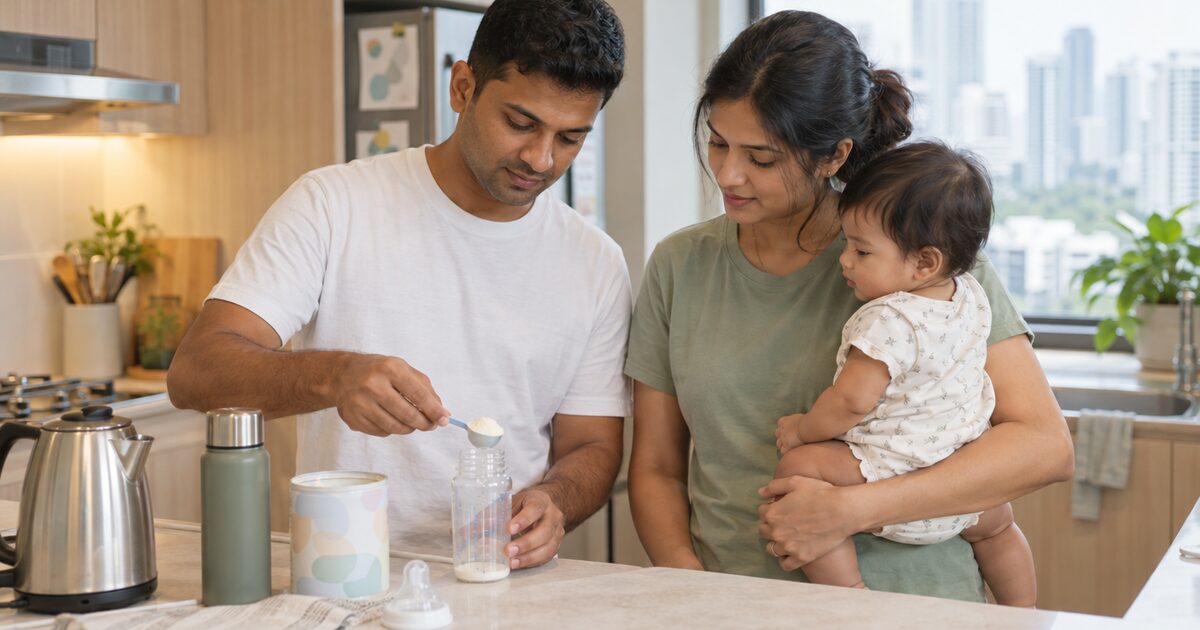
To prepare formula milk safely, you need water that's still hot. Boil fresh tap water, use it within 30 minutes while it's at least 70 degrees C, and pour it into the bottle before you add level scoops from the tin. Then shake, cool the bottle under a cold tap and test a few drops on your wrist. That's how Singapore's Ministry of Health (MOH) and the World Health Organization (WHO) both say to do it.
How to prepare formula milk, step by step
- Wash your hands with soap and water and wipe the counter, since MOH asks for a clean space and clean tins, lids and scoops.
- Check the tin and the bottle. The Singapore Food Agency (SFA) says to skip formula that's expired, recalled or in a damaged tin, and to use sanitised bottles. Our guide on how to clean and sterilise baby bottles walks you through that part.
- Boil a kettle of fresh tap water, not water that's been boiled before, as the NHS advises.
- Let the water stand for no more than 30 minutes. MOH says that keeps it at 70 degrees C or above, hot enough to kill germs in the powder.
- Pour the water into the bottle first, to the amount the tin gives for your feed. Double-check the line.
- Add the powder with that tin's own scoop, levelled with a clean, dry knife or the leveller. WHO says more or less powder than the label says could make your baby ill.
- Fit the teat and cap, then shake until the powder dissolves.
- Cool the bottle fast under a cold running tap or in a bowl of iced water. WHO says to keep the cooling water below the cap.
- Test a few drops on the inside of your wrist. The NHS says it should feel warm or cool, but not hot.
- Feed your baby, then throw away what's left. MOH says to use made-up formula within two hours and discard any milk your baby doesn't finish.
Formula prep at a glance
Stick this on the fridge for whoever makes the bottles: you, your partner, a helper or a grandparent.
| Situation | Rule | Who says so |
|---|---|---|
| Water when you mix | No cooler than 70 degrees C | MOH, SFA, WHO |
| Boiled water in the kettle | Use within 30 minutes | MOH, WHO |
| Made-up bottle at room temperature | Use within 2 hours | MOH, SFA |
| Once your baby starts drinking | Finish within 1 hour | CDC |
| Bottle in the fridge, 5 degrees C or colder | Use within 24 hours | MOH, WHO |
| Bottle in a cool bag with ice packs | Use within 2 hours | WHO |
| Rewarming a chilled bottle | 15 minutes at most, never in a microwave | WHO |
| Milk left after a feed | Throw it away | MOH, NHS |
| Opened tin of powder | Most last 1 month, so check the label | CDC |
Singapore tap water: do you still need to boil it?
Yes, for formula. PUB says Singapore's tap water is fine to drink straight from the tap. The boiling is for the powder. SFA says powdered formula may not be completely free from germs, and that a germ called Cronobacter can live in the dry powder for months. Water of at least 70 degrees C kills it.
This counts for more in our heat. WHO says mixing with water of 70 degrees C or hotter cuts the risk sharply. That protection holds for up to two hours of feeding, even in a room at 35 degrees C. SFA says babies under four weeks old, babies born early and babies with weaker immunity are most at risk.
You may read US advice that drops this step. The CDC tells most American parents to mix safe tap water as the tin says. It keeps the hot-water method for babies under two months, born premature or with weak immunity. MOH's advice to parents here is to cool boiled water to no less than 70 degrees C. Some tins, such as some anti-reflux formulas, ask for cooler water. The NHS says to follow the pack or ask a health professional, so check with your polyclinic or paediatrician.
Leave bottled water for emergencies. The NHS says it isn't sterile and may hold too much salt, and WHO says it must be boiled before use.
Making feeds ahead, night feeds and going out
Fresh is safest. WHO says it's best to make each feed when your baby needs it. If you must make bottles ahead, cool them fast and keep them in a fridge at 5 degrees C or colder. Use them within 24 hours.
Rewarm a chilled bottle for 15 minutes at most, says WHO. Never use a microwave, which heats unevenly and can scald your baby's mouth. The CDC says formula doesn't need to be warmed at all. If you'd still like to, read whether you need a bottle warmer.
For night feeds, HealthHub's tip is to get ready in advance: sterilise the bottles, measure out the powder and have boiled water in a flask. Fill it straight from the kettle: the NHS says a full, sealed vacuum flask keeps water above 70 degrees C for several hours, so each bottle you mix from it still gets hot enough water.
Going out works the same way. The NHS suggests measured powder in a clean, dry container, a flask of just-boiled water and an empty sterilised bottle. You mix a fresh feed when your baby is hungry. Ready-to-feed liquid formula is the easiest backup, since SFA says it's sterile until you open it. A bottle made at home and carried in a cool bag should be used within two hours, WHO says, because cool bags don't always stay cold enough.
If a helper or grandparent makes some bottles, agree on one method and walk through it together once. Our helper interview questions include feeding questions to ask before they start.
Formula milk for babies: the types and how to choose
Price doesn't buy a safer tin. MOH and the Health Promotion Board said in 2017 that all infant formula sold in Singapore meets the same safety and nutrition rules, regardless of price. They called the evidence weak for brands that claim to do more. HealthHub adds that the nutrients in major brands are similar.
HealthHub lists three basic types of infant formula:
- Cow's milk-based formula. HealthHub says most babies without special medical conditions adapt well to it.
- Soy-based formula. It has no lactose or animal protein, and HealthHub says to ask your doctor before you start it.
- Specialised formula, made for babies with specific medical conditions. HealthHub says to get medical advice first.
Goat's milk formula sits on the same shelf. The NHS says it's made to the same nutrition standards as cow's milk formula, but it's no less likely to cause allergies, so it isn't a fix for a baby who reacts to cow's milk. The NHS adds that ready-to-feed liquid costs more than powder and has to be used sooner once you open it.
HealthHub describes Stage 1 for 0 to 6 months and Stage 2 for 6 to 12 months, and says never to give Stage 2 before 6 months. The NHS says your baby can stay on first infant formula as the main drink until age 1. From 12 months, HealthHub says plain full cream milk can come in.
If you're comparing tins on price, the formula cost calculator shows what each one works out to per month and over the first year. Combining breast milk and formula? Our guide to mixed feeding shows how to do it without losing your supply.
When to see a doctor
Get your baby checked if you notice any of these:
- Fever, poor feeding, unusual crying, listlessness or a seizure. MOH lists these as signs of Cronobacter infection in babies.
- Diarrhoea with fever, stomach cramps, or blood in the stools. MOH lists these as signs of Salmonella infection.
- Hives, a swollen face, lips or tongue, vomiting, watery stools or trouble breathing. HealthHub lists these as allergy signs and says to see a paediatrician immediately.
- Far fewer wet nappies than usual. The NHS says a baby should have around six wet nappies a day from a few days after birth.
Start with your GP or polyclinic for anything that isn't urgent. For urgent care, KKH says to go to the nearest medical facility or KKH Children's Emergency, or call 995, and NUH Children's Emergency is the other hospital option for children. If the worry is a temperature, our baby fever guide covers when it needs a doctor.
Frequently asked questions
Which formula milk for babies is best in Singapore?
There isn't one best tin. MOH says every infant formula sold here meets the same safety and nutrition rules, whatever the price. HealthHub says most babies do well on a standard cow's milk-based formula. Your paediatrician will tell you if your baby needs soy or a specialised formula.
Do I need to boil Singapore tap water to make formula milk?
Yes. PUB says the tap water is safe to drink, but the heat is there for the powder. SFA says water of at least 70 degrees C kills Cronobacter, a germ that can live in dry formula powder.
Can I prepare formula milk in advance for night feeds?
Keep just-boiled water in a full vacuum flask and pre-measured powder near the cot, then mix each bottle fresh. If you make whole bottles ahead, WHO says to cool them fast, keep them at 5 degrees C or colder and use them within 24 hours.
Is a formula milk machine safe?
It can be, if the water comes out hot enough. The NHS says machine water should be at least 70 degrees C when it meets the powder, and suggests checking with a digital food thermometer. If it's cooler, stop using the machine and make bottles by hand.
How much formula milk does my baby need?
HealthHub says it depends on your baby's growth and weight, and you shouldn't push your baby to finish a bottle. Our newborn feeding guide by age covers how much and how often, month by month. The milk feeding calculator works out a rough amount per feed from your baby's weight and age.
Can I mix two brands of formula milk in one bottle?
No. HealthHub says brands have different compositions, so use one brand per feed. To change brands, give more feeds of the new one each day until it has taken over.
- MOH, Health advisory on preparing formula milk, press release of 23 Feb 2022 (read 5 Nov 2026)
- Singapore Food Agency, Cronobacter in infant formula (read 5 Nov 2026)
- HPB and MOH, Response to CCS recommendations on formula milk, 10 May 2017 (read 5 Nov 2026)
- HealthHub, Parent Hub 0-2 years: healthy diet (read 5 Nov 2026)
- PUB, Water quality (read 5 Nov 2026)
- WHO and FAO, Safe preparation, storage and handling of powdered infant formula: guidelines (read 5 Nov 2026)
- NHS, How to make up baby formula (read 5 Nov 2026)
- CDC, Infant formula preparation and storage (read 5 Nov 2026)
Baby Choking First Aid: What Every Singapore Parent Should Know
Baby choking first aid in Singapore: spot true choking, do infant back blows and chest thrusts, know when to call 995, a...
11 min read
Baby colic, reflux and gripe water: what Singapore doctors advise and when to worry
Baby colic and reflux in Singapore: what KKH, NUH and HealthHub say about gripe water and gas drops, how to soothe cryin...
12 min read
Baby Eczema in Singapore: Calm Skin in a Hot, Humid Climate
A calm, practical guide to baby eczema in Singapore: hot, humid-climate triggers, soak-and-seal moisturising, managing t...
11 min read