

How to cut baby nails: when to start, which tools, and signs of a nail infection
In this article
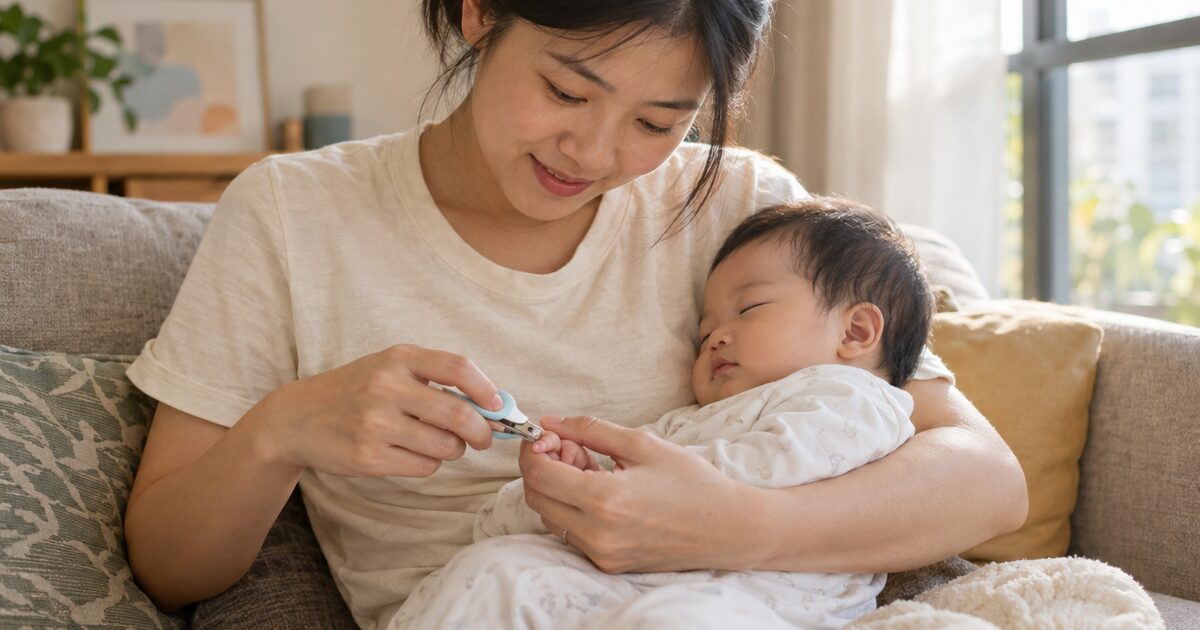
The short answer to how to cut baby nails: wait until your baby is asleep or lying still after a bath. Pull the finger pad away from the nail, then trim with baby nail clippers, blunt-tipped baby scissors or a soft emery board. HealthHub says to skip trimming for the first few weeks, while the nails are very soft, and to start at about one month. For toenails, cut straight across and leave the sides alone.
How to cut baby nails, step by step
- Wait until the nails firm up. HealthHub says you'll need to start cutting at about one month, and to avoid trimming in the first few weeks while the nails are very soft.
- Choose a time when your baby is still. HealthHub says it may be easier while your baby sleeps, and the AAP says just after a bath works if your baby will lie quietly. Our newborn bath steps fit right before it.
- Get one tool ready: baby nail clippers, blunt-tipped baby scissors or a soft emery board. Keep it where your baby naps.
- Sit in good light. If you can, get another adult to hold your baby, as HealthHub suggests.
- Hold one finger and gently pull the finger pad away from the nail. Raising Children Network says this helps you avoid cutting the skin.
- Trim the fingernail in small snips, then file any sharp corner smooth. The AAP says to keep fingernails as short and smooth as possible so your baby can't scratch.
- Cut toenails straight across. Don't cut down the sides: HealthXchange says this can leave a sharp ridge of nail that digs into the skin.
- If you nick the skin, press a soft cloth pad on it until the bleeding stops. Raising Children Network says to skip the plaster, because your baby might suck it off.
- Check the nails at bath time. The AAP says fingernails may need trimming twice a week in the early weeks, and toenails only once or twice a month.
What you need, and why not your teeth
You need one tool, not a kit. The AAP lists three that work: a soft emery board, baby nail clippers or blunt-nosed scissors. It warns that clippers and scissors can catch the tip of the finger, which hurts and bleeds, so go slowly with those. If blades make you nervous, start with the emery board. Raising Children Network says filing rounds the nails off so they're smooth.
Some parents bite the nails off instead. The AAP says to avoid this because of the risk of herpetic whitlow, a finger infection caused by the herpes simplex virus. Tearing and peeling carry their own risk. NUH says a nail fold infection usually follows an injury to the nail fold, and Raising Children Network lists biting or pulling off broken nails among the habits that make nail infections more likely.
Fingernails and toenails at a glance
| Fingernails | Toenails | |
|---|---|---|
| How often | Maybe twice a week in the early weeks (AAP) | Once or twice a month (AAP) |
| How short | As short and smooth as possible (AAP) | Don't need to be as short as fingernails (AAP) |
| Shape | Trim, then file the corners smooth (Raising Children Network) | Straight across, never down the sides (Raising Children Network, HealthXchange) |
| What parents notice | Scratches on the face | Soft nails that look ingrown. The AAP says that's fine unless the skin beside the nail is red, inflamed or hard |
Mittens: for the first weeks only
HealthHub says you can put mittens on your newborn's hands, and booties on the feet, to stop scratching. From about six weeks old, it discourages mittens. By then your baby should be learning to put the hands together, touch the cheeks and feel different textures. Raising Children Network also says to give your baby mitten-free time to play with their hands.
Our guide to newborn clothes sizes covers what to buy for the first weeks, mittens included.
Scratching and eczema
Short nails matter more if your baby has eczema. KKH's leaflet on atopic dermatitis lists scratching as a trigger, because of the itch-scratch cycle. Its advice for that is to cut and file fingernails regularly. Our baby eczema guide covers moisturising and the other triggers.
Confinement, helpers and grandparents
If your family would rather leave the nails alone during confinement, HealthHub's timing fits: it says to start cutting at about one month. Until then, mittens take care of the scratching.
Whoever trims, whether that's you, your helper or a grandparent, the steps are the same. Agree on one tool and keep it with your baby's things. HealthHub's tip of a second adult to hold the baby works well here. For the rest of the first month, see newborn care basics, and if you're still deciding who looks after your baby, infant care, a helper or grandparents.
Nail infections and ingrown toenails
NUH calls paronychia an infection of the nail fold. The signs are pain, swelling and redness beside the nail, and sometimes pus. Raising Children Network says it's quite common in young babies and often clears up without treatment, though you might need a small amount of antiseptic cream or liquid. If you use a cream, it says to put mittens or socks on afterwards so the hands and feet don't go straight into the mouth.
HealthXchange says an ingrown toenail happens when a spike of nail pierces the skin at the edge. Baby toenails are soft, so they can look ingrown when they aren't. The AAP says there's no cause for concern unless the skin alongside the nail gets red, inflamed or hard.
Raising Children Network says nail infections are much less common in children than in adults. For a mild bacterial or viral infection with no pus, it says to clean the finger or toe with an antiseptic solution. When there's pus, your baby will probably need oral antibiotics from a GP, who might also drain the pus. Your GP or pharmacist will tell you which product to use and how much.
When to see a doctor
See a GP or polyclinic doctor if you notice any of these:
- Redness or swelling that spreads from the nail into the finger or toe (Raising Children Network).
- Pus around the nail, or a blister of pus next to it (Raising Children Network, NUH).
- Your baby seems to be in pain from the finger or toe (Raising Children Network).
- A fever, or trouble moving the finger or toe (Raising Children Network). Our baby fever guide has the age rules.
- Skin beside a toenail that is red, inflamed or hard (AAP).
- Nail infections that keep coming back. Raising Children Network says this might be a sign of an underlying illness.
- A cut from trimming that you're worried about (Raising Children Network).
If your baby needs urgent care, KKH says to go to the nearest children's emergency department, such as KKH Children's Emergency or NUH Children's Emergency. In an emergency, call 995.
Frequently asked questions
When can I start cutting my newborn's nails?
HealthHub says at about one month. It advises against trimming in the first few weeks because the nails are very soft. Raising Children Network says newborn nails also wear down against clothing. Mittens can cover the gap.
Is it okay to bite my baby's nails off?
No. The AAP says parents should avoid it because of the risk of herpetic whitlow, a finger infection caused by the herpes simplex virus. A soft emery board does the same job without your mouth.
How often should I cut my baby's nails?
The AAP says fingernails may need trimming twice a week in the early weeks, because they grow fast. Toenails grow more slowly and may only need it once or twice a month. Check them at bath time.
Baby nail clippers or scissors, which is better?
Either works. The AAP lists baby nail clippers, blunt-nosed scissors and a soft emery board, and says to take care with the two that cut. Pick the one you can hold steady, then file the edges smooth.
What do I do if I cut my baby's finger while trimming nails?
Raising Children Network says to press a soft cloth pad on the cut until the bleeding stops. Don't put a plaster on, because your baby might suck it off. If you're worried about the cut, take your baby to a GP.
How long should my baby wear mittens?
Only for the first weeks. HealthHub discourages mittens from about six weeks old, so your baby can explore with bare hands.
- HealthHub, The Beginner's Guide To Taking Care of Your Baby: 0 to 6 Months (read 5 Nov 2026)
- HealthHub, Care of Your Newborn: To Have and to Hold (read 5 Nov 2026)
- KKH (SingHealth), Atopic dermatitis patient leaflet (read 5 Nov 2026)
- National University Hospital, Nail diseases (read 5 Nov 2026)
- HealthXchange (SingHealth), Ingrown toenails: treatment and prevention (read 5 Nov 2026)
- American Academy of Pediatrics, HealthyChildren.org, Nail care: fingers and toes (read 5 Nov 2026)
- Raising Children Network, How to cut baby nails and treat nail problems (read 5 Nov 2026)
- Raising Children Network, Toenail infection and fingernail infection (read 5 Nov 2026)
Baby Choking First Aid: What Every Singapore Parent Should Know
Baby choking first aid in Singapore: spot true choking, do infant back blows and chest thrusts, know when to call 995, a...
11 min read
Baby colic, reflux and gripe water: what Singapore doctors advise and when to worry
Baby colic and reflux in Singapore: what KKH, NUH and HealthHub say about gripe water and gas drops, how to soothe cryin...
12 min read
Baby Eczema in Singapore: Calm Skin in a Hot, Humid Climate
A calm, practical guide to baby eczema in Singapore: hot, humid-climate triggers, soak-and-seal moisturising, managing t...
11 min read