

How to bathe a newborn: step by step, with a Singapore bath essentials list
In this article
- How to bathe a newborn, step by step
- How to hold a newborn in the bath
- Top-and-tail wash between baths
- Sponge bath or tub bath before the cord falls off?
- Baby bath essentials in Singapore: what you need
- How often to bathe a newborn in Singapore's heat and aircon
- What you may notice on the skin after a bath
- When a grandparent or helper gives the bath
- When to see a doctor
- Frequently asked questions
To bathe a newborn, you need a shallow tub of warm water, everything within reach, and one hand that stays on your baby the whole time. Wash the face first, then lower your baby in feet first and keep the bath short. Australia's Raising Children Network says two or three baths a week is enough, with quick top-and-tail washes in between. Here's how to do it, step by step.
How to bathe a newborn, step by step
- Put everything within reach before you start: a towel, a soft cloth, cotton balls, cooled boiled water, a clean nappy and clothes. HealthHub says never to leave your baby alone in the bath, even for a moment.
- Pick a time when your baby is awake and content, not straight after a feed or when hungry or tired, as the NHS suggests. Take off your watch and rings and wash your hands.
- Fill the tub with about 5 cm (2 inches) of water, the depth the American Academy of Pediatrics (AAP) suggests. Add hot water to cold, not the other way round, as HealthHub advises.
- Test the water with your elbow. Raising Children puts the right temperature at 37 to 38 degrees C, which feels warm but not hot.
- Clean the eyes and face before you undress your baby. HealthHub says to use moist cotton balls with no soap, and a fresh one for each eye.
- Wash the hair while your baby is still wrapped in the towel, tucked along your arm with the head in your hand. Dry it straight away so your baby doesn't get cold.
- Unwrap your baby and lower them in feet first with the hold described below. Keep it the whole time, and if the doorbell rings, take your baby with you, as the AAP advises.
- Wash from the neck down with the soft cloth: the creases, under the arms, then the bottom and genitals last. Wipe front to back. Plain water is fine, with a mild baby cleanser only if needed.
- Lift your baby out within 5 to 10 minutes, which Raising Children says is long enough. Wrap them in a dry towel and pat every fold dry, under the chin, in the armpits and in the groin.
- Dab the cord stump dry, fasten the nappy below it and dress your baby. Then lay your baby somewhere safe, like the cot, and empty the tub.
How to hold a newborn in the bath
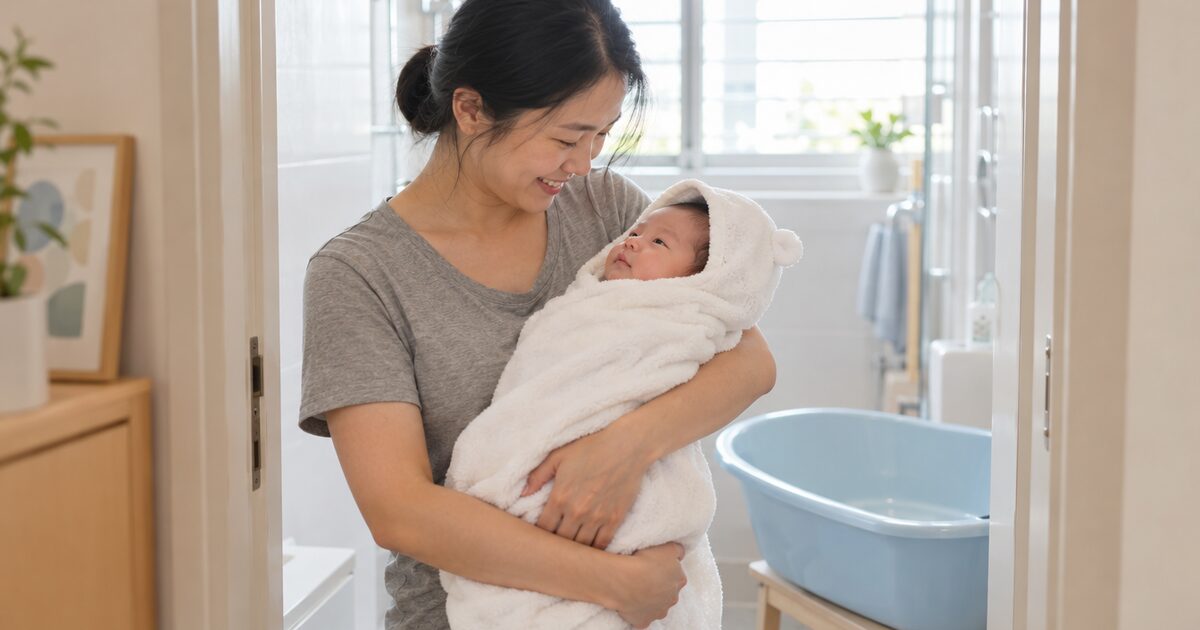
Rest your baby's head and shoulders on one forearm and use that hand to hold your baby's upper arm, as the NHS describes. Your other hand guides the body in feet first, then swishes water over your baby. Keep the head clear of the water. HealthHub puts it the same way: your arm supports the head, neck and shoulders from the moment your baby goes in.
Top-and-tail wash between baths
On days without a bath, a top-and-tail wash cleans the parts that need it. Raising Children says you can leave most of your baby's clothes on.
- Lay your baby on a changing mat or towel, in a vest and nappy or wrapped in a towel.
- Wipe each eye from the inner corner outward with cotton wool dipped in cooled boiled water, a fresh piece for each eye.
- Wipe the face, then around the outer ears. The NHS says never to use cotton buds inside the ears, and HealthHub notes that ears clean themselves.
- Wipe the neck folds and hands with fresh cotton wool, then pat them dry.
- Take off the nappy and clean the bottom and genitals with fresh cotton wool and warm water, front to back.
- Dry between the skin folds before the clean nappy goes on.
Sponge bath or tub bath before the cord falls off?
Advice differs here. HealthHub says to bathe your baby as you normally would, then dab the cord stump dry with a clean towel. The AAP prefers sponge baths until the stump falls off. Both approaches work as long as the stump ends up clean and dry, and KKH says it falls off on its own in seven to 10 days.
A sponge bath is the top-and-tail wash plus the body. The AAP suggests keeping your baby wrapped and uncovering only the part you're washing. Clean the stump with cotton wool and cooled boiled water, as KKH advises, and fold the nappy below it. Our newborn care basics guide covers cord care and the rest of the first month. Bath time is also a good moment for trimming baby nails, while your baby is calm.
Baby bath essentials in Singapore: what you need
The list is short. Raising Children says a clean sink will do instead of a baby bath.
| Item | What it's for | Good to know |
|---|---|---|
| Baby bath or a clean basin | Holding about 5 cm of water | The AAP suggests a hard plastic tub with a sloped, textured surface or a sling, so your baby can't slide |
| Soft towel | Wrapping and patting dry | Lining the tub with a towel or cloth nappy makes it less slippery, says Raising Children |
| Soft washcloth | Washing the body and skin folds | Warm water alone does the job most days |
| Cotton balls and cooled boiled water | Eyes, face and the cord stump | Use a fresh cotton ball for each eye |
| Mild baby cleanser | Only if needed | See what to look for below |
| Bath thermometer (optional) | Checking the water | Your elbow works too. Aim for 37 to 38 degrees C |
| Barrier cream | The nappy area after the bath | Raising Children suggests a thick zinc paste |
| Fragrance-free moisturiser | Dry patches only | Skip it if the skin looks fine |
| Clean nappy and a loose top | Dressing straight after | KKH suggests a shirt rather than a bodysuit until the cord falls off |
What to look for in bath products, and what to skip:
- Pick a mild cleanser made for babies and use it only where your baby is dirty. The AAP says to choose mild, neutral-pH soaps without additives.
- Pick a fragrance-free moisturiser for dry skin, applied straight after the bath, as the AAP suggests.
- Skip regular soap, which Raising Children says dries a baby's skin, and adult products. The NHS says to check any oil or lotion is suitable for babies.
- Skip talcum and cornstarch powder, which Raising Children says not to use on a baby's skin.
- Skip bath seats. The AAP says they can tip over.
How often to bathe a newborn in Singapore's heat and aircon
Raising Children says two or three baths a week keep a newborn clean, and a daily bath is fine if you both enjoy it. More than that can dry the skin. NUH's first-month advice is that your baby will enjoy a bath in our hot, humid weather, and the hair can be washed too. On the other days, use the top-and-tail wash above.
Watch the aircon. HealthHub has you dry the hair before the body goes in so your baby doesn't catch a chill, and Raising Children says to bath your baby in a warm room. If the bedroom runs the aircon, use the bathroom or a room without it, and dress your baby before you go back in. KKH's newborn care sheet suggests keeping a newborn's room at about 25 degrees C.
What you may notice on the skin after a bath
HealthHub says the skin on the hands and feet peels for the first couple of weeks. Tiny white spots on the face, called milia, are harmless and fade within a few weeks, and small red bumps on the cheeks around one month are newborn acne. NUH says to clean these pimply spots with water. If patches stay dry or red, keep baths to 5 to 10 minutes, which Raising Children says matters most for dry or sensitive skin, and see our baby eczema guide. For redness in the nappy area, our diaper rash guide has the steps.
When a grandparent or helper gives the bath
In many Singapore homes, a grandparent, confinement nanny or helper gives some of the baths. The rules are the same for everyone. HealthHub says never to leave a baby alone in the bath, even for a moment, because babies can drown in as little as 5 cm of water. Raising Children adds that older children or siblings should never be the ones watching.
Do the first few baths together. NUH invites parents to its post-natal class to learn how to bathe a baby, and HealthHub's advice for a first-timer is to ask, learn and practise.
Confinement habits sometimes come up at bath time. If an elder hesitates over washing a newborn's hair, NUH says it can be washed in our hot, humid weather. HealthHub says to keep medicated oil off the cord stump and out of the belly button, and NUH no longer recommends cord spirit because it delays the cord coming off. Our confinement guide covers other customs, and infant care vs helper vs grandparents helps you decide who does what.
When to see a doctor
Get your baby checked if you notice any of these during or after a bath:
- Redness around the navel, watery discharge from it, or urine coming from the cord. KKH and NUH both list these as reasons to see a doctor.
- A temperature above 37.5 degrees C under the arm. KKH treats any fever in a baby under 3 months as an emergency.
- A temperature below 36.5 degrees C that is still low when you check again an hour later, as KKH advises.
- An unusual rash, which KKH lists among signs to see a doctor, or a nappy rash that doesn't settle, which NUH says needs medical care.
- Eye discharge that turns very sticky, or swelling around the eye. NUH says to get help straight away.
- Any slip under the water. KKH lists near drowning among cases for its Children's Emergency.
- Lips or skin that look pale or blue, or trouble breathing. KKH says to call 995 in an emergency.
- A burn from hot water. The AAP says hot tap water can burn badly enough to need hospital care.
For a red cord or a rash that lingers, see your GP or polyclinic. For a fever in a baby under 3 months, a near drowning or a burn, go to KKH or NUH Children's Emergency. Call 995 for an emergency. Our baby fever guide covers temperatures in more detail.
Frequently asked questions
What water temperature is right for a newborn bath?
Raising Children puts it at 37 to 38 degrees C. Without a thermometer, test with your elbow. HealthHub says the water should feel warm and comfortable, not hot, and to add hot water to cold when you fill the tub.
What are the baby bath essentials in Singapore?
A baby tub or clean basin, a soft towel, a washcloth, cotton balls with cooled boiled water, a clean nappy and a loose top. A mild baby cleanser, barrier cream, a fragrance-free moisturiser and a bath thermometer are optional. Skip bath seats and talcum powder.
Can I bathe my newborn before the umbilical cord falls off?
Yes. HealthHub says to bathe your baby as normal and dab the stump dry afterwards. The AAP prefers sponge baths until it drops off. Either way, fold the nappy below the stump so it stays dry. Our umbilical cord care guide has the daily cleaning steps.
How often should I bathe my newborn in Singapore?
Two or three times a week is enough, says Raising Children, and once a day is fine if your baby enjoys it. On the days in between, top-and-tail the face, hands and nappy area. Keep baths short if your baby's skin is dry.
What is the best time of day to bathe a newborn?
Any time that suits you. The NHS suggests a time when your baby is awake and content, not straight after a feed or when hungry or tired. Raising Children adds that a time when you're relaxed and unlikely to be interrupted works best.
Can my helper or mother-in-law bathe my newborn?
Yes, if they follow the same steps. Show them the routine, do a few baths together, and agree that nobody leaves the baby alone in water, even for a moment. HealthHub notes that babies can drown in as little as 5 cm of water.
- HealthHub (Health Promotion Board), Care of your newborn: to have and to hold (read 5 Nov 2026)
- HealthHub (Health Promotion Board), Safe home for your baby (read 5 Nov 2026)
- SingHealth and KK Women's and Children's Hospital, Caring for your newborn baby (read 5 Nov 2026)
- KK Women's and Children's Hospital, Emergency: childhood illnesses (read 5 Nov 2026)
- National University Hospital, First month concerns (read 5 Nov 2026)
- NHS, Washing and bathing your baby (read 5 Nov 2026)
- Raising Children Network, Bathing a newborn (read 5 Nov 2026)
- American Academy of Pediatrics, HealthyChildren.org, Bathing your baby (read 5 Nov 2026)
Baby Choking First Aid: What Every Singapore Parent Should Know
Baby choking first aid in Singapore: spot true choking, do infant back blows and chest thrusts, know when to call 995, a...
11 min read
Baby colic, reflux and gripe water: what Singapore doctors advise and when to worry
Baby colic and reflux in Singapore: what KKH, NUH and HealthHub say about gripe water and gas drops, how to soothe cryin...
12 min read
Baby Eczema in Singapore: Calm Skin in a Hot, Humid Climate
A calm, practical guide to baby eczema in Singapore: hot, humid-climate triggers, soak-and-seal moisturising, managing t...
11 min read