

Lonely new mum: why it happens and what helps
In this article
Feeling like a lonely new mum is common, and for many mums it comes as a surprise. COPE, an Australian perinatal mental health charity, says it can start once the busy first weeks quiet down. What helps most is small, regular contact with other adults: one honest talk, one outing, one group. Low mood most days for up to two weeks is different. SingHealth says you're entitled to care then, so see a GP or polyclinic doctor.
How to feel less lonely as a new mum, step by step
- Tell one person how you feel, in plain words. SingHealth suggests talking to your husband, a friend, a doctor or a counsellor about what's on your mind.
- Plan one outing a week and put it in your calendar. SingHealth says even a short break out of the house helps.
- Find one group of parents at the same stage. HealthHub suggests a mothers' support group, and our parent support groups guide sorts them by need.
- Keep one old friendship going with short messages. The NHS suggests messaging old friends and colleagues, or starting a group chat.
- Ask your partner for one evening a week that's yours. Try: "Can you do bath and bedtime on Thursdays so I can see a friend?"
- Go back to one thing you enjoyed before the baby. HealthHub suggests planning quiet time for yourself, even if it's only 15 minutes a day.
- Say yes when someone offers to help. COPE's advice is to accept rather than say you're fine.
- See a doctor if the loneliness comes with low mood that won't lift. SingHealth's guide is low mood or anxiety most days for up to two weeks.
Why new mums feel lonely, even with people around
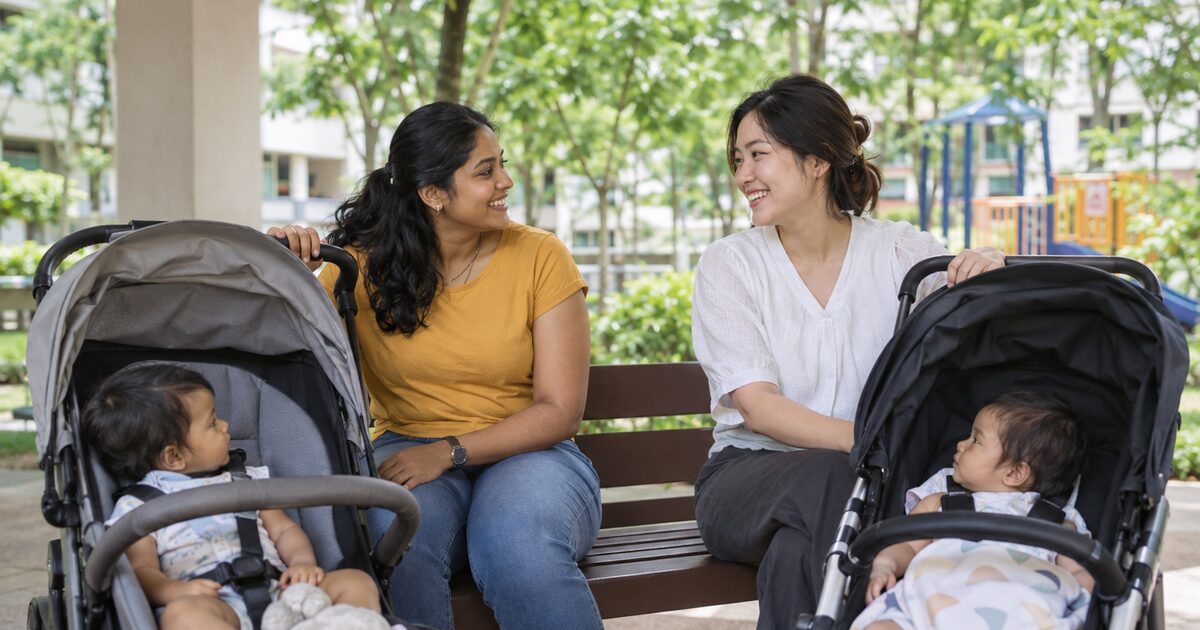
COPE says loneliness can begin once the build-up to the birth is over. Life with the baby settles, and the visitors stop. The NHS counts staying home with a newborn among the life changes that can make people lonely. Long stretches without adult company make it worse, COPE adds. So does being the first of your friends to have a baby.
In Singapore, a few things stack up. HealthHub notes that Chinese families here usually keep confinement for 30 days. Malay families keep 44 days and Indian families 40. The house is full, then it empties. MOM gives eligible fathers up to 4 weeks of Government-Paid Paternity Leave. After that, many days are just you and the baby. Our paternity leave calculator and shared parental leave calculator help you plan those weeks together.
You can also feel lonely in a full flat. Your parents, in-laws or helper may share your home, and you can still go days without a real conversation. The NHS describes this as feeling alone in a room of people you know. If you moved here from abroad, your own mother may be a flight away. Getting to know people near you helps, the NHS says, especially after a move.
Dads feel it too. COPE says stay-at-home fathers often feel they don't fit into mothers' groups. If your partner is the one at home, see our guide to involved dads.
Adjusting to being a mum
Adjusting to being a mum means letting go of parts of your old life for a while. COPE says your sense of independence and freedom changes. You may feel less part of a group, at work or with friends. You can love your baby and still miss your old self.
SingHealth suggests building a routine around the baby, with room to change it as feeds and sleep shift. Once the day has a shape, it's easier to fit in a call or a walk. HealthHub also says not to compare yourself with other mothers. That's harder online, where most people only share the good parts, as the NHS points out.
For the practical side of looking after yourself, our self-care plan for new mums has a weekly planner. Going back to work shifts things again, and our guide to returning to work after maternity leave covers that stage.
New parent worries and what helps
Most mothers worry about managing the baby's needs on their own, HealthHub says, especially first-time mums. It also says this is normal. Most of these worries have a small fix you can start this week.
| The worry | What helps |
|---|---|
| I'm the only one of my friends with a baby. | Keep one old friend close with short messages, and find one new parent friend through a group. |
| My husband is back at work and the days are long. | Plan each week around one outing, one call and one evening off. |
| I live with family but still feel alone. | Ask for a real conversation, not more help with chores. |
| My family is overseas. | Set a regular video call, and say hello to the parents you see nearby. |
| I don't know who I am apart from being a mum. | Go back to one thing you enjoyed, in short slots. |
| Other mums seem to cope better. | Mute the accounts that leave you feeling worse. |
| I'm not sure I'm doing it right. | Write your questions down for your postnatal check or the baby's next check-up. |
Talking to a stranger is often the hardest part. COPE suggests keeping it simple, such as asking how old their baby is. The NHS adds that a smile and a hello to someone you recognise is a good start.
What to say to the people around you
People can't guess you're lonely, least of all when you look like you're coping. HealthHub advises talking openly with family when you feel low. COPE says to speak up and tell people how you feel. A few lines to borrow:
- To your husband: "I'm not asking you to fix anything. I miss talking to adults. Can we eat together with our phones away twice a week?"
- To your mum or mother-in-law: "Thank you for all the cooking. What would help most is an hour with the baby so I can meet a friend."
- To a friend without kids: "I'd love to see you. Can you come over? I can't go far yet, but I want to hear about your life."
- To another mum at a class or playground: "How old is yours? Do you come here every week?"
If talks with your partner keep turning into arguments, our guide to marriage after a baby can help. For clashes over how grandparents look after the baby, see mother-in-law parenting conflict. Our guide to the mental load for mothers has a section on making friends with other parents.
When to see a doctor
Loneliness on its own isn't an illness. But the NHS says loneliness that's severe or goes on for a long time can raise the risk of some physical and mental health conditions. SingHealth says up to one in 10 women get depression in pregnancy or after birth. See a doctor if any of these apply:
- Low mood or anxiety most days for up to two weeks, or trouble getting through your day (SingHealth).
- Losing interest or pleasure in things, or feeling hopeless (SingHealth).
- Constant worry about the baby, a racing heart or a tight chest. SingHealth lists these as signs of anxiety.
- Baby blues that haven't lifted after two weeks. HealthHub says they can then turn into postnatal depression.
- Thoughts of harming yourself or your baby. SOS says to call 995 or go to the nearest A&E if someone is in immediate harm. The SOS hotline, 1767, is open 24 hours. So is SOS CareText on 9151 1767.
Start with a GP or polyclinic doctor, or your gynae if you're still seeing one. Your postnatal check is a good time to raise it. For a KKH Women's Mental Wellness specialist, SingHealth gives the appointments line, 6294 4050. NUH's Women's Emotional Health Service supports women in pregnancy and the first postnatal year. Call 6772 2037, Monday to Friday, 8.30am to 5pm.
Is the loneliness tied up with problems at home? MSF says you can call, walk in or email a Family Service Centre. They help with family and relationship issues. Our guides to postnatal depression help and postpartum anxiety explain the signs. Our list of mental health helplines for parents has every line.
Frequently asked questions
Is it normal to be a lonely new mum?
Yes. COPE says many new parents feel isolated and lonely, and for many it's unexpected. The NHS says loneliness can pass. Regular contact with other adults, a weekly outing and one group are the places to start.
How do I cope with adjusting to being a mum?
Give the day a loose routine built around the baby, as SingHealth suggests. Keep one thing that's yours, even 15 minutes a day, as HealthHub suggests. COPE says your sense of independence and freedom changes when a baby arrives, so expect to miss parts of your old life.
Which new parent worries are normal?
Worrying about feeding, sleep and whether you're doing it right is common. HealthHub says most mothers worry about managing the baby's needs alone, first-time mums most of all, and that this is normal. If the worry is constant, or comes with a racing heart or chest tightness, see a doctor. Our guide to postpartum anxiety explains the difference.
How can a lonely new mum make friends in Singapore?
Pick one regular thing and keep going back. Try a support group, a library baby session or a class at your community club. Our children's libraries guide covers library story times. Our breastfeeding support guide lists the breastfeeding groups.
Should I see a doctor about feeling lonely after having a baby?
Yes, if it comes with low mood or anxiety that won't lift, or daily life feels hard. SingHealth's guide is most days for up to two weeks. A GP or polyclinic doctor is a good first stop. You can also raise it at your postnatal check.
- SingHealth (KKH), Emotional wellness during and after pregnancy (read 6 Nov 2026)
- HealthHub, Baby has come home: dealing with changes (read 6 Nov 2026)
- NUH, Women's Emotional Health Service (read 6 Nov 2026)
- MOM, Paternity leave (read 6 Nov 2026)
- MSF, Family Service Centres (read 6 Nov 2026)
- Samaritans of Singapore, 24-hour hotline and CareText (read 6 Nov 2026)
- NHS Every Mind Matters, Loneliness (read 6 Nov 2026)
- COPE, Loneliness in early parenthood (read 6 Nov 2026)
Affirmations for mums: kind, believable lines for hard moments
Affirmations for mums that sound like you: kind lines for feeds, crying, work guilt and body changes, how to use them, a...
8 min read
Body image after baby: why it dips and what helps
Body image after baby and in pregnancy: how long your body takes to recover, what to say to family comments, and when to...
8 min read
Childhood Myopia in Singapore: A Parent's Guide to Signs, Prevention and Eye Checks
A Singapore parent's guide to childhood myopia: why it is so common, early signs, outdoor and screen habits that help, e...
11 min read