

Pelvic pain during pregnancy: easing pelvic girdle and round ligament pain, and when to see a doctor
In this article
Pelvic pain during pregnancy often comes from pregnancy hormones loosening your joints and ligaments. Small changes in how you move ease a lot of it. Pelvic girdle pain aches over your pubic bone, lower back or thighs, while round ligament pain catches you low in the tummy or groin when you move suddenly. Pain with bleeding, fever, contractions or burning when you pee is different: get it checked the same day.
How to ease pelvic pain during pregnancy, step by step
- Keep your knees together as you get in and out of a car, a taxi or bed. The NHS says moving your legs apart can make pelvic girdle pain worse.
- Sit down to get dressed. Standing on one leg to pull on pants or shoes is another move the NHS says can make the pain worse.
- Stand with your weight spread evenly on both legs, and wear supportive shoes. Both are NHS tips.
- Take the lift instead of the HDB stairs where you can, because the NHS advises against going up and down stairs too often.
- Hand the heavy grocery bags to someone else. SingHealth's HealthXchange lists heavy lifting as a thing to avoid with pelvic and groin pain.
- Change position often. HealthXchange says not to stay in one position for too long, and the NHS says to avoid standing for long periods, so ask for a seat on a packed MRT.
- Sleep on your side with a pillow between your knees. KKH suggests this for round ligament pain, and the NHS suggests a pillow between your legs for pelvic girdle pain.
- For round ligament pain in your groin, change position slowly. When you're about to cough or sneeze, KKH says to lean forward and support your bump with your hands.
- Tell your gynae if it hurts to get out of a car, climb stairs or turn over in bed. The NHS says these can be signs of pelvic girdle pain.
- Ask your doctor or pharmacist before you take a painkiller. HealthXchange says paracetamol is safe in pregnancy and can ease the pain.
Which kind of pelvic pain is it?
Pelvic girdle pain and round ligament pain are the two you can work on at home, and a few other pains need a doctor. Use this table to decide what to try and who to call. Only your gynae can tell you the cause.
| Pain | What it can feel like | What to do |
|---|---|---|
| Pelvic girdle pain (PGP or SPD) | Pain over the pubic bone, across the lower back, between the vagina and anus, or into the thighs. It may click or grind. | Try the steps above. Tell your gynae if it's hard to get around. |
| Round ligament pain | Pain low in the tummy or groin when you stand up, roll over, cough, sneeze or laugh | Move slowly, support your bump and rest on your side |
| Contractions before 37 weeks | Regular, painful tightening, sometimes with a show or your waters breaking | Go to hospital now. See where to go below. |
| Pain when you pass urine | It hurts or burns when you pee | See your doctor soon, as it can be a urine infection |
| Pain on one side in early pregnancy | Lower tummy or pelvic pain, often on one side | Go to an urgent O&G centre or emergency department today |
The descriptions come from the NHS for pelvic girdle pain, KKH for round ligament pain and urine symptoms, and SingHealth for labour and ectopic pregnancy.
Why your pelvis hurts more as your bump grows
HealthXchange explains that pregnancy hormones relax the connective tissue that holds your bones in place, especially in the pelvic area. That loosening can leave the joints sore, often in the third trimester.
The NHS describes pelvic girdle pain as stiffness in the pelvic joints, or the joints moving unevenly at the back or front of your pelvis. It affects up to 1 in 5 pregnant women to some degree, by the NHS estimate. It isn't harmful to your baby. It can still be painful, though, and make it hard to get around.
The NHS says a history of lower back or pelvic girdle pain makes it more likely. So do an old pelvic injury, PGP in an earlier pregnancy and a physically demanding job. Round ligament pain comes from the same loosening: KKH says the looser ligaments can go into spasm when they stretch, which is why a sudden move sets it off.
If your main ache sits across your lower back, our guide to back pain during pregnancy covers it. Pain under the ribs has its own page on rib pain during pregnancy. For the full list of aches by stage, see pregnancy aches and pains by trimester.
Physio, support belts and pain relief in Singapore
The NHS says getting diagnosed early helps keep the pain to a minimum. Pelvic girdle pain tends not to clear completely until your baby is born, it adds, but treatment from an experienced practitioner can improve it before then. SingHealth says each antenatal visit is a chance to discuss any questions or concerns, so raise it early and your gynae can refer you on.
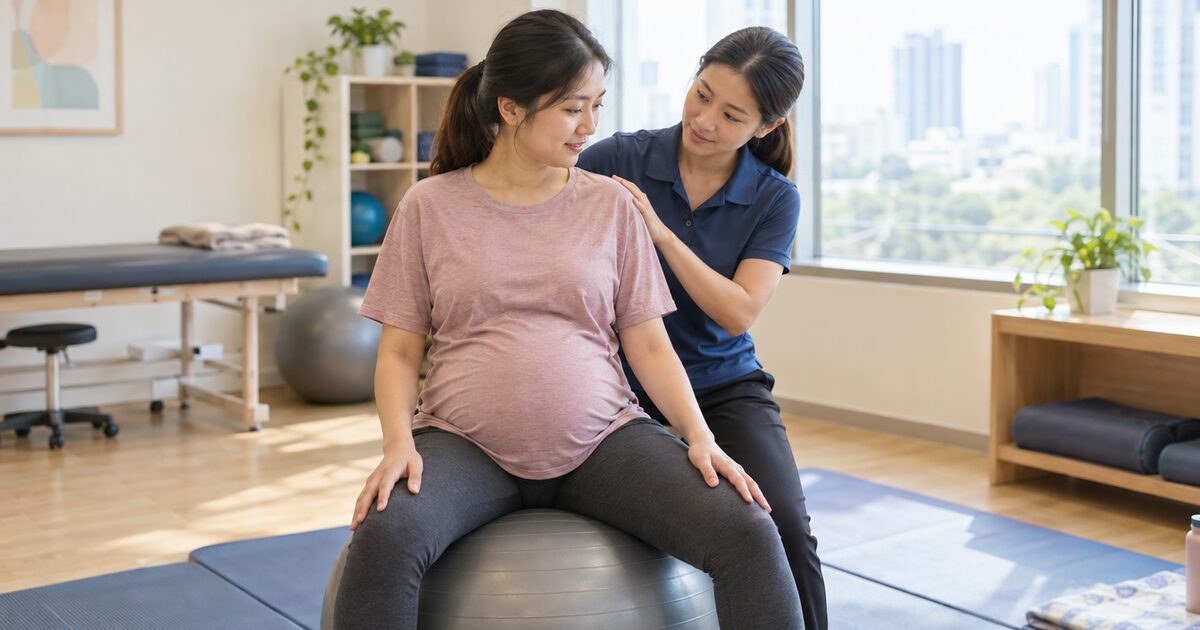
KKH's physiotherapists assess women with muscle and joint complaints in pregnancy. They teach pain-relief strategies and exercises, and they give out maternity belts where needed. KKH also runs outpatient group classes such as Aquafitness in Pregnancy and a pre and postnatal fitball class. Seeing a gynae at another hospital or a private clinic? Ask which physio service they refer to.
On belts, HealthXchange says garments that support your back and tummy may help. The NHS says a physiotherapist may recommend a pelvic support belt, so let the physio check which kind suits your pain.
For pain relief, HealthXchange says paracetamol is safe in pregnancy and can give some relief. Take the dose your doctor or pharmacist gives you. If the pain carries on despite it, see your doctor, and read our guide to safe medicine during pregnancy before you take anything else.
Exercise, sleep and giving birth with pelvic girdle pain
Stay active, but skip whatever makes the pain worse. That's the NHS advice, along with resting when you can. HealthXchange adds that you should lower your exercise intensity if you have pelvic or groin pain, and our safe exercise guide covers what you can do in each trimester.
In bed, lie on your side with a pillow between your knees. KKH also advises against lying flat on your back later in pregnancy, so turn to your side instead. Our guide to pregnancy sleeping positions has more ways to get comfortable.
Most women with pelvic girdle pain can have a vaginal birth, the NHS says. It suggests writing in your birth plan that you have it, along with the birth positions that feel most comfortable, so the team in labour knows. Our birth plan guide shows how to raise it with your hospital.
When to see a doctor
Pelvic pain that comes with any of these needs a doctor the same day, not at your next check-up:
- Severe lower tummy pain with fever or chills, bleeding, nausea or vomiting, or if it's hard to walk. KKH says to seek immediate medical attention.
- Lower tummy or pelvic pain in early pregnancy, often on one side. SingHealth lists it as a sign of ectopic pregnancy, where the pregnancy grows outside the womb.
- Regular, painful contractions, a show or your waters breaking before 37 weeks. SingHealth says these signs mean preterm labour, and our premature labour signs guide has the full list.
- Bright red bleeding that comes and goes. SingHealth says it can come from a low-lying placenta or mild placental separation.
- Pain when you pass urine, or a burning or stinging feeling. KKH lists it as a reason to see a doctor and says urine symptoms can come from a urinary tract infection.
- Pain that carries on despite paracetamol, which HealthXchange says needs your doctor immediately.
Where to go depends on how many weeks pregnant you are. At KKH, the Urgent O&G Centre at Basement 1 of the Women's Tower is a 24-hour walk-in centre for problems before 22 weeks, such as abdominal pain and bleeding. From 22 weeks, KKH asks you to go straight to its Delivery Suite on Level 2 of the Women's Tower. If you're under 16 weeks with mild tummy pain, you can book KKH's Early Pregnancy Assessment Unit, which sees you the same or the next working day.
Booked at another hospital? Call your gynae's clinic, or go to that hospital's delivery suite or emergency department. In a life-threatening emergency, call 995. Our guide to bleeding in early pregnancy covers where else to go in the first weeks.
Frequently asked questions
Is pelvic pain during pregnancy normal?
Often, yes. KKH calls round ligament pain very common and not dangerous to you or your baby, and the NHS says pelvic girdle pain isn't harmful to your baby. Pain with bleeding, fever, contractions or burning urine is different, so see a doctor that day.
What does round ligament pain feel like?
KKH describes pain in the lower tummy or groin as stretched ligaments go into spasm. A cough, a sneeze or a laugh can set it off, and so can standing up from a chair or rolling over in bed. KKH suggests moving slowly and supporting your bump with your hands.
Is SPD in pregnancy the same as pelvic girdle pain?
Yes. The NHS says pregnancy-related pelvic girdle pain (PGP) is sometimes called symphysis pubis dysfunction (SPD). Both names describe pain from pelvic joints that are stiff or move unevenly.
What causes pubic bone pain in pregnancy?
Pain over the pubic bone at the front, roughly level with your hips, is one of the signs of pelvic girdle pain, the NHS says. It can get worse when you walk or climb stairs, or when you move your legs apart. If it stops you moving easily, ask your gynae about physio.
Can pelvic girdle pain affect my baby or my birth?
The NHS says it isn't harmful to your baby. Most women with it can have a vaginal birth, so note it in your birth plan with the positions that feel best.
Does pelvic pain mean labour is starting?
Not by itself. SingHealth says labour begins with regular, painful contractions, a show or your waters breaking. The same signs before 37 weeks mean preterm labour, so go to hospital straight away if you have them.
- KK Women's and Children's Hospital, Coping with common symptoms in pregnancy (read 6 Nov 2026)
- HealthXchange (SingHealth, contributed by KKH's HELMS study), Pregnancy symptoms: what to expect (read 6 Nov 2026)
- KK Women's and Children's Hospital, Physiotherapy (read 6 Nov 2026)
- KK Women's and Children's Hospital, Urgent O&G Centre (read 6 Nov 2026)
- SingHealth, Ectopic pregnancy (read 6 Nov 2026)
- SingHealth, Care during pregnancy (read 6 Nov 2026)
- Singapore Civil Defence Force, Emergency medical services (read 6 Nov 2026)
- NHS (UK), Pelvic pain in pregnancy (read 6 Nov 2026)

Alcohol and smoking during pregnancy: the risks to your baby, secondhand smoke, and where to get help to quit in Singapore
Alcohol and smoking during pregnancy: what each does to your baby, secondhand smoke, drinking before you knew, and Singa...
6 min read
Antenatal classes in Singapore: what each hospital's class covers, fees and when to book
Antenatal classes in Singapore compared: KKH, NUH, SGH, Mount Alvernia and other hospitals, what each covers, fees read ...
6 min read
Antidepressants in pregnancy and breastfeeding: how Singapore doctors weigh the risks, which medicines come up, and how to get a referral
Antidepressants in pregnancy and breastfeeding: what KKH and SingHealth say about the risks, SSRIs, timing by trimester,...
7 min read