

Pregnancy skin, hair and nails: what changes, what helps and when to see a doctor
In this article
- How to care for your skin, hair and nails in pregnancy, step by step
- Skin changes: darker patches, linea nigra, red spots and skin tags
- Itchy skin and pregnancy rashes
- Hair changes: thicker hair and more body hair
- Nails, eyes and gums
- Normal or worth a call: a quick guide
- When to see a doctor
- Frequently asked questions
Most pregnancy skin, hair and nails changes are normal, and most fade in the months after your baby arrives. KKH says pregnancy hormones cause the darker patches and the extra hair. Sunscreen and an unperfumed moisturiser ease most of it at home. A few signs, such as severe itching on your palms and soles, mean calling your gynae.
How to care for your skin, hair and nails in pregnancy, step by step
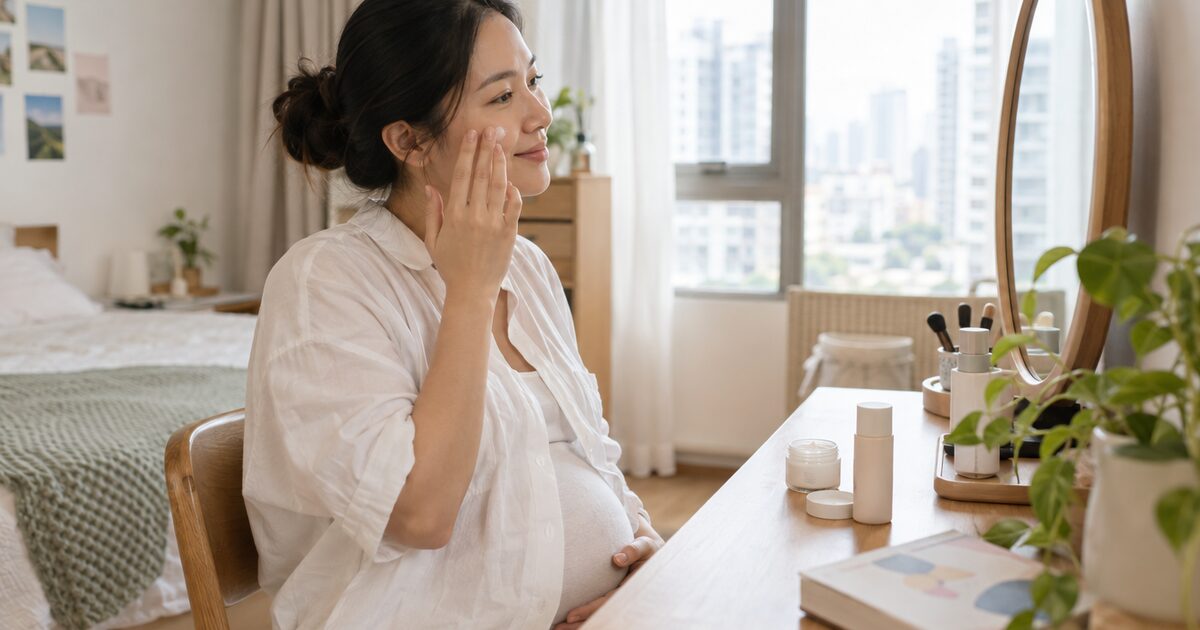
- Wear sunscreen and a hat when you go out. KKH's skin doctors suggest SPF 30 or higher, since sunlight can make melasma (dark patches on the face) worse.
- Wash your face gently twice a day with a mild cleanser, and leave pimples alone. KKH's Dr Wee Wei-Wei says squeezing them can leave scars.
- Take warm showers rather than very hot ones, which HealthHub says leave your skin drier and itchier.
- Use an unperfumed moisturiser, and pat or tap an itch instead of scratching it, as the NHS suggests.
- Wear loose clothes, ideally cotton, washed in a mild, fragrance-free detergent. HealthHub and the NHS both suggest this for itchy skin.
- Keep your nails short and trim them straight across. The NHS also suggests rubber gloves for washing up, and hand cream on your nails and fingertips.
- Pick water-based makeup labelled non-comedogenic, and take it off fully before bed, as Dr Wee advises.
- Brush twice a day and floss once a day, as HealthHub advises. Pregnancy hormones can make your gums bleed more easily.
- Give dry eyes a rest by wearing glasses more often than contact lenses. SNEC's Dr Woo Jyh Haur also suggests less time in air-conditioning and on screens.
- Ask your gynae or a pharmacist before you use any medicated cream, and say you're pregnant. HealthHub warns against self-medicating or traditional remedies in pregnancy.
Skin changes: darker patches, linea nigra, red spots and skin tags
Pregnancy hormones make your skin hold more pigment. KKH says the darkening often shows on your nipples, armpits, genitals, scars and moles. It's usually more noticeable if you have a darker complexion.
Linea nigra is the dark line down the middle of your belly, above and below your belly button. KKH says it fades over several months after the birth. Melasma is slower. These brown patches on your cheeks and forehead may improve after delivery, but KKH says they rarely clear fully, and treatments such as lightening creams and lasers wait until after the birth. Our guide to pregnancy-safe skincare in Singapore covers acne and melasma care.
You may also spot small red bumps, or tiny red veins on your face, neck and arms. Dr Wee says the bumps come from extra blood flow and usually go away on their own after pregnancy. The American College of Obstetricians and Gynecologists (ACOG) says these spider veins are most common in the first half of pregnancy.
Skin tags are soft, skin-coloured growths, often where skin rubs together. The NHS says hormonal changes make them more likely in pregnancy. Don't cut one off yourself, though. The NHS says that can lead to an infection or a scar.
Two changes have guides of their own. For stretch marks, see how to reduce stretch marks. For sweating and heat rash in Singapore's humidity, see pregnancy heat in Singapore.
Itchy skin and pregnancy rashes
A mild itch on your bump is common. HealthHub says it comes from your growing belly stretching the skin. The NHS says the itching usually stops once your baby is born.
Some rashes only happen in pregnancy. KKH describes PUPPP, an itchy red rash that often starts in the stretch marks on your belly near the end of the third trimester, and says it isn't known to harm you or your baby. It usually clears within one to two months of the birth, and your doctor can treat the itch until then.
One kind of itch needs a doctor. Obstetric cholestasis, also called intrahepatic cholestasis of pregnancy (ICP), is a liver condition that the NHS says needs treatment with medicine. ACOG says its main sign is severe itching with no rash, often on your palms and soles and worse at night. HealthHub says to see your doctor if a severe itch affects your palms and soles without a rash, usually after 28 weeks. ACOG adds that ICP is found with blood tests, and you and your baby are then watched closely.
Hair changes: thicker hair and more body hair
Your hair may feel thicker from around 15 weeks. KKH explains that each strand isn't thicker. Your hair stays in longer, so less of it falls out than usual. Some women shed more instead, during or after pregnancy, and KKH says that's usually nothing to worry about.
Hair can also grow in new places, such as your face, chest and belly. ACOG says it's safe to tweeze or wax it, or to shave. KKH's skin doctors say the extra hair usually settles after delivery, and laser removal can be considered then.
KKH says your hair growth should be back to normal by the time your baby is around 12 months old, and to see your doctor if it isn't. Our postpartum hair loss guide covers the shedding months and when to test thyroid or iron.
Nails, eyes and gums
ACOG says some women find their nails grow faster in pregnancy, while others find they split and break more easily. Either way, ACOG says nail changes ease after the birth. Our cleaning products guide covers nail polish and face masks.
Your eyes may feel dry and gritty. Dr Woo Jyh Haur of the Singapore National Eye Centre (SNEC) says women are more likely to get dry eye because of hormonal changes in pregnancy. He says lifestyle changes and eye lubricants sold over the counter usually help. Tell the pharmacist you're pregnant. If your eyes don't settle, Dr Woo advises seeing an eye doctor.
Blurred vision is a different matter. HealthHub lists it among the signs of pre-eclampsia, a high blood pressure condition that it says usually starts in the second half of pregnancy.
HealthHub says hormonal changes can make your gums softer, so they may bleed when you brush. SingHealth says routine dental care is safe in pregnancy, so keep your check-ups. Our dental care in pregnancy guide covers treatments and X-rays.
Normal or worth a call: a quick guide
| Change | Normal? | What helps |
|---|---|---|
| Darker nipples, armpits or linea nigra | Yes | Nothing; fades over months |
| Brown patches on your face | Yes | SPF 30 or higher and a hat |
| Red bumps or spider veins | Yes | Usually go after the birth |
| Skin tags | Yes | Leave them; don't cut them off |
| Mild itch on your bump | Yes | Warm showers and moisturiser |
| Severe itch on palms and soles | See a doctor | Call your gynae for a blood test |
| Thicker hair or more body hair | Yes | Tweeze, wax or shave |
| Brittle or splitting nails | Yes | Short nails and hand cream |
| Dry, gritty eyes | Yes | Glasses instead of lenses, less air-con |
| Blurred vision or a bad headache | See a doctor now | Call your gynae or go to hospital |
| Gums that bleed when you brush | Common | Floss daily and see your dentist |
When to see a doctor
See your gynae or a polyclinic doctor if you notice any of these, so they can find the cause.
- Severe itching, especially on your palms and soles, with no rash. HealthHub says to see your doctor, and the NHS says itchy palms or soles need urgent treatment if they're from ICP.
- Bad headaches, blurred vision, vomiting, pain just below your ribs, or sudden swelling of your hands, feet or face. HealthHub says to see your doctor immediately. The NHS adds seeing flashing lights. Our pre-eclampsia guide has more.
- A mole that changes size, shape or colour, or one that bleeds, itches or turns crusty. The NHS says moles can get slightly darker in pregnancy, but these changes need a GP to look.
- A new rash, or contact with someone who has one. The NHS says to call your doctor as soon as possible, as you may need a blood test. HealthHub says rubella in the first four months of pregnancy can cause birth defects.
- Tiny blisters that start around your belly button. HealthHub says this rare pregnancy rash can occasionally lead to an early birth.
- A tender, red spot on your leg. ACOG says your gynae should check it.
- Dry eyes that keep bothering you after you've switched to glasses and cut down on air-conditioning. SNEC's Dr Woo advises seeing an eye doctor.
For most of these, call your gynae's clinic first. KKH's Urgent O&G Centre is a 24-hour walk-in centre at Basement 1 of the Women's Tower, for urgent problems before 22 weeks. From 22 weeks, KKH asks women with urgent concerns, such as bleeding or signs of labour, to go straight to its Delivery Suite on Level 2 of the Women's Tower. If you're booked at another hospital, call its delivery suite. For a life-threatening emergency, call 995, which MOH says is the number to use. Our bleeding in early pregnancy guide has more on where to go.
Frequently asked questions
Is itchy skin in pregnancy normal?
A mild itch over your bump is common, and HealthHub puts it down to your skin stretching. Warm showers and an unperfumed moisturiser help. Severe itching on your palms and soles with no rash is different. HealthHub says to see your doctor, and the NHS says it can be a sign of a liver condition called ICP.
When does linea nigra go away?
KKH says the line fades gradually over several months after delivery, so there's nothing to treat. Darkening on your nipples and moles fades over the same months. Melasma is slower; KKH says it rarely clears completely.
Can I dye or rebond my hair during pregnancy?
Singapore sources differ. SingHealth says colouring, straightening and bleaching are generally safe, because the dose in hair dye is very low. KKH's pregnancy book, quoted on HealthXchange, says it's best to avoid dyeing or rebonding once you've conceived, as there's no reliable data. If you're unsure, ask your gynae at your next check-up.
Is my usual makeup and skincare safe in pregnancy?
KKH's Dr Wee suggests water-based makeup rather than oil-based, in products labelled non-comedogenic or non-acnegenic. Take it off fully before bed. Skincare needs more care: ACOG says retinoid creams are best avoided in pregnancy. Our pregnancy-safe skincare guide lists the ingredients to check.
Why do I have dry eyes in pregnancy?
SNEC's Dr Woo says hormonal changes in pregnancy make dry eye more likely. Wearing glasses more often and spending less time in air-conditioning can help, and a pharmacist can suggest eye lubricants. Blurred vision, especially with a bad headache, needs your doctor straight away, as HealthHub lists both as signs of pre-eclampsia.
My gums bleed in pregnancy. Should I see a dentist?
Yes, and tell the dentist you're pregnant when you book. SingHealth says routine dental care is safe in pregnancy, and HealthHub suggests having your teeth cleaned and checked regularly. Our dental care guide covers what treatment can go ahead.
- KK Women's and Children's Hospital, Common skin changes in pregnancy (read 6 Nov 2026)
- KK Women's and Children's Hospital, Coping with common symptoms in pregnancy (read 6 Nov 2026)
- HealthHub, Pregnancy: A to Z of pregnancy health (read 6 Nov 2026)
- HealthXchange (KKH), Stretch marks, acne and other skin changes during pregnancy (read 6 Nov 2026)
- HealthHub, Coping with the unexpected: pregnancy complications (read 6 Nov 2026)
- HealthXchange (SNEC), Dry eye syndrome: home remedies and coping tips (read 6 Nov 2026)
- KK Women's and Children's Hospital, Urgent O&G Centre (read 6 Nov 2026)
- American College of Obstetricians and Gynecologists, Skin conditions during pregnancy (read 6 Nov 2026)

Alcohol and smoking during pregnancy: the risks to your baby, secondhand smoke, and where to get help to quit in Singapore
Alcohol and smoking during pregnancy: what each does to your baby, secondhand smoke, drinking before you knew, and Singa...
6 min read
Antenatal classes in Singapore: what each hospital's class covers, fees and when to book
Antenatal classes in Singapore compared: KKH, NUH, SGH, Mount Alvernia and other hospitals, what each covers, fees read ...
6 min read
Antidepressants in pregnancy and breastfeeding: how Singapore doctors weigh the risks, which medicines come up, and how to get a referral
Antidepressants in pregnancy and breastfeeding: what KKH and SingHealth say about the risks, SSRIs, timing by trimester,...
7 min read