

Baby cough remedies: what helps at home and when to see a doctor

In this article
You can ease most coughs at home, and the baby cough remedies that work are simple ones like milk, rest and saline for a stuffy nose. Most coughs come from a cold or another virus, RCH says. HSA says cough and cold medicines don't cure a cold or make it shorter. This guide covers home care first, then the signs that mean your child needs a doctor.
How to ease your baby's cough at home, step by step
- Keep the milk coming. HealthHub says babies under 1 need more frequent feeds during a cold, so offer small amounts through the day and keep breastfeeding.
- Give older children warm drinks to sip. KKH says fluids, especially warm drinks, soothe the throat. The NHS says to keep hot drinks away from small children.
- Let your child rest. HealthHub calls rest and fluids the best remedy for a cold.
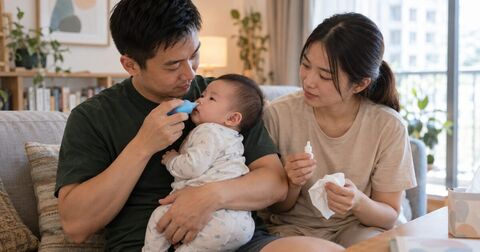
- Clear a blocked nose before feeds with saline drops or spray, as HealthHub and HSA suggest. Our blocked nose guide shows how.
- Save honey for after the first birthday. RCH says honey may ease a cough, but it's not for babies under 12 months because of the risk of botulism.
- Keep cigarette smoke and vaping away from your child, since RCH says both make a cough worse.
- Treat a fever for comfort. RCH says paracetamol and ibuprofen ease pain and fever but don't treat the cough. The dose comes from the label, your pharmacist or the doctor, and our guide to giving medicine to a baby covers the how.
- Leave cough and cold syrups on the shelf unless a doctor prescribes one. HSA says children under 2 need a medical professional's advice before any.
- Watch your child's breathing and feeds. HealthHub says there's no need to worry if your little one stays active and eats and plays as usual.
- Tell grandparents and your helper the plan: no honey before 1, no syrups without the doctor, and the warning signs further down this page.
Cough medicines to skip, and why
HSA says cough and cold medicines given the wrong way can cause a racing heart, seizures, reduced consciousness and even death in very young children, which is why the advice depends on age.
- Under 1: HealthHub says oral cough and cold medicines are generally not given to babies this young. Check with your paediatrician before any medicine.
- Under 2: HSA says to see a doctor first, who will check whether medicine is needed or something more serious is going on. KKH says most over-the-counter medicines aren't recommended at this age, including mucolytics, the kind that thin phlegm.
- Under 6: the NHS says children shouldn't have over-the-counter cough and cold remedies unless a GP or pharmacist advises it. RCH says cough medicines can harm children this young.
- Under 12: no codeine. HSA allows codeine for cough only from age 12, to cut the risk of dangerous breathing problems in infants and children. KKH notes it's a common ingredient in cough suppressants, so ask the pharmacist to check.
- Ages 2 to 12: HSA says to ask a doctor or pharmacist when unsure, check that two medicines don't share an ingredient, and never use a cough medicine just to make a child sleepy.
Antibiotics won't speed up a viral cough. RCH says most coughs get better without them, and the NHS says the GP will prescribe them if bacteria are the cause.
Cold vs flu in children
A cold and the flu both bring a cough, but the flu hits harder. HealthHub says flu is usually more severe than a cold and comes on suddenly, with a high fever and muscle aches. This table follows the CDC's cold versus flu chart, with HSA for how long a cold lasts.
| What you notice | Cold | Flu |
|---|---|---|
| How it starts | Gradually | Suddenly |
| Fever | Rare, or mild | Common, often for 3 to 4 days |
| Aches | Slight | Common, often severe |
| Tiredness | Sometimes | Usual, with weakness |
| Cough | Mild to moderate | Common, can be severe |
| How long it lasts | About a week (HSA) | A few days to under 2 weeks (CDC) |
HealthHub puts children aged 6 months to under 5 among those at highest risk of flu complications, and says young children with flu should see a doctor promptly. Timing counts: flu antiviral medicines work only if taken within the first 2 days of illness, HealthHub says. The fever checker can help you decide how soon to go.
How long a cough lasts after a cold
HSA says a cold usually lasts about a week, and the NHS says most colds in younger children get better within 2 weeks. The cough often hangs on a little longer, though KKH says coughs usually go away in a week or two. RCH says it's common for a dry cough to carry on for several weeks after a cold, and a cough in a child who is otherwise well is unlikely to be serious.
Get it checked if it drags on. The NHS says to see a GP for a cough that goes past 3 weeks. RCH says the same for a daily wet cough past 4 weeks that isn't getting better. A long cough that's worse at night or starts when your child runs about could be asthma, the NHS says. Our asthma guide explains what the doctor looks for.
RCH's view is that a child whose cough lingers after the illness has passed doesn't need weeks at home. Your centre's own rules still apply, and our guide to children falling sick at childcare covers them.
Cough sounds that need a doctor
Some coughs have a sound worth knowing. Get your child seen if you hear one of these.
- A barking cough with a harsh sound when your child breathes in. The NHS says this is croup, which a GP can usually diagnose and treat.
- Coughing fits with a whoop, a gasp for breath between coughs. This can be whooping cough. The NHS says babies under 3 months may not whoop at all, and young babies may turn blue or grey after a coughing fit.
- Wheezing, which HealthHub lists among the signs that a cold may be turning into pneumonia.
- Fast breathing, or the skin between the ribs pulling in with each breath. The CDC lists both as warning signs that need care right away.
Not sure what you're hearing? Our guide to noisy baby breathing goes through each sound and how to count breaths. The NHS says the whooping cough vaccine protects babies and children, so keep your child's jabs on time with the vaccination schedule. For RSV and how to protect a young baby from it, see our RSV protection guide.
The flu vaccine for young children in Singapore
HealthHub says children under 5 are strongly recommended to get a flu jab every year, and children aged 6 to 59 months can get it at no cost. Flu jabs are highly subsidised at CHAS GP clinics and polyclinics for Singaporeans in the high-risk groups. The jab is yearly because flu viruses keep changing.
Flu circulates all year here. HealthHub says it usually peaks from May to August and again from December to March. The jab needs about 2 weeks to work, so go before a peak. Do grandparents or a helper live with you? HealthHub encourages a yearly shot for people who share a home with someone at risk.
When to see a doctor
For most coughs, start with your GP or a polyclinic, which KKH says can treat non-urgent conditions. For advice at any hour, KKH's U-PAL is a free online chatbot that runs 24 hours a day. SCDF says the NurseFirst helpline at 6262 6262 advises on non-emergency care.
Go to KKH Children's Emergency or NUH Children's Emergency if your child has any of these:
- Any fever in a baby under 3 months. KKH lists this as a reason for Children's Emergency, and the CDC says any fever under 12 weeks needs care right away.
- Signs of whooping cough in a baby under 6 months, which the NHS treats as urgent.
- Bluish lips or gasping for air. HealthHub says to go to the emergency department.
- Severe difficulty breathing, fast breathing, or ribs pulling in with each breath (KKH, CDC).
- Signs a cold may be turning into pneumonia: a fever of 38 degrees C or more, breathing difficulty, wheezing, refusing feeds, or looking tired (HealthHub, and see our pneumonia guide).
- Drowsiness, confusion or unusual irritability, or looking pale, ashen or blue (KKH).
- Refusing to drink or vomiting again and again, with tiredness and less urine (KKH).
- A fever or cough that improves, then comes back or gets worse (CDC).
- A cough that started after choking on food or a small object (RCH).
Book a GP or polyclinic visit for a cough that goes past 3 weeks (NHS), or cold symptoms that don't improve, get worse or come with a fever (HSA). Call 995 for an emergency. SCDF lists seizures, breathlessness and loss of consciousness among them, so a child who can't be woken needs 995. For fever by age, see our baby fever guide.
Frequently asked questions
What are the best baby cough remedies?
Plenty of fluids and rest come first, and HealthHub calls them the best remedy for a cold. Saline helps a blocked nose. For children over 1, honey may help, RCH says. Cough syrups aren't a home remedy for babies: HSA says children under 2 need a doctor's advice before any.
Cold vs flu in children: how do I tell them apart?
Flu tends to start suddenly, often with a high fever and aches. A cold builds up slowly and stays milder. HealthHub says young children with flu should see a doctor promptly, since antivirals work only in the first 2 days.
Can I give my baby honey for a cough?
Only after 12 months. RCH says honey may ease a cough in older children, but carries a risk of botulism under 12 months. The NHS uses the same age.
How long does a cough last after a cold in a child?
Often longer than the cold. KKH says most coughs go in a week or two, and RCH says a dry cough can carry on for several weeks. The NHS says to see a GP once it passes 3 weeks.
Does my child need antibiotics for a cough?
Usually not. RCH says most coughs get better without antibiotics, and HealthHub says antibiotics don't work on flu viruses. If the doctor finds a bacterial infection, the NHS says they'll prescribe them.
Does my toddler need a flu jab every year?
HealthHub strongly recommends it for children under 5, every year, because flu viruses keep changing. Children aged 6 to 59 months can get it at no cost, and it takes about 2 weeks to work.
- Health Sciences Authority, Cough and cold medicines for children: what you should know (read 6 Nov 2026)
- Health Sciences Authority, Restrictions on the use of codeine-containing products in children and adolescents (read 6 Nov 2026)
- SingHealth (contributed by KK Women's and Children's Hospital), Cough and colds (read 6 Nov 2026)
- HealthHub, Q&A: Is my child having a cold? (read 6 Nov 2026)
- HealthHub (Communicable Diseases Agency), Influenza (read 6 Nov 2026)
- KKH Department of Emergency Medicine on HealthXchange, When to take your child to the A&E (read 6 Nov 2026)
- NHS, Colds, coughs and ear infections in children (read 6 Nov 2026)
- CDC, Signs and symptoms of flu (read 6 Nov 2026)
Baby blocked nose: how to clear it, and which breathing sounds need a doctor
Baby blocked nose? Saline drops, then gentle suction, as KKH and NUH advise. Plus a table of noisy breathing sounds and ...
8 min read
Baby Choking First Aid: What Every Singapore Parent Should Know
Baby choking first aid in Singapore: spot true choking, do infant back blows and chest thrusts, know when to call 995, a...
11 min read
Baby colic, reflux and gripe water: what Singapore doctors advise and when to worry
Baby colic and reflux in Singapore: what KKH, NUH and HealthHub say about gripe water and gas drops, how to soothe cryin...
12 min read