

How to give medicine to a baby: syringe steps, drops, tablets and safety
In this article
- How to give liquid medicine to a baby, step by step
- Paracetamol vs ibuprofen for a child: what each is for
- Why you don't give both, or double up
- Eye drops, ear drops and suppositories
- If your baby spits it out or vomits
- Helping an older child swallow a tablet
- Storing medicine, and sharing doses with helpers and grandparents
- When to see a doctor
- Frequently asked questions
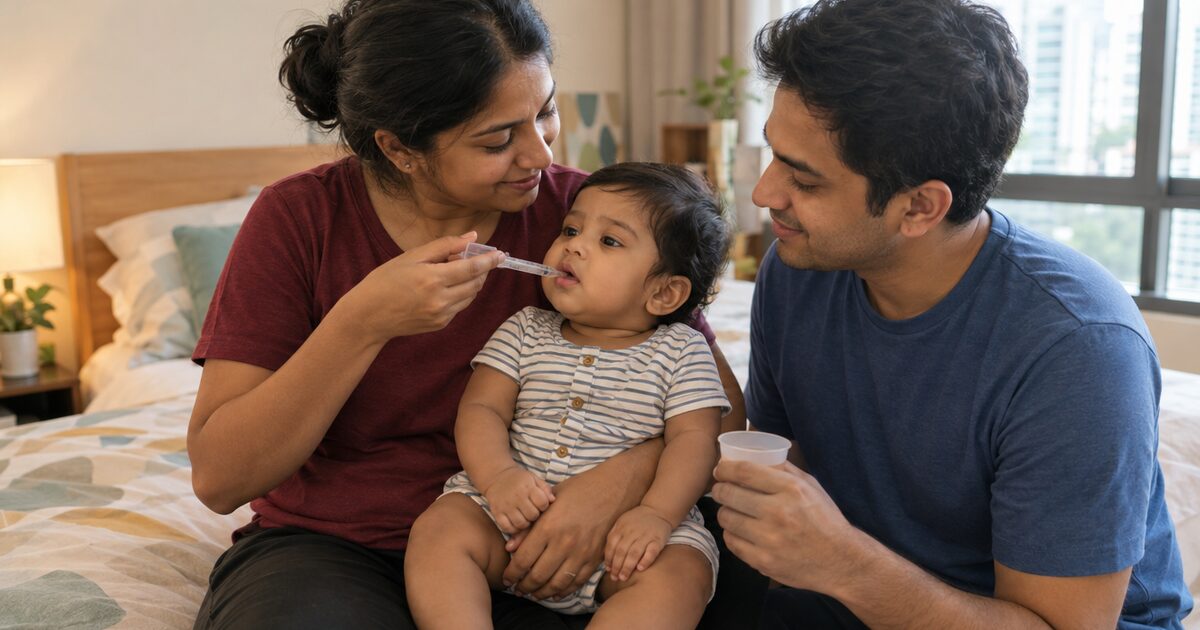
The short answer to how to give medicine to a baby: sit your baby up, draw the dose into the oral syringe that came with the medicine, and squirt it slowly inside the cheek, a little at a time. The dose itself comes from the label, your pharmacist or your doctor.
How to give liquid medicine to a baby, step by step
- Wash your hands and check the label for the medicine's name and strength. The AAP says infant and children's versions of one medicine can differ in strength.
- Shake the bottle well, as Medicines for Children advises.
- Use the syringe, dropper or cup from the box, or one made for medicines, as HSA advises. Medicines for Children says a kitchen teaspoon won't give the right amount.
- Pull off any small cap on the syringe tip and bin it, because the AAP warns it could choke your child.
- Draw up the dose and match the number to the label. The AAP points out that 0.5 mL is not 5 mL, and a mix-up can mean 10 times the medicine.
- Hold your baby sitting up in the crook of your arm, since Medicines for Children says your child should be sitting up or standing.
- Put the syringe tip inside the cheek, away from the back of the throat, and push slowly. Medicines for Children says a fast push can make your child choke.
- Pause after each small squirt so your baby can swallow, then offer a drink of milk to wash the taste away.
- Write down the time and the amount you gave. The NHS says a written note keeps doses spaced out and helps you avoid giving too much.
- Wash the syringe straight away in fresh, soapy water and rinse it in clean water.
Paracetamol vs ibuprofen for a child: what each is for
Both ease pain and fever. The NHS says paracetamol relieves pain and high temperature, while ibuprofen also treats swelling but can cause more side effects, so the NHS suggests paracetamol first if it suits your child. Take a reading first: see how to take a baby's temperature. Whether a fever needs medicine at all is covered in our guide to baby fever in Singapore.
Singapore hospitals start both medicines later than UK guidance. KKH says no paracetamol under 3 months and no ibuprofen under 6 months, and NUH says a baby under 1 month gets no medicine at home without a doctor's advice. The NHS allows most children over 2 months to have paracetamol and most over 3 months to have ibuprofen, but your own doctor's advice comes first. Our baby age calculator gives your baby's exact age in months.
| Medicine | Youngest age in official advice | Also know |
|---|---|---|
| Paracetamol | Not under 3 months, says KKH; the NHS (UK) allows most children over 2 months | HSA says to check cough and cold mixes for the same ingredient |
| Ibuprofen | 6 months and up, say KKH and NUH; the NHS allows most children over 3 months | KKH says not with severe vomiting or a bleeding disorder, and the NHS says it may not suit a child with asthma |
| Diclofenac suppositories | Not under 1 year unless your doctor advises, says KKH | KKH says never at the same time as ibuprofen, as both belong to the same class of medicine |
| Cough and cold medicines | Under 2, ask a doctor first, says HSA | HSA says never to use them just to make a child sleepy |
| Codeine | 12 and up, for a dry cough or moderate pain, says HSA | HSA says it's not for pain after tonsil or adenoid surgery in anyone under 18 |
| Aspirin | Never give it to your child, says HealthHub | HealthHub links it to Reye's syndrome, which causes swelling in the liver and brain |
Why you don't give both, or double up
The NHS says not to give ibuprofen and paracetamol at the same time, and to alternate them only if a doctor or nurse tells you to. KKH's fever advice brings in ibuprofen only when a fever stays high after paracetamol, which is a plan for your doctor to set.
Doubling up can also happen by accident, since HSA warns that two medicines with the same ingredient can add up to an overdose, and HealthHub says paracetamol poisoning can happen when a caregiver gives the same medicine from two different doctors. So show each doctor every medicine your child already takes.
Eye drops, ear drops and suppositories
For eye drops, lie your baby down, wrapped in a blanket, with a second adult holding the head. Medicines for Children says to place the drop in the inner corner of a baby's eye, where it drains in even with the eye closed if you keep the head still for a few seconds, and not to try more than twice. Give drops before ointment, then wait 5 minutes before the next one, as HealthHub advises.
For ear drops, SingHealth says to warm the bottle by rolling it between your palms and lie your child on their side, affected ear up. Gently pull the lower ear down and back for a child under 3, or the upper ear up and back for an older child. Then rub the small flap in front of the ear and keep the head tilted for a few minutes.
For a suppository, Medicines for Children says to lie your child on their side, push it in gently about 2 cm, rounded end first, and keep them lying down for about 15 minutes. If your child poos within those 15 minutes, it says you'll need to give another one.
Stir liquid medicine into milk or juice only if your doctor or pharmacist says that medicine allows it, since Medicines for Children says your child must then drink all of it straight away. A baby who leaves half a bottle has had half the dose.
If your baby spits it out or vomits
The general rule from Medicines for Children: a child who vomits more than 30 minutes after a dose usually doesn't need another, and one who vomits within 30 minutes gets the same dose again. Some medicines have their own rule, so check the leaflet or ask your pharmacist before you repeat anything.
If your baby spat or dribbled out part of a dose, the Medicines for Children parents booklet says not to give more, because nobody can tell how much went down.
Helping an older child swallow a tablet
There's no right age to start, says the Medicines for Children tablet guide. Practise when your child needs a medicine anyway, and keep it calm and low-key.
- Sip some water first, since a dry mouth makes swallowing harder.
- Put the tablet in the middle of the tongue, then take a big sip and swallow straight away.
- Keep the head level or tilted a little to one side, because leaning back makes it harder.
- Try a straw, or seal the lips around a water bottle and suck.
- If you use food, agree on it together first, as the guide says not to hide tablets in food.
Medicines for Children says some tablets can be crushed into a little yoghurt or jam, but only when your child can't swallow them whole, and only after you've checked with your doctor or pharmacist. Enteric-coated tablets, which have a coating to protect the stomach, must never be crushed. A tablet shouldn't be chewed unless it says chewable, or taken with a hot drink that can dissolve the coating. HealthHub also says not to call medicine sweets, so children don't go looking for more.
Storing medicine, and sharing doses with helpers and grandparents
HealthHub says to keep medicine on a high shelf or in a locked box, in its original labelled bottle, somewhere cool and dry, away from direct sunlight. Some need the fridge, so read the label. Write the opening date on liquids and drops, because Medicines for Children says opened eye drops normally last no more than 28 days. Our baby medicine and first aid kit checklist lets you tick off what to keep at home.
When a helper or grandparent gives some doses, keep one written log beside the medicine for everyone to fill in. The AAP suggests asking your pharmacist to mark the right line on the syringe and to write the instructions in the language the person giving it reads best. Never give your baby medicine prescribed for another child, HealthHub says. If coughs and colds keep coming, our guide to children falling sick at childcare explains why.
When to see a doctor
Take a question that can wait to your GP or polyclinic, which KKH says is faster and cheaper for non-emergencies. For any sign below, go to the KKH Children's Emergency or the NUH 24-hour Children's Emergency, or call 995.
- A swollen face, eyes, lips or tongue, trouble breathing, or an itchy rash all over after a medicine. HealthHub says to stop the medicine and see a doctor straight away.
- A rash with breathlessness, chest tightness, dizziness, trouble swallowing or vomiting. SingHealth says this can be anaphylaxis, which is an emergency, so call 995.
- Your child swallowed someone else's medicine, or more than the label says. KKH lists suspected poisoning as a Children's Emergency case, and HealthHub says not to give food and to note the time and what was taken, so bring the bottle with you.
- Unusual sleepiness, confusion, or hard or noisy breathing after a codeine medicine, which HSA says needs medical help at once.
- Vomiting so often that your child can't keep fluids down, which KKH lists as an emergency.
- Any illness or fever in a baby under 3 months, which KKH says needs the Children's Emergency.
- Cold symptoms that don't improve, get worse or come with a fever. HSA says to see a doctor.
Keep our baby choking first aid guide handy, and find a children's clinic near you with our paediatrician map.
Frequently asked questions
Giving medicine to a baby who refuses it: what helps?
Use the syringe, aim inside the cheek and give small squirts with pauses, then a drink of milk to hide the taste. If your baby still won't take it, ask your doctor or pharmacist about another form, since the NHS lists paracetamol as a liquid, tablets and suppositories.
Paracetamol vs ibuprofen for my child: which one should I use?
The NHS suggests paracetamol first, as ibuprofen can cause more side effects, and KKH and NUH say ibuprofen is for babies 6 months and older. Don't give both at the same time or alternate them unless your doctor tells you how.
How can I help my child swallow pills?
Start when your child needs a medicine anyway and is willing, and follow the tablet steps above. If it doesn't work, Medicines for Children says to give the liquid and try again another time.
Can I crush a tablet or mix medicine into milk?
Only if your doctor or pharmacist says that medicine allows it, and never with enteric-coated tablets. Your child then has to finish the whole drink or spoonful straight away to get the full dose.
Can I give cough medicine to my baby?
For children under 2, HSA says to ask a doctor first whether medicine is needed at all. HSA says cough and cold medicines don't cure a cold or shorten it, and suggests plenty of fluids, saline nose drops and gentle suction with a bulb syringe instead.
How long can I keep children's medicine once it's open?
Check the label. Some liquids don't keep long once opened, which is why Medicines for Children says to write the start date on the bottle, and opened eye drops normally last no more than 28 days. HealthHub says to throw out expired medicine.
- Health Sciences Authority, Cough and cold medicines for children: what you should know (read 5 Nov 2026)
- HealthHub (Health Promotion Board), Keep your home free from these safety hazards (read 5 Nov 2026)
- HealthHub, Ibuprofen medication information (read 5 Nov 2026)
- SingHealth and KK Women's and Children's Hospital, Fever in children (read 5 Nov 2026)
- National University Hospital, Fever (children) (read 5 Nov 2026)
- KK Women's and Children's Hospital, Emergency childhood illnesses (read 5 Nov 2026)
- NHS, Ibuprofen for children (read 5 Nov 2026)
- Medicines for Children (RCPCH, NPPG, WellChild), How to give liquid medicine using an oral syringe (read 5 Nov 2026)

Baby blocked nose: how to clear it, and which breathing sounds need a doctor
Baby blocked nose? Saline drops, then gentle suction, as KKH and NUH advise. Plus a table of noisy breathing sounds and ...
8 min read
Baby Choking First Aid: What Every Singapore Parent Should Know
Baby choking first aid in Singapore: spot true choking, do infant back blows and chest thrusts, know when to call 995, a...
11 min read
Baby colic, reflux and gripe water: what Singapore doctors advise and when to worry
Baby colic and reflux in Singapore: what KKH, NUH and HealthHub say about gripe water and gas drops, how to soothe cryin...
12 min read