

Baby blocked nose: how to clear it, and which breathing sounds need a doctor
In this article
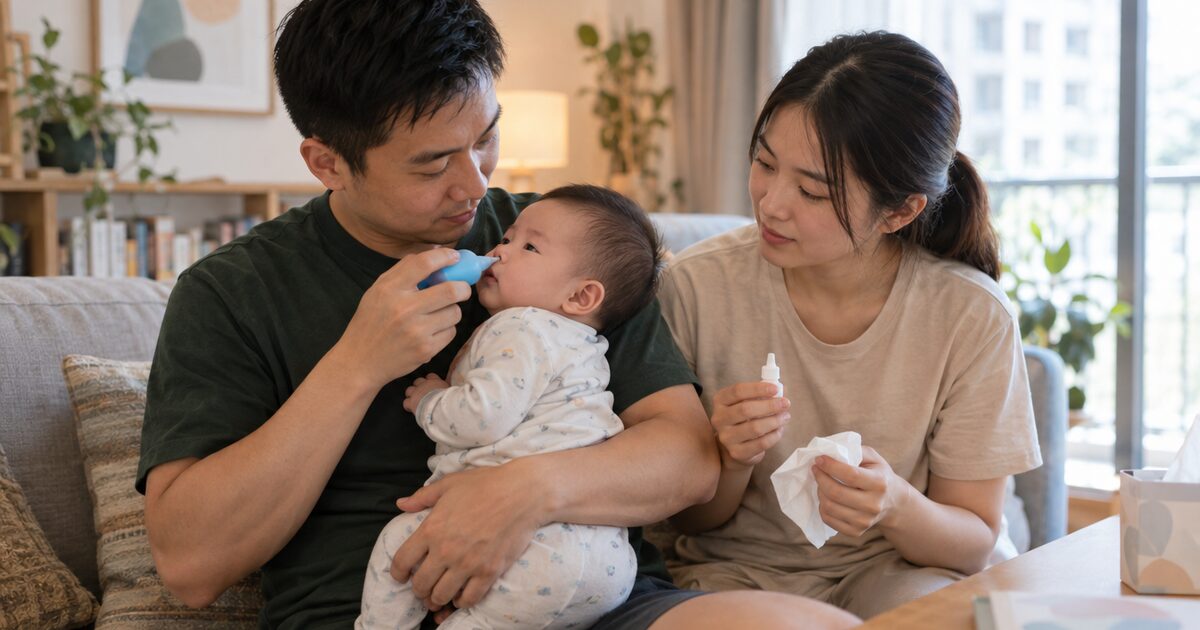
For a baby blocked nose, you need two things: saline drops to loosen the mucus, then gentle suction. That's the pair KKH and HSA name. Most snorts and snuffles in a newborn come from dried mucus, says the AAP. Grunting, wheezing, fast breathing or a chest that sinks in with each breath are different. The table below shows where each sound sends you.
How to clear your baby's blocked nose, step by step
- Drip saline into one nostril, then the other. NUH says three drops a side, and the AAP says 2 to 3.
- Wait about one minute before you suction, as NUH advises.
- Suction gently with a bulb syringe or a small manual suction device, whichever you have.
- Keep cotton buds out of the nose. The AAP says they can injure its lining.
- Do it just before feeds and sleep, up to 3 to 4 times a day (NUH).
- Hold your baby upright while awake. The NHS says this helps a baby with bronchiolitis breathe more easily.
- Offer smaller feeds more often, as NUH and the NHS both suggest. If latching gets hard, the AAP says expressed milk in a cup or bottle may work.
- Stop the room air drying out. The AAP suggests a humidifier when the air at home is dry, and KKH suggests a room of about 25 degrees C with the cot out of any draught.
- Leave cough and cold medicines on the shelf. HSA says a child under 2 needs a medical professional's advice first, and the NHS says decongestants are not for children under 6.
- Keep medicated oils and rubs off your baby unless your doctor says otherwise. Raising Children says inhaled eucalyptus or other essential oils can irritate or even burn some children's airways.
Noisy baby breathing: what each sound may mean
Plenty of newborn noises are normal. The AAP counts snorting, throat gurgles and short pauses as normal in a comfortable baby. Use the table to sort what you hear. If a sound is new to you, KKH lists breathing that is noisier or takes more effort as a reason to see a polyclinic or Children's Emergency.
| Sound | What it may mean | What to do |
|---|---|---|
| Snorting or snuffling, baby feeding well | Dried mucus in the nose, most likely not a cold (AAP) | Saline drops, then suction if needed |
| Gurgling in the throat, louder in sleep | Air passing through saliva or milk (AAP) | Nothing; the AAP says babies slowly learn to swallow more often |
| Pauses under 10 seconds, then a few quick breaths | Periodic breathing, normal if your baby is comfortable, usually gone by 1 month (AAP) | Call your doctor if a pause lasts more than 10 seconds (AAP) |
| Whistling or wheezing | Can be bronchiolitis, an infection of the small airways (NHS, NUH) | Go to a Children's Emergency; KKH lists wheezing and noisy breathing |
| High-pitched sound on breathing in, often with a barking cough | Stridor, which NUH links to croup | See a doctor as soon as possible (NUH) |
| Grunting or moaning with each breath | Difficulty breathing (NHS) | Call 995; the AAP treats it as an emergency |
| Neck, chest or tummy sinking in with each breath | Recessions, which the WHO calls chest indrawing (NUH, WHO) | Go to a Children's Emergency now (NHS) |
| Fast breathing | Over 60 a minute in a newborn (SGH); 40 to 50 counts as fast under age 2 (NUH) | Get medical help now (SGH) |
The WHO uses fast breathing or lower chest wall indrawing to diagnose pneumonia in children under 5 who have a cough or trouble breathing. NUH says doctors at the clinic or Children's Emergency check your child's breathing rate and oxygen levels.
How to count your baby's breaths
Count how many times the tummy or chest rises in one full minute. The AAP says to watch the rib cage as your baby breathes in. If it caves in under the neck, your baby is working hard to breathe.
- Newborn: the AAP puts a normal rate below 60 a minute. SGH says a rate that stays over 60 needs medical help at once.
- Under 2: NUH says normal rates differ by age, but generally 40 to 50 a minute counts as fast.
- Pauses: under 10 seconds is normal in a newborn, the AAP says. Longer ones need a doctor.
Why babies get blocked noses
The AAP says most nose noises in a newborn come from dried mucus, and your baby most likely doesn't have a cold. You notice it most at feeds, because your baby can't breathe through the mouth while it's closed around the breast or bottle, so a blocked nose gets in the way of feeding.
Colds block the nose as well, and HSA says one usually lasts about a week, and medicines don't cure it or make it shorter. If your baby has started infant care, our guide on why children keep getting sick at childcare covers that stretch.
Smoke, dust and strong smells can also cause a stuffy nose or sneezing, the AAP says, and sneezing helps a newborn open the nose. For haze days, read haze and kids in Singapore. For aircon and outings, our guide on when a newborn can go outside has the detail.
Which baby nasal aspirator to use
Singapore hospital pages name a type, never a brand: KKH and HSA mention a bulb syringe, and NUH a small manual suction device. Put saline in first, because the AAP says the drops loosen dried mucus so your baby can sneeze it out or swallow it, and to reach for a suction bulb only if needed.
- Use gentle suction with a bulb syringe, as HSA advises.
- Do the drops one side at a time, as the AAP describes.
- Stop at 3 to 4 times a day (NUH).
- Clean and dry the aspirator the way its leaflet says.
- It clears the nose only. NUH says nose washes won't remove the phlegm in the small airways.
How to tell the blocked nose is affecting feeds
The AAP says a baby with a cold may feed more slowly or lose interest, because breathing is hard. SGH says a baby should suck, swallow and breathe smoothly during feeds. Watch for these:
- Refusing feeds several times in a row: KKH says go to a polyclinic or Children's Emergency.
- No wet nappy in six to eight hours, with dry lips: KKH says see a doctor.
- Blue lips, repeated choking, or pauses in breathing during a feed: SGH says get medical help at once.
NUH says a baby who isn't eating and drinking well may need a hospital stay for fluids. For normal amounts by age, see our newborn feeding guide.
RSV and bronchiolitis
Bronchiolitis is an infection of the small airways in the lungs, NUH says, and it mostly affects children under 2. RSV is one of the viruses behind it. KKH says it starts like a cold. Babies are usually sick for three to five days and recover over the next three, though the cough can last two to three weeks.
The NHS says almost all children catch RSV before age 2. Babies under 6 months and babies born early are more likely to get seriously ill. Antibiotics generally don't help, NUH says, because a virus causes it. At home, the steps above still apply, with smaller feeds and your baby held upright.
When to see a doctor
Go to a Children's Emergency, or call 995, if your baby has any of these:
- Grunting, a tummy that sucks in under the ribs, or fast, hard breathing (NHS)
- Pauses in breathing (NHS), or a pause longer than 10 seconds (AAP)
- Blue or grey skin, lips or tongue (NHS), or a pale, ashen look (KKH)
- Over 60 breaths a minute in a newborn, and it stays that high (SGH)
- Wheezing, noisy breathing, or too breathless to drink (KKH)
- Poor feeding, or vomiting that keeps nothing down (KKH)
- Any fever or illness under 3 months old (KKH). Our baby fever guide has the temperatures.
- Floppiness, or not waking up or staying awake (NHS)
- Something stuck in the nose (KKH)
See a GP or polyclinic for a cold in a baby under 2. HealthHub lists children under 2 among those who should see a doctor for a cold. HSA says to go when cold symptoms don't improve, get worse or come with a fever. NUH adds a phlegmy cough that lasts over a week without improving.
Where to go: KKH says a GP or polyclinic is faster and cheaper for a cold with none of the signs above. KKH runs a Children's Emergency, and NUH's Children's Emergency is open 24 hours at NUH Main Building, Zone F, Level 1. Call 995 in an emergency. Our paediatrician map can help you find a doctor near home, and newborn care basics covers the first weeks.
Frequently asked questions
How do I unblock my baby's nose?
Drip in saline, wait about a minute, then suction gently with a bulb syringe or small manual suction device. NUH says you can do this up to 3 to 4 times a day, before feeds and sleep. Keep cotton buds out, which the AAP says can injure the nose.
Is a baby nasal aspirator safe for a newborn?
Used gently, it's what KKH, NUH and HSA suggest for babies. Put saline in first, because the AAP says the drops loosen dried mucus and suction is only for when it stays stuck. Keep to NUH's limit of 3 to 4 times a day.
Is noisy baby breathing normal?
Often, yes. The AAP calls snorting from dried mucus, throat gurgles and pauses under 10 seconds normal in a comfortable newborn. Grunting, wheezing, a high-pitched sound on breathing in, or a chest that sinks in with each breath need a doctor.
Can I give my baby cold medicine for a blocked nose?
Not without advice. HSA says children under 2 should see a medical professional before any cough or cold medicine, and KKH says most over-the-counter ones aren't recommended under 2. The NHS says decongestants are not for children under 6, and HealthHub says no honey under 1.
Can I use medicated oil or a vapour rub on my baby?
Ask your doctor first. Raising Children says inhaled eucalyptus or other essential oils can irritate or even burn some children's airways. The AAP lists a mentholated rub as a home remedy only for children 2 and older.
Can I keep breastfeeding if my baby or I have a cold?
Yes. The AAP says breastfeeding is still recommended for babies with colds, and expressed milk in a cup or bottle may help if latching is hard. If you have the cough, KKH says wear a mask, and you can keep breastfeeding.
- KK Women's and Children's Hospital (SingHealth), Cough and Colds: use of cough and cold medicines in young children (read 5 Nov 2026)
- Health Sciences Authority, Cough and cold medicines for children: what you should know (read 5 Nov 2026)
- National University Hospital, Bronchiolitis (Children) (read 5 Nov 2026)
- KK Women's and Children's Hospital, How to use the Children's Emergency wisely (read 5 Nov 2026)
- Singapore General Hospital AHPedia, When should I be concerned about my baby's breathing during feeding? (read 5 Nov 2026)
- HealthHub, Common cold (read 5 Nov 2026)
- NHS, Bronchiolitis (read 5 Nov 2026)
- American Academy of Pediatrics, HealthyChildren.org, Newborn reflexes and behavior: breathing sounds and patterns (read 5 Nov 2026)
Baby Choking First Aid: What Every Singapore Parent Should Know
Baby choking first aid in Singapore: spot true choking, do infant back blows and chest thrusts, know when to call 995, a...
11 min read
Baby colic, reflux and gripe water: what Singapore doctors advise and when to worry
Baby colic and reflux in Singapore: what KKH, NUH and HealthHub say about gripe water and gas drops, how to soothe cryin...
12 min read
Baby Eczema in Singapore: Calm Skin in a Hot, Humid Climate
A calm, practical guide to baby eczema in Singapore: hot, humid-climate triggers, soak-and-seal moisturising, managing t...
11 min read