

Best Strollers in Singapore: A Parent's Buying Guide
In this article
- The main types of strollers, explained
- The Singapore tests that matter most
- Newborn readiness: what under-six-months needs
- Safety basics to check on any stroller
- Match the stroller to how your family lives
- Budget tiers and where the money goes
- New versus preloved
- What to keep in the basket
- A quick pre-purchase checklist
- Frequently asked questions
Buying a stroller in Singapore feels much bigger once you are standing in the shop with ten models in front of you and a sales rep folding each one a different way. The good news is that the best stroller is not the most expensive or the one with the longest spec sheet. It is the one that suits your home, your daily routes, and how your family actually gets around. This guide is for parents who want to choose well rather than be told what to buy. It walks through the stroller types, the Singapore-specific tests that really matter, what to check for a newborn, the safety basics, and how to think about budget in broad ranges, without declaring a winner or quoting prices that go stale in a month. You will leave able to judge any stroller you push, and confident enough to test the final two yourself before paying.
The main types of strollers, explained
Most strollers fall into a handful of categories. Knowing the differences saves you from paying for features you will never use, or buying something too flimsy for daily life with a growing toddler. Many families own more than one over the years, so do not feel you must find a single do-everything model.
- Full-size strollers: heavier and bulkier, but with plush seats, deep recline, large canopies, good suspension, and a roomy basket. Best when comfort and longevity beat packing small; many have reversible seats so baby faces you or out.
- Travel systems: a frame plus a compatible infant car seat (and sometimes a carrycot) that click on and off, so a sleeping baby moves from car to stroller without waking. Confirm the car seat and frame are actually compatible.
- Lightweight and compact (cabin) strollers: lighter, fold smaller, often one-hand fold, great for buses, MRT, taxis, and travel. Some fold small enough for an aircraft cabin (confirm with your airline). Trade-off: smaller canopy and less storage.
- Ultra-compact one-hand-fold strollers: collapse to roughly the size of a small backpack and pop open in seconds, brilliant for taxi boots and crowded buses, though better for shorter outings than long days of pavement-pounding.
- Double and tandem strollers: two children side-by-side or one behind the other, for twins or close siblings. Side-by-side models can be wide for gantries and shop doors, so check the width.
- Jogging strollers: three larger wheels and firm suspension for running and rougher park connectors. Smooth on the move, but bulkier to store and overkill for mostly malls and MRT.
- Convertible and modular strollers: grow with your family, switching single to double or swapping seat units. Pricier upfront, but cheaper across several years and two children.
The Singapore tests that matter most
A stroller that scores well on an overseas review site can still be wrong for an HDB lift lobby and a sweaty afternoon at the bus stop. Run any model through these local tests first.
Narrow enough for MRT faregates and shop doors
MRT faregates and many shop and cafe doorways are narrower than they look once you add a stroller, a bag on the handle, and a toddler, and the wide gates are not at every entrance. A slimmer width makes daily life smoother. If you live in a flat where every inch counts, measure your front door and lift before falling for a wide model.
One-hand fold for buses and quick pickups
This sounds like a gimmick until you are juggling a toddler, a diaper bag, and a closing bus door. A quick, reliable fold you can do without putting your child down is one of the most useful real-world features, and it speeds up Grab and taxi pickups.
Folds small enough for a taxi or Grab boot
Most taxis and private-hire cars have modest boots, often shared with shopping, so picture the folded stroller going into a sedan, not an SUV. Ultra-compact and lightweight models win here; some full-size strollers only fit if you remove a wheel or seat, no fun in the rain with a tired child.
Handles our humidity, heat, and sudden rain
Our sun and surprise downpours are relentless. Look for a large, extendable canopy, ideally with UPF protection and a peek-a-boo window. Breathable, removable, machine-washable fabrics are a quiet lifesaver between humidity, spills, and the occasional milk explosion, and a clip-on rain cover that lives in the basket means a passing shower does not end your outing.
Suspension, recline, and handlebar height
Pavements are mostly smooth, but you will still meet kerb cuts, tactile paving, void-deck thresholds, and the odd rough park connector, so decent suspension and slightly larger wheels help; lean sturdier if you walk a lot at parks, smaller for nimble mall-and-MRT use. A deep, near-flat recline with multiple positions keeps babies comfortable for naps on the go. And if several people will push, an adjustable handlebar saves hunched backs, since tall and shorter pushers rarely agree on height.
Newborn readiness: what under-six-months needs
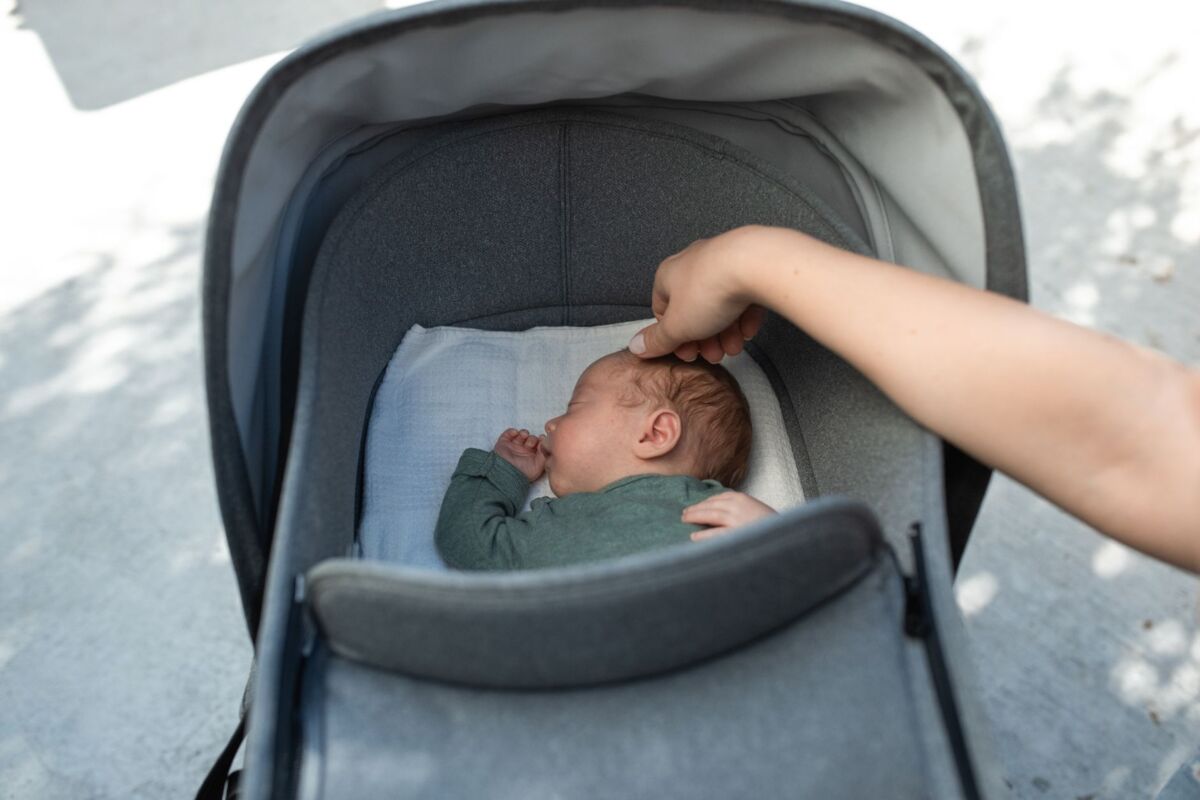
A young baby cannot sit up or hold their head steady, so an upright toddler seat is not suitable from birth. If you are buying before your baby arrives, check how the stroller handles the newborn stage. There are three common options: a fully lie-flat seat that reclines close to horizontal, as many full-size strollers do; a bassinet or carrycot attachment that makes the frame a flat pram for the early months and comes off once baby can sit; or a compatible infant car seat that clicks on as a travel system, ideal if you drive.
Always follow the manufacturer's stated minimum age and weight for each mode, as these vary. Some lightweight strollers only suit babies from around six months unless you add a carrycot or use a car seat. If you plan to babywear early on, a compact stroller useful from six months can be a lighter, sensible choice.
Safety basics to check on any stroller
Whatever type you choose, a few safety fundamentals are non-negotiable, and they matter more than colour or brand prestige.
- A secure five-point harness over shoulders, hips, and between the legs, with a buckle that is firm but you can work one-handed.
- Reliable brakes you can engage and release with your foot and that hold firmly on a slope; test them on a gentle ramp in store.
- A recognised safety standard, such as the European EN 1888 or a comparable American ASTM mark, which covers stability, brakes, and locking mechanisms. A standards label is a baseline sign the stroller was tested, not just marketing.
- A locked fold so the frame cannot collapse unexpectedly, plus finger-safe hinges once curious toddlers start helping.
- Stability, so it does not tip backwards when you hang a bag on the handle. A model that tips easily is a real daily hazard.
Match the stroller to how your family lives
Rather than chasing a single best stroller, match the type to your routine. A car-light, MRT-and-bus family is best served by a lightweight or ultra-compact model with a one-hand fold. Drivers doing school runs and malls can justify a full-size stroller or travel system, where boot space and comfort matter more than packing tiny. Frequent travellers want a cabin-friendly compact, with airline rules confirmed in advance. Park-goers and runners benefit from sturdier wheels and suspension, or a true jogging stroller. Families with twins or two under three should look at a double, tandem, or convertible. And if a newborn is arriving soon, confirm the stroller lies flat or takes a carrycot or compatible car seat from birth.
Budget tiers and where the money goes
Stroller prices here span an enormous range and shift with sales, so treat these tiers as broad guidance and verify current prices yourself. Budget cabin and lightweight strollers cover the essentials: a one-hand fold, basic canopy, and usable recline, ideal as a second, travel, or grandparents' stroller. Mid-range strollers add better suspension, larger canopies, more recline positions, and sturdier frames that last through the toddler years. Premium and full-size travel systems are the priciest, with reversible seats, plush rides, modular bassinets and car-seat compatibility, and a convert-to-double option, the cost spreading across years if you plan more than one child.
Prices tend to soften during the mid-year Great Singapore Sale and the year-end online sales, so plan around them if your due date allows. Buying in your second trimester leaves time to test and assemble without last-minute pressure, and our planning tools help you slot the stroller into the bigger baby budget.
New versus preloved
Strollers hold their value well here, especially premium brands, so the secondhand market on resale marketplaces and parenting groups is active. A gently used quality stroller can outperform a brand-new budget one for the same money. It just needs a bit more care.
- Inspect the frame for cracks, bends, or rust, especially around the fold joints and seat mounts.
- Test the fold lock several times, and check the harness buckle clicks in firmly and releases cleanly with no fraying straps.
- Roll it and brake it to feel for wobbly wheels or flat spots, and test the brakes on a slope.
- Ask about recalls and missing parts, since covers, baskets, and inserts are pricey to replace. Local warranty support usually does not transfer to a second owner, and cheap parallel imports may have no local service at all.
What to keep in the basket
A few low-cost add-ons make our climate far more manageable: a rain cover that fits your model, a clip-on sunshade or muslin for when the canopy is not enough, and a small fan or breathable mosquito net for parks, never blowing directly on a young baby. A couple of stroller hooks help with bags, used in moderation so you do not tip the frame, and a compact change mat and spare clothes are handy, since nursing and diaper-change facilities are common in malls but not guaranteed everywhere. Related reading: our guides to the best breast pumps in Singapore.
A quick pre-purchase checklist
- Measure your boot, front door, and lift lobby for the maximum folded and unfolded size that works.
- Confirm the recline and harness suit your child's age, and whether it works from birth or needs a carrycot or car seat.
- Check canopy coverage, UPF, washable fabrics, and whether a rain cover is included.
- Look for a recognised safety standard, a five-point harness, and brakes that hold on a slope.
- Test the fold one-handed, and check the handlebar height for everyone who will push.
- Read up on current bus and MRT stroller rules before relying on public transport.
Frequently asked questions
Can I bring an open stroller onto the MRT and buses?
Yes. MRT stations have lifts and ramps, so a heavier stroller is easier to manage on the train than on a bus. Open strollers are allowed on public buses too, though wheelchair users have priority in the designated space and a bus captain can ask you to fold if the bus is crowded or the stroller obstructs others. Operators advise an open stroller be no more than about 1.2m long and 70cm wide. Rules can change, so confirm the latest with SBS Transit and Tower Transit.
Lightweight or full-size for Singapore?
If you mostly use public transport and live in a compact home, lightweight usually wins. If you drive and value comfort and a long lifespan, full-size is worth the bulk. Many families end up with one of each, using the full-size for serious outings and a compact for travel and the grandparents' place.
Do I need a travel system?
Only if you drive often with a newborn and want to move a sleeping baby from car to stroller without unbuckling. Otherwise a stroller that reclines flat or takes a carrycot may be all you need. If you do go this route, confirm your chosen car seat is genuinely compatible with the frame, since not every seat fits every stroller.
Is it safe to buy a secondhand stroller?
It can be, if you inspect it carefully: check the frame for cracks, test the fold lock and brakes, make sure the harness buckle works cleanly, and ask about any recall. Premium strollers in good condition can be excellent value preloved, but local warranty support generally does not transfer to a second owner.
When is the best time to buy a stroller?
Many parents buy in the second trimester, leaving time to test models, assemble, and practise the fold before the baby arrives. If your timing is flexible, the mid-year Great Singapore Sale and year-end online sales often bring better prices. Confirm the current price and warranty terms before you commit.
A stroller rarely travels alone, so plan the rest of your gear at the same time. If you want to babywear early on, the best baby carriers in Singapore pair naturally with a six-month-plus compact stroller, and drivers should read up on the best car seats in Singapore before committing to a travel system. Keeping the load light is easier with the right diaper bag, and the baby fairs in Singapore let you push a few models back to back. For more gear guides, browse the style hub.

Art Jamming in Singapore: A Family Guide to Painting and Art Fun
Your parent's guide to art jamming in Singapore: what it is, the best ages, studio vs cafe vs at-home, what to bring, ro...
11 min read
Baby Fairs in Singapore: A Parent's Guide to Deals, Dates and Smart Shopping
A practical guide to baby fairs in Singapore: where they run, what to buy and skip, how to spot real deals, what to brin...
10 min read
Best Baby Swaddles and Sleep Sacks in Singapore
How to choose safe, breathable baby swaddles and sleep sacks in Singapore's hot climate, when to stop swaddling, and wha...
9 min read