

Dry drowning signs in children: what to watch for after a pool scare, supervision rules and water safety in Singapore
In this article
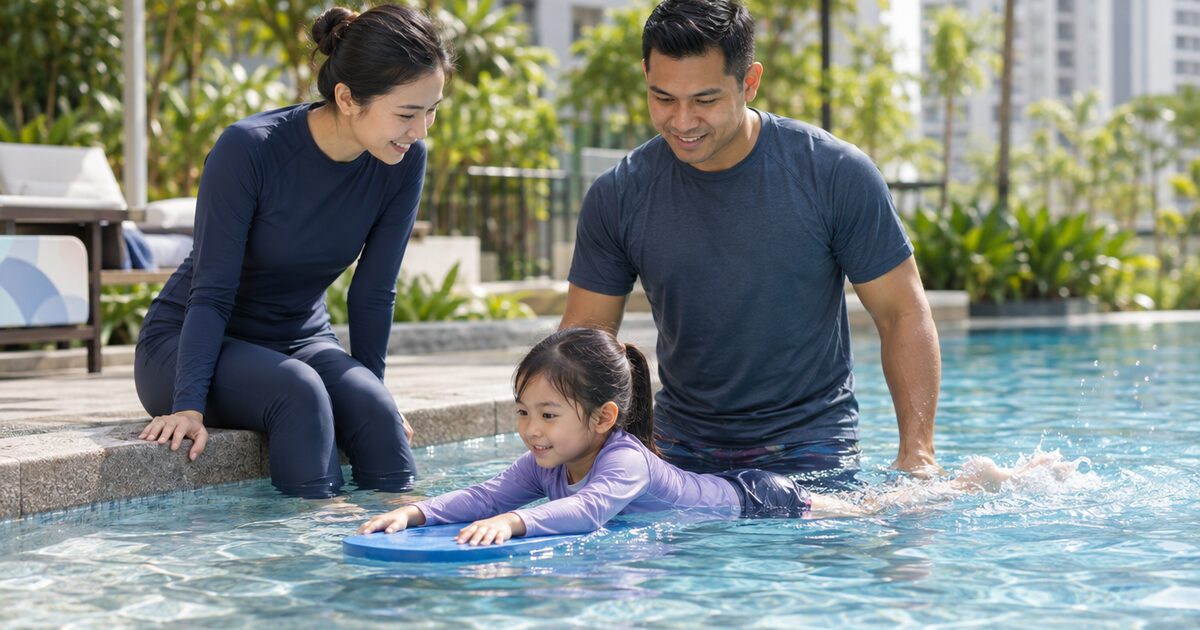
The signs to watch for after a child has a scare in the water, sometimes called dry drowning or secondary drowning, are a cough that does not stop, chest pain, difficulty or shallow breathing, and unusual tiredness or drowsiness. SGH's emergency doctors, writing in HealthXchange, say delayed drowning can happen within 8 hours of a rescue because a little water stays in the lungs, and that it may have no symptoms at first, so always get your child checked by a doctor after being pulled from the water, even if they seem fine. Call 995 for a child who is blue, struggling to breathe, unusually drowsy or not breathing. Prevention is simpler than any of this: an adult within arm's reach of every young child in water, which ActiveSG requires for children six and under at public pools.
What "dry drowning" actually means
You will see several terms online, and they overlap. SGH's emergency doctors use them like this:
| Term | What happens | When |
|---|---|---|
| Dry drowning | Water reaches the voice box and causes a spasm (laryngospasm) that closes the airway completely | During the event |
| Wet drowning | The spasm is only partial, so water enters the lungs | During the event |
| Delayed or secondary drowning | A small amount of water left in the lungs causes breathing problems after the rescue | Within 8 hours |
The World Health Organization treats drowning as one process, breathing trouble from being under or in water, with outcomes that range from no harm at all to death. For parents, the names matter less than the rule: any child who needed rescuing, swallowed or breathed in water and coughed hard needs watching, and a doctor's check.
Dry drowning signs: what to watch for after a water scare
SGH's emergency doctors list these symptoms of delayed drowning. Watch for them closely for the rest of the day.
Signs to watch for after a water scare
Breathing
Behaviour
SGH's advice is clear: delayed drowning may not show symptoms, so always seek emergency care after a rescue from drowning, even if your child appears fine. A doctor can listen to the chest and check oxygen levels.
What real drowning looks like
Drowning rarely looks like it does in films. SGH's doctors say real drowning victims stay quiet because they are struggling to breathe. The Singapore Life Saving Society, quoted in HealthXchange, lists these signs:
- The child cannot call for help.
- The body stays upright in the water, with no kicking.
- The child is completely limp.
The US CDC says drowning happens in seconds and is often silent, which is why watching matters more than listening.
If you see a child drowning
- Shout for help and get a lifeguard if there is one.
- Reach or throw, do not jump in unless you are trained: hold out a long pole, or throw a float or rescue tube, as the Singapore Life Saving Society advises.
- Once the child is out, check breathing. If they are not breathing, start CPR and call 995.
- Even if your child recovers quickly, see a doctor the same day.
HealthHub urges parents to learn CPR and how to use an AED. Many community and first-aid providers run short courses.
Pool rules and supervision in Singapore
| Rule or tip | What it says | Source |
|---|---|---|
| Arm's reach | Children aged 6 and under must be accompanied by an adult and kept within arm's reach at ActiveSG pools | ActiveSG rules |
| No distractions | An adult within arm's length, with no phone or reading | HealthHub |
| A water watcher | At parties, adults take turns to be the one watching; the AAP suggests swapping every 15 to 20 minutes | HealthHub, AAP |
| Floats | Flotation devices are not life-saving devices | HealthHub |
| Big inflatables | Giant floats and rafts are not allowed at ActiveSG pools without approval | ActiveSG rules |
| Swim nappies | ActiveSG lists diapers as attire that is not permitted; check your pool's rules | ActiveSG rules |
| Thunder and lightning | Everyone leaves the pool | ActiveSG rules |
| Breath-holding games | Prolonged breath-holding is not allowed | ActiveSG rules |
Lifeguards watch a whole pool, not your child, so stay close even when they are on duty, as the CDC advises. In a condo, check whether the pool has a lifeguard on duty, and assume it does not.
Water safety at home and on holiday
Babies and toddlers can drown in very little water at home. HealthHub's advice:
- Never leave a baby alone in the bath, even for a moment. Babies can drown in as little as 5cm of water.
- Empty pails and the bathtub straight after use, and keep toilet lids closed.
- Fence home pools on all four sides, at least 1.2m high, with a latched gate.
- Teach water safety and survival skills before children swim in the sea or other open water, and keep them out of the water in bad weather.
The AAP adds that children should not bathe alone until at least age six.
Swimming lessons and SwimSafer
Lessons help, but HealthHub warns not to assume a child is safe because they have learnt to swim. SwimSafer is Sport Singapore's national water-safety programme, taught and assessed by SportSG-accredited instructors, and many schools and swim schools use it. The AAP says children can begin swim lessons after their first birthday. Our guides to swimming lessons for kids in Singapore and public swimming complexes cover SwimSafer stages, ActiveSG pools and costs, and our water play parks guide lists splash areas for younger children.
Frequently asked questions
What are the signs of dry drowning in a child?
A cough that does not settle, difficulty or fast shallow breathing, chest pain, unusual tiredness or drowsiness, and looking pale or blue. Watch closely after any water scare and see a doctor.
How long after swimming can dry drowning happen?
SGH's emergency doctors say delayed (secondary) drowning can happen within 8 hours of a rescue, when a little water remains in the lungs.
Should I take my child to a doctor after they swallow water?
If your child needed rescuing, inhaled water or coughed hard afterwards, yes. SGH advises seeking emergency care after a rescue from drowning even if the person seems fine. If you are unsure whether it was serious, see a doctor anyway.
At what age can my child swim without an adult at a public pool?
At ActiveSG pools, children aged six and under must be accompanied by an adult and kept within arm's reach.
Do floats and armbands keep my child safe?
No. HealthHub says flotation devices are not life-saving devices, so an adult still needs to be within arm's reach.
- HealthXchange (SGH Emergency Medicine), What is drowning? (read 11 October 2026)
- HealthXchange (Singapore Life Saving Society), What to do when someone is drowning (read 11 October 2026)
- HealthXchange, When to take your child to the ER (read 11 October 2026)
- HealthXchange, What to do in a children's emergency (read 11 October 2026)
- HealthHub, Safe home for your baby (read 11 October 2026)
- HealthHub, Keeping your child safe (read 11 October 2026)
- HealthHub, Growing up safe (read 11 October 2026)
- ActiveSG (Sport Singapore), Rules and regulations: swimming complexes (read 11 October 2026)
- ActiveSG Circle, SwimSafer (read 11 October 2026)
- NUH, Children's Emergency (read 11 October 2026)
- KKH, Children's Emergency (read 11 October 2026)
- WHO, Drowning fact sheet (read 11 October 2026)
- CDC (US), Preventing drowning (read 11 October 2026)
- AAP HealthyChildren, Water safety and young children (read 11 October 2026)
Childhood Myopia in Singapore: A Parent's Guide to Signs, Prevention and Eye Checks
A Singapore parent's guide to childhood myopia: why it is so common, early signs, outdoor and screen habits that help, e...
11 min read
Choosing a Paediatrician in Singapore: A Practical Guide for Parents
How to choose a paediatrician in Singapore: GP vs polyclinic vs private PD, cost guidance, vaccinations, first-visit tip...
12 min read
Mosquito Repellent for Kids in Singapore: A Parent's Guide to Dengue Protection
How to choose mosquito repellent for kids in Singapore by age, protect babies from dengue, cover up, use nets, clear sta...
11 min read