

How to burp a baby: three holds, when to burp, and when spit-up needs a doctor

In this article
How to burp a baby comes down to three holds: upright over your shoulder, sitting on your lap, or face down across your lap. In each one you support your baby's head and pat or rub their back for a few minutes. KKH says to burp partway through a feed and again at the end, whether you breastfeed or bottle-feed. If nothing comes up, HealthHub says your baby probably doesn't need to burp.
How to burp a baby, step by step
- Lay a cloth or muslin over your shoulder or lap. HealthHub says normal spit-up usually comes right after a feed or a burp, so expect a little milk.
- Stop partway through the feed for a burp, then burp again at the end, as KKH advises. If your baby is crying hard before a feed, KKH suggests a burp first so they feed better.
- Lift your baby onto your chest with their chin over your shoulder and their tummy against you. Pat or rub their back with your free hand. HealthHub calls this the over-the-shoulder burp.
- Sit your baby on your lap if the shoulder doesn't work. Hold their chin in your hand, lean them forward onto your palm and arm, and pat their back. The NHS says to keep any pressure off the throat.
- Lay your baby face down across your lap for the third hold. The AAP says to keep their head higher than their chest while you pat or rub their back. Raising Children says to skip this hold if your baby brings up a lot of milk.
- Give each hold a few minutes before you switch. If no burp comes after several minutes, the AAP says to carry on feeding, because no baby burps every time.
- Keep your baby upright for 10 to 15 minutes after the last burp. The AAP says this helps the milk stay down.
- Lay your baby on their back on a firm, flat mattress for sleep. HealthHub says on the back for every sleep, naps included.
When to burp a breastfed or bottle-fed baby
Bottle-fed babies usually need more burping. KKH explains why: a baby who latches fully at the breast gets a steady flow at their own pace and swallows less air. With a bottle, air gets in when your baby sucks too fast, cries hard, or sucks while milk doesn't fill the teat.
| Breastfed | Bottle-fed | |
|---|---|---|
| How much air | Usually less, because the mouth latches fully onto the nipple (KKH) | Usually more, from fast sucking, hard crying or a teat that isn't full of milk (KKH) |
| Usual burps | Partway through and at the end (KKH), and when you switch sides (AAP) | Partway through and at the end (KKH), or every 60 to 90ml (AAP) |
| Windy or colicky baby | Every five minutes of feeding (NUH) | After each ounce, about 30ml (NUH) |
| Less air to start with | Ask a lactation consultant to check the latch | Keep the teat full of milk (KKH), and pause every three to five sucks (SGH) |
| No burp after a few minutes | Some breastfed babies swallow little air and may not need to burp (AAP) | Carry on feeding, then burp again at the end (AAP) |
Watch your baby as well as the bottle. If they squirm, pull away or fuss mid-feed, the AAP says it helps to stop and burp, because a baby who fusses while feeding swallows even more air. HealthHub adds that feeding in a slightly reclined position cuts down the air your baby takes in. The pause every three to five sucks is the paced feeding SGH suggests for babies who gulp at the bottle. For how much milk and how often, see our newborn feeding schedule by age.
What to do if your baby won't burp
You don't have to get a burp every time. HealthHub says there's no need to force it, and a baby who doesn't burp after a few minutes probably doesn't need to. Swap to another hold once, then carry on with the feed.
If your baby still seems uncomfortable, NUH suggests holding them securely and massaging the lower tummy. Then check the other common reasons for fussing. HealthHub's newborn guide lists hunger, a dirty nappy, being too hot or too cold, and being tired but unable to sleep. Our guide to why babies cry covers each one. Long daily bouts of crying in a well baby may be colic, and our colic and reflux guide has the feeding and winding tips for that.
How to burp a sleeping baby
If your baby dozes off mid-feed, SGH says it usually means they're full. To keep the feed going, SGH suggests a nappy change, loosening their wrap, or talking softly. If they stay sleepy, let them sleep.
You can still try for a burp. Lift your baby slowly onto your shoulder with their head supported, and rub their back for a few minutes. The shoulder hold is the easiest one to keep a sleeping baby in. If nothing comes, put them down anyway. HealthHub's sleep page puts the burp right before bed, and the place to sleep is the cot, on their back. HealthHub says it isn't safe for babies to sleep on their side or tummy, so move your baby off your lap if they nod off there face down.
Spit-up or vomiting: how to tell
Most young babies spit up. HealthHub says most babies under 6 months do, and KKH says reflux symptoms usually ease by 6 months as the ring of muscle at the end of the food pipe gets stronger. The AAP says spit-up almost never causes choking or harm, even during sleep.
| Normal spit-up | See a doctor | |
|---|---|---|
| When it happens | Right after a feed or a burp (HealthHub) | It starts for the first time after 6 months (NHS) |
| What it looks like | Milk, or slightly curdled milk (HealthHub) | Green, which can mean a blockage (HealthHub), or yellow or bloody (NHS) |
| How much and how hard | Small amounts (KKH) | Projectile (NHS), or large amounts again and again (HealthHub) |
| Your baby | Feeding and growing well (HealthHub) | Poor weight gain, frequent back arching, or refusing milk (KKH) |
A baby who spits up but eats and grows well is no cause for concern, HealthHub says. If reflux seems to bother your baby, read our colic and reflux guide. It has the safe-sleep rules for reflux too.
Grandparents, helpers and confinement nannies
If someone else does some of the feeds, show them the three holds and agree on one routine: burp partway, burp at the end, keep your baby upright, then put them to sleep on their back. A note on the fridge helps when you're out.
Burping is a gentle job. HealthHub says never to shake a newborn or jiggle one on your knee, so swap any firm thumping or bouncing for a soft pat or rub, and give it time.
Some families rub medicated oil on a baby's tummy for wind. HealthHub says to keep medicated oil off the cord stump and out of the belly button, and not to give a baby any medicine without talking to a doctor first. If you're hiring help, our helper interview questions include what to ask about feeding, and our guide to hiring a confinement nanny covers what she does.
When to see a doctor
Get medical help if you notice any of these. The first two need help straight away.
- Blue lips, tongue or face, working hard to breathe, or pauses in breathing during or after a feed. SGH says these need immediate medical attention.
- Fast breathing that doesn't settle, over 60 breaths a minute in a newborn, or frequent choking during feeds (SGH).
- Green spit-up, which HealthHub says may mean a blockage in the intestines.
- Yellow vomit, blood in the vomit, or projectile vomiting (NHS).
- Large amounts of vomit again and again, a bloated or swollen tummy, fever or diarrhoea (HealthHub).
- Signs of dehydration: less or darker urine, crying without tears, or a dry mouth (HealthHub).
- Poor weight gain or weight loss, frequent back arching, or refusing milk (KKH).
- Constant crying for more than three hours, or a baby who seems in pain or unwell (NUH).
For blue colour or breathing trouble, call 995 for an ambulance. For green vomit, projectile vomiting or signs of dehydration, go straight to the Children's Emergency at KKH or NUH. For slow weight gain or a feeding worry that can wait a day, see your GP, polyclinic or paediatrician. Our paediatrician map shows clinics near you.
HealthHub counts 38 degrees C and above as a fever and says a baby under 3 months with one needs a doctor. Our baby fever guide explains the rest. For a breastfed baby who seems to gulp a lot of air, a lactation consultant can check the latch; our breastfeeding support guide lists where to find one. For a baby who gulps and dribbles at the bottle, SGH suggests a paediatric feeding speech therapist. It's also worth learning baby choking first aid.
Frequently asked questions
How long should I burp my baby for?
HealthHub suggests a few minutes, with no need to force it. If no burp comes after several minutes, the AAP says to carry on feeding and try again at the end.
Do breastfed babies need to be burped?
KKH says to burp your baby whether you breastfeed or bottle-feed, though breastfed babies usually swallow less air. The AAP suggests a burp when you switch sides, and says some breastfed babies may not need to burp at all.
How often should I burp a newborn?
Partway through each feed and again at the end, KKH says. With a bottle, the AAP suggests every 60 to 90ml. For a windy or colicky baby, NUH suggests a burp after each ounce of formula or every five minutes of breastfeeding.
Do I need to burp my baby if they fall asleep?
Try for a few minutes with your baby upright on your shoulder. If nothing comes, put them down on their back in the cot. HealthHub says a baby who doesn't burp probably doesn't need to.
Is it normal for my baby to spit up when burping?
Yes. HealthHub says normal spit-up usually comes right after a feed or a burp, and most babies under 6 months spit up. See a doctor if it's green, comes up in large amounts again and again, or your baby seems unwell.
- KK Women's and Children's Hospital, Burping your baby (read 5 Nov 2026)
- KK Women's and Children's Hospital, Gastroesophageal reflux (GER) and GERD (read 5 Nov 2026)
- HealthHub, Care of your newborn: to have and to hold (read 5 Nov 2026)
- HealthHub, Q&A: Is my baby's spit-up normal? (read 5 Nov 2026)
- National University Hospital, Infant colic (read 5 Nov 2026)
- SGH AHPedia, When should I be concerned about my baby's breathing during feeding? (read 5 Nov 2026)
- NHS, Reflux in babies (read 5 Nov 2026)
- American Academy of Pediatrics (HealthyChildren.org), Baby burping, hiccups and spit-up (read 5 Nov 2026)
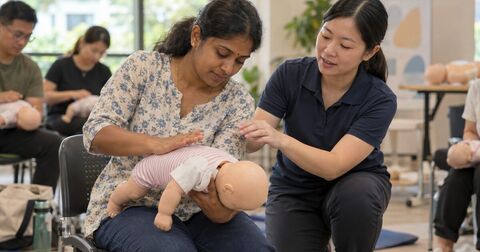
Baby Choking First Aid: What Every Singapore Parent Should Know
Baby choking first aid in Singapore: spot true choking, do infant back blows and chest thrusts, know when to call 995, a...
11 min read
Baby colic, reflux and gripe water: what Singapore doctors advise and when to worry
Baby colic and reflux in Singapore: what KKH, NUH and HealthHub say about gripe water and gas drops, how to soothe cryin...
12 min read
Baby Eczema in Singapore: Calm Skin in a Hot, Humid Climate
A calm, practical guide to baby eczema in Singapore: hot, humid-climate triggers, soak-and-seal moisturising, managing t...
11 min read