

Math skills by age: counting, number sense and the Singapore maths approach, with home activities from toddler to Primary 2
In this article
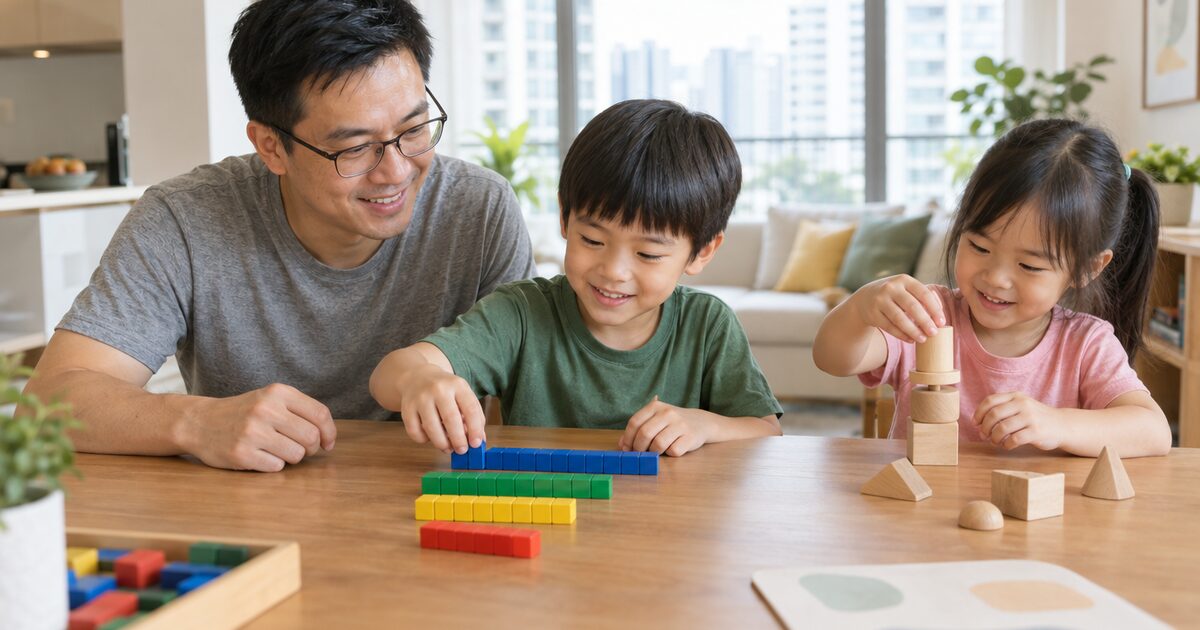
Math skills by age build slowly, and Singapore's own targets are gentler than many parents expect. By the end of K2, at about 6, MOE's preschool goals are to count by rote to at least 20, count up to 10 objects reliably, and know that 5 can be made of 2 and 3. Adding within 100, money and telling the time come in Primary 1, and times tables of 2, 3, 4, 5 and 10 wait until Primary 2. Before that, maths is talk and play, like saying "more" at snack time or counting the stairs. Below is an age-by-age table with a five-minute home activity for each stage, how Singapore maths teaches with objects, pictures and the bar model, and what support schools give.
Math skills by age, from toddler to Primary 2
The early-years rows come from the US Centers for Disease Control and Prevention and NAEYC, which describe what most children do by each age, alongside SingHealth's milestones. From 6, the targets are MOE's own: its Nurturing Early Learners (NEL) goals for the end of K2, and the December 2023 edition of the 2021 primary mathematics syllabus. MOE has since listed an October 2025 edition on its syllabus page.
| Age | What most children can do | Five-minute home activity |
|---|---|---|
| 1 to 2 years | Understands "more", one of the first maths ideas children grasp, as NAEYC notes; notices when food is "all gone" | Say "more" and "all gone" at every snack; fill and empty cups in the bath |
| 3 years | Starting to learn about numbers and counting, says the CDC | Count stairs or lift buttons out loud together; sort laundry by colour |
| 4 years | SingHealth says a 4-year-old understands the concept of counting and may know a few numbers | Count fingers, toys or bananas; copy simple patterns with beads: red, blue, red, blue |
| 5 years | Counts to 10 and names some numbers between 1 and 5 when you point to them (CDC) | Count the plates at the hawker centre table; spot numbers on buses and MRT doors |
| End of K2, about 6 | MOE's goals: rote count to at least 20, count 10 objects, see that 10 things stay 10 however they're arranged, split numbers up to 10 into parts, continue patterns, know circle, square, rectangle and triangle | Split 5 beans into two piles every way you can; hunt for shapes on the walk to school |
| Primary 1, about 7 | Numbers up to 100, adding and subtracting within 100, multiplying within 40, dividing within 20, money up to $100, time to 5 minutes, length in cm, picture graphs | Let your child pay with coins at the kopitiam; read the clock to the nearest 5 minutes |
| Primary 2, about 8 | Numbers up to 1000, odd and even numbers, times tables of 2, 3, 4, 5 and 10, metres, kilograms and litres | Skip-count in twos and fives on the stairs; weigh fruit at the supermarket |
Every child moves at their own pace, and the CDC defines a milestone as something 75% or more of children can do by that age. If counting is still shaky at 5, keep it playful; if you're worried about development more broadly, check the milestones in your child's Health Booklet and talk to your doctor. Our baby milestones guide covers the earlier months.
Building number sense at home
Number sense means understanding what numbers stand for, which reciting from 1 to 20 doesn't show. MOE's NEL goals put it in concrete terms: knowing that 10 sweets are still 10 when you spread them out, and that 5 can be made of 2 and 3, or 1 and 4. You can practise both in daily life:
- Count real things, touching each one, rather than reciting numbers in the air.
- Spread out a handful of coins and ask, "Are there more now?" Then bunch them up and ask again.
- Play "how many are hiding?": put 5 beans under two cups, show one cup, and let your child work out the other.
- Use maths words in passing: bigger, shorter, heavier, first, last, between, behind.
- Cook together; measuring cups and splitting a pizza into halves and quarters teach fractions before the word.
- Play board games with dice, which make children count on from where they are.
For more home ideas by age and skill, see our guide to learning activities for preschoolers.
The Singapore maths approach: objects, pictures, then symbols
Singapore teaches maths in three stages, which MOE's NEL portal calls the Concrete-Pictorial-Abstract approach. Canossa Catholic Primary School describes them as the doing, seeing and symbolic stages:
| Stage | What it means | At home |
|---|---|---|
| Concrete: doing | Children handle real objects, such as counters or blocks, to learn an idea | Add 3 apples and 2 apples on the table |
| Pictorial: seeing | They draw or look at pictures that stand for the objects to model a problem | Draw the apples as circles, or as two bars joined together |
| Abstract: symbolic | They write the equation and solve it | Write 3 + 2 = 5 |
The bar model, which MOE calls the model method, is taught from Primary 1. A National Institute of Education paper describes three basic models: part-whole, comparison and change. A child who has spent K2 splitting real beans into parts finds the part-whole bar natural. If you help with P1 homework, ask your child to show you the bar they drew before you reach for the answer.
If your child finds maths hard
Primary schools screen children for Learning Support for Mathematics at the start of Primary 1; Punggol Green Primary School, for example, describes this screening on its website. MOE says P1 and P2 children in the programme get 4 to 8 periods a week in small groups of up to 8. If your child is picked, treat it as extra help that comes early.
- Ask the teacher which topic is the sticking point, and whether to go back to objects for a while.
- Keep home practice short, around ten minutes, and stop while it's still fun.
- Skip times-table drills before P2 and worksheets before your child can count real objects.
- If maths is one of several areas of concern, mention it to your doctor.
If you're weighing up classes, our guide to maths enrichment in Singapore compares the options and what they cost.
Frequently asked questions
What math skills should a 5-year-old have?
The CDC says most children count to 10 and name some numbers between 1 and 5 by age 5. MOE's goals for the end of K2, at about 6, are counting to 20 and counting 10 objects reliably.
When do children learn times tables in Singapore?
In Primary 2. MOE's 2021 syllabus puts the times tables of 2, 3, 4, 5 and 10 in P2; P1 covers multiplying within 40 using objects and pictures.
What is the Singapore maths method?
Children learn with real objects first, then pictures such as the bar model, then written numbers. MOE's preschool portal calls it the Concrete-Pictorial-Abstract approach, and the bar model starts in P1.
What maths does a child learn in Primary 1?
Numbers up to 100, adding and subtracting within 100, simple multiplication and division, money up to $100, time to 5 minutes, length in centimetres and picture graphs.
How can I teach maths to my preschooler at home?
Count real things, cook and measure together, play dice games and use words like more, less, first and last. Keep it to a few minutes of play a day.
- MOE - Nurturing Early Learners: about numeracy (read 12 October 2026)
- MOE - 2021 primary mathematics syllabus, P1 to P6, updated December 2023 (PDF, archived copy) (read 12 October 2026)
- MOE - Primary school syllabuses, which lists an October 2025 edition of the 2021 mathematics syllabus (read 12 October 2026)
- MOE - Learning support in primary schools (read 12 October 2026)
- Canossa Catholic Primary School - Mathematics (read 12 October 2026)
- Punggol Green Primary School - Mathematics (read 12 October 2026)
- National Institute of Education - Kaur (2019), The why, what and how of the model method (read 12 October 2026)
- HealthXchange (SingHealth) - Child development milestones: 4 years old (read 12 October 2026)
- CDC (US) - Milestones by 3 years (read 12 October 2026)
- CDC (US) - Milestones by 5 years (read 12 October 2026)
- NAEYC (US) - Math talk with infants and toddlers (read 12 October 2026)
Best preschools in Singapore: how to choose a preschool by fees, hours, quality and curriculum
How to choose the best preschool in Singapore: ECDA fees for 1,795 preschools by operator type, hours and SPARK status, ...
14 min read
Bullying in preschool: the warning signs, what to say to your child, and how to escalate with a Singapore childcare centre
Bullying in preschool: how to tell it from rough play, the warning signs, what to say to your child, and the steps to es...
6 min read
Childcare centres in Singapore: infant care, anchor vs partner operators, subsidies and choosing one
How childcare centres in Singapore work: anchor vs partner operator fee caps, infant care, subsidies, waitlists and what...
11 min read