

Learning activities for preschoolers in Singapore: free and cheap ideas by age and skill, at home and around town
In this article
The best learning activities for preschoolers in Singapore are mostly free: play dough letters and ball games at home, storytime at a public library, and a morning at the Jacob Ballas Children's Garden, which charges no entry fee. MOE's preschool framework groups what children learn into five areas, from language and numbers to movement and art, and every activity below is sorted by age and by those areas. For a paid treat, the Science Centre's KidsSTOP costs a Singapore citizen or PR child $5 on weekdays outside school holidays. Prices and hours were read on each venue's own website on 12 October 2026.
Activities by skill and age
MOE's Nurturing Early Learners (NEL) framework sets learning goals in five areas: aesthetics and creative expression; discovery of the world; health, safety and motor skills; language and literacy; and numeracy. Its goals describe what children are expected to know by the end of K2, so there's no need to rush. MOE's advice to parents is to encourage children to explore and ask questions beyond school.
| Learning area | Age 3 to 4 | Age 5 to 6 | Free place to do it |
|---|---|---|---|
| Language and literacy | Picture books, naming things on a walk, nursery rhymes | Retelling a story, letter-spotting on signs, a shopping list you write together | Public library storytime |
| Numeracy | Counting stairs and snacks, and sorting laundry by colour | Setting the table for the family, measuring with cups, simple board games with dice | Home, the wet market |
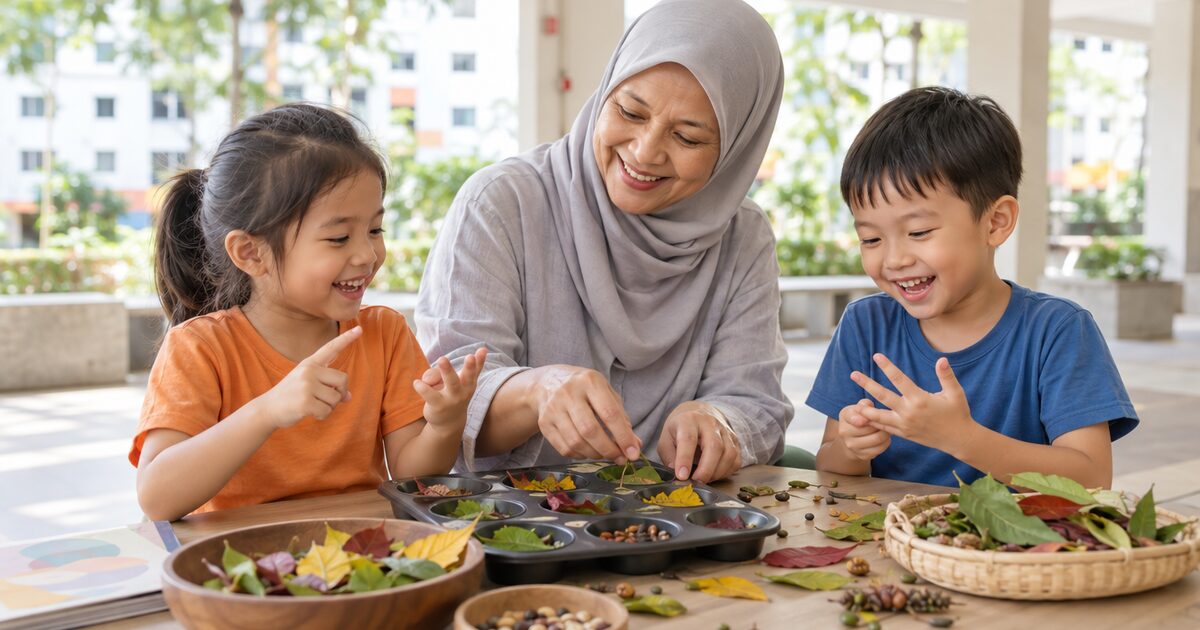
| Discovery of the world | Collecting leaves, watching ants, water play | Growing beans in a cup, a nature walk with a checklist | Jacob Ballas Children's Garden, neighbourhood parks |
| Health, safety and motor skills | Rolling and kicking a ball, a traffic-light game | Bouncing and catching, balancing, scooter or bike riding | The playground downstairs |
| Aesthetics and creative expression | Play dough, finger painting and dancing to songs | Drawing a story, a home-made puppet and a show to go with it | Home |
Children 3 to 6 need at least 180 minutes of physical activity a day under Singapore's 24-hour activity guidelines, so mix sitting activities with running ones. Our daily routine for preschoolers shows where they fit in a school day.
Free learning activities at home
HealthHub's Health Promotion Board suggests several activities that need nothing more than what's already in the flat:
- Ball skills: start by rolling a ball, then move on to bouncing, throwing, kicking and catching, as HealthHub suggests.
- Play dough shapes: HealthHub suggests making letters of the alphabet or the shapes of fruits and vegetables, which builds hand strength for writing too.
- Traffic-light game: with red, yellow and green flags or cards, play the traffic light at different spots around the house while your child walks, slows or stops.
- Kitchen maths: count spoons, pour water between cups, and talk about more and less. Our math skills by age guide has an activity for each stage. Our guide to easy science experiments has more ideas with kitchen ingredients.
- Story baskets: put three toys in a basket and make up a story with them, then let your child tell the next one.
- Art from the recycling box: robots and cities built from boxes, toilet rolls and bottle caps. Our art and craft ideas list projects by age.
Libraries: books, storytime and toys for free
Public libraries are the best free learning resource in Singapore. The National Library Board's Basic Membership is free for Singaporeans, and lets you borrow up to 16 physical items and 16 eBooks for 21 days; permanent residents pay a one-time registration fee of $10.69 with GST.
- Early READ Storytime is for 4- to 6-year-olds, at selected branches; Serangoon Library, for example, runs it from 11.30am to 12pm on the 2nd and 4th Sunday of the month. Check NLB's page for your branch, as some libraries are closed for renovation.
- Let your child choose some of the books. A pile of 16 lasts three weeks and costs nothing.
- A library visit makes a cool, free rainy-day outing, even without a storytime.
Our guides to children's libraries in Singapore and the toy library list the best branches and how to borrow toys.
Parks and gardens
Singapore Botanic Gardens is free for everyone, every day, and its Jacob Ballas Children's Garden is built for learning through play: NParks describes 4 hectares of play equipment and hands-on gardens in a woodland with streams, with trails through an orchard and pollinator plants. The Tree House is closed after termite damage, and NParks hopes to open a new one around the end of 2027.
- Opening hours: 8am to 7pm, last admission 6.30pm, closed on Mondays except public holidays.
- Entry: free, with no booking needed.
- Age: NParks' visitor information says the garden is for children up to 14, each with an adult. Its water play area suits ages 2 to 12, and an adult must supervise the whole time.
- Go in the morning, bring a change of clothes for the water play, and turn it into a nature hunt for leaves, seeds and insects.
Our Botanic Gardens family guide covers the rest of the Gardens, and most neighbourhood parks have playgrounds and fitness corners for the movement goals.
Low-cost outings that are worth paying for
| Place | Price for a Singapore citizen or PR child | Good to know |
|---|---|---|
| Science Centre KidsSTOP, ages 8 and below | $10 at peak times, $5 off-peak; free under 18 months; adults $5 peak or $2 off-peak | Off-peak means weekdays outside public and school holidays; closed on Mondays; an adult aged 18 or over must come too; strollers stay outside, and socks are needed for some exhibits |
| National Museum of Singapore | Free for citizens and PRs in the permanent galleries, and free for all children aged 6 and below | Short visits work best; pick one gallery |
| Science Centre with Omni-Theatre, ages 3 to 12 | $10 peak, $8 off-peak | Better from about age 5 |
Our guides to the Science Centre and kid-friendly museums have opening hours and tips for each.
A free week of learning
Mixing home, library, park and one paid outing keeps it fresh without adding classes. A sample week for a 4-year-old:
- Monday: play dough letters at home, then the playground after dinner.
- Tuesday: kitchen maths while you cook, and a bedtime story your child chooses.
- Wednesday: KidsSTOP at the off-peak rate, or a long park walk.
- Thursday: traffic-light game and ball skills downstairs.
- Friday: art from the recycling box.
- Saturday: library storytime and a new pile of books.
- Sunday: Jacob Ballas Children's Garden in the morning, then a quiet afternoon.
If you're weighing up paid classes as well, our enrichment budget planner adds up what they'd cost over a year.
Frequently asked questions
What are good learning activities for preschoolers?
Everyday play that covers MOE's five learning areas: books and storytelling, counting and sorting, nature walks, ball games and art. Most need nothing more than what's at home, a library card or a park.
Are there free learning activities for kids in Singapore?
Yes. NLB membership is free for Singaporeans, Early READ Storytime for 4- to 6-year-olds is free, and the Jacob Ballas Children's Garden charges no entry fee.
How much is KidsSTOP for Singaporeans?
For a Singapore citizen or PR child aged 18 months to 8 years, $10 at peak times and $5 off-peak, on 12 October 2026. Children under 18 months go in free.
How old should my child be for the children's garden at the Botanic Gardens?
NParks says it's for children up to 14, and an adult must always come with them. The water play area suits ages 2 to 12. It's open 8am to 7pm and closed on Mondays.
Do preschoolers need enrichment classes?
Not to meet MOE's goals, which describe what children should know by the end of K2. Free play, books and outdoor time cover all five learning areas.
- MOE - Nurturing Early Learners: learning areas (read 12 October 2026)
- MOE - Nurturing Early Learners portal (read 12 October 2026)
- MOE - Nurturing Early Learners framework (read 12 October 2026)
- National Library Board - Types of membership, privileges and fees (read 12 October 2026)
- National Library Board - Early READ Storytime (read 12 October 2026)
- NParks - Jacob Ballas Children's Garden (read 12 October 2026)
- NParks - Singapore Botanic Gardens visitor information (read 12 October 2026)
- Science Centre Singapore - KidsSTOP (read 12 October 2026)
- Science Centre Singapore - Ticket prices (read 12 October 2026)
- National Museum of Singapore - Admissions (read 12 October 2026)
- HealthHub (HPB) - Activity ideas to get your pre-schooler moving (read 12 October 2026)
- KKH (College of Paediatrics and Child Health) - Singapore Integrated 24-Hour Activity Guidelines for Early Childhood, summary (PDF) (read 12 October 2026)
Best preschools in Singapore: how to choose a preschool by fees, hours, quality and curriculum
How to choose the best preschool in Singapore: ECDA fees for 1,795 preschools by operator type, hours and SPARK status, ...
14 min read
Bullying in preschool: the warning signs, what to say to your child, and how to escalate with a Singapore childcare centre
Bullying in preschool: how to tell it from rough play, the warning signs, what to say to your child, and the steps to es...
6 min read
Childcare centres in Singapore: infant care, anchor vs partner operators, subsidies and choosing one
How childcare centres in Singapore work: anchor vs partner operator fee caps, infant care, subsidies, waitlists and what...
11 min read