

New parent sleep deprivation: why you are so tired after giving birth, how to share nights, and when tiredness is anaemia, thyroid or postnatal depression
In this article
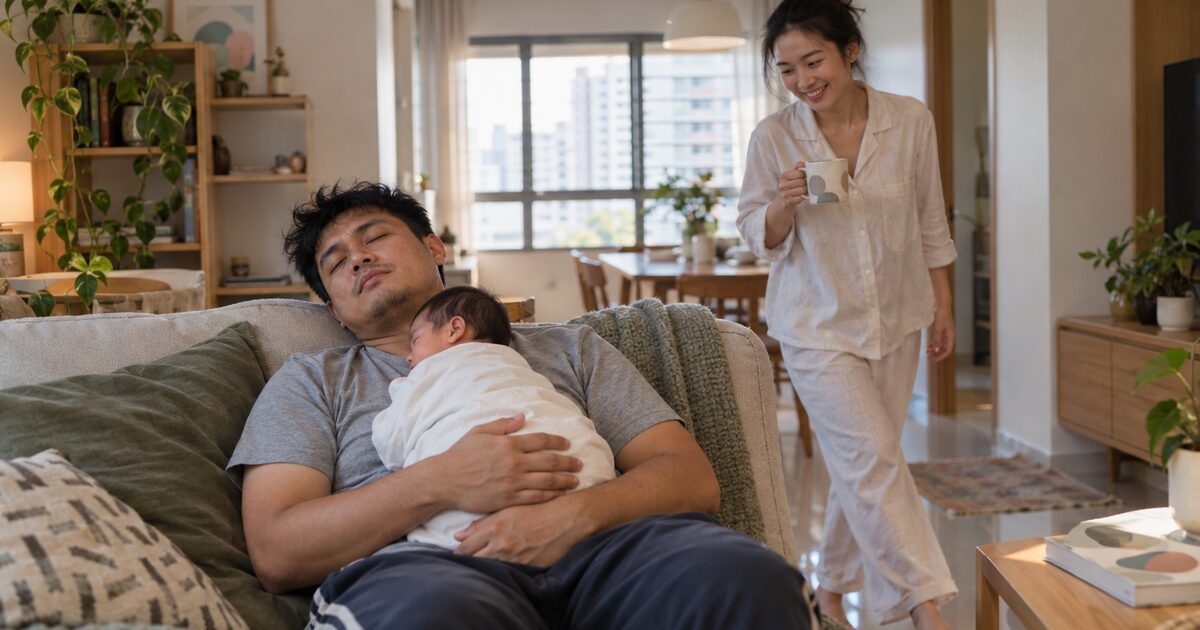
New parent sleep deprivation is normal and temporary: newborns need 14 to 17 hours of sleep a day in short stretches because they have no body clock yet, HealthHub explains, and SingHealth says most healthy babies stop needing a night feed by five to six months. Until then, the fixes that work are practical. Split the night into shifts with your spouse or a family member, which HealthHub recommends, nap when your baby naps (even 10 to 20 minutes helps), let someone else do the chores, and use your leave: fathers get 4 weeks of Government-Paid Paternity Leave and parents can share 10 weeks of Shared Parental Leave for babies born from 1 April 2026. Watch for the line between tired and unwell: sleep trouble that has nothing to do with the baby, low mood for more than two weeks, or thoughts of harming yourself need a doctor.
Feeling tired after giving birth is expected, and it should ease as nights get longer. If it doesn't lift when you do get sleep, or comes with breathlessness, a racing heart or low mood, ask your doctor for a blood test. Anaemia and thyroid problems both cause tiredness, and SingHealth says thyroid disorders are most common in women aged 20 to 50.
Why new parents get so little sleep
HealthHub, with a KKH paediatrician, explains that babies have not yet developed their circadian rhythm, the internal clock that regulates sleep and waking, so they sleep and feed around the clock. Adults typically need about 7 hours of good-quality sleep to function well; most new parents get much less, in broken pieces.
The lack of sleep does more than make you tired. HealthHub says it adds to stress and irritability, can deepen the emotional changes after birth such as postpartum blues or depression, and makes accidents more likely because you are less alert. SingHealth notes the brain can drop into microsleeps of up to half a minute, whatever you are doing, and lists a higher risk of road accidents.
| Baby's age | What sleep is like | What helps you |
|---|---|---|
| 0 to 6 weeks | 14 to 17 hours a day in short stretches, day and night mixed up | Night shifts, naps, help with everything else |
| 6 weeks to 3 months | Still waking at night to feed | A regular nap and bedtime routine for your baby (HealthHub) |
| 3 to 6 months | SingHealth says most healthy babies need no night feed by 5 to 6 months | Put your baby down drowsy but awake |
| 6 months on | Many sleep 9 to 10 hours or wake once, SingHealth says | A sleep plan if nights are still broken |
Share the nights: shift plans that work
HealthHub's Parent Hub advice is direct: share baby care with your spouse or a trusted family member, and take turns or shifts for night-time duties. Fathers can feed, change or settle the baby at night. If you are breastfeeding, HealthHub suggests resting whenever your baby rests and arranging for someone to babysit on weekend mornings so you can sleep in.
Night shift plan
If you bottle-feed or pump
If you breastfeed
Every day
Getting help in a Singapore home
Many Singapore families have extra hands, and this is the time to use them.
| Help | What it covers | What is worth knowing |
|---|---|---|
| Your spouse on leave | Night shifts, feeds and settling | Fathers of babies born from 1 April 2025 get 4 weeks of Government-Paid Paternity Leave; give your employer 4 weeks' notice (MOM) |
| Shared Parental Leave | More weeks at home for either parent | 10 weeks for babies born from 1 April 2026, 6 weeks for those born 1 April 2025 to 31 March 2026 (MOM) |
| A confinement nanny | Baby care, night feeds by bottle, housework | A Malaysian confinement nanny's Work Permit lasts up to 16 weeks from the birth (MOM) |
| Grandparents and family | Shifts, meals and a morning sleep-in | Agree on safe-sleep rules first |
| A helper | Housework and laundry, so you can rest | Babies sleep on their back in their own cot |
Our paternity leave calculator and shared parental leave calculator work out your dates, and our guide to hiring a confinement nanny covers costs and permits.
Help your baby sleep longer
HealthHub's tips for settling babies:
- Keep a regular nap and bedtime routine.
- Put your baby to bed sleepy but still awake, so they learn to fall asleep on their own.
- Keep nights dark and quiet and days bright, to help the body clock form.
For your own sleep, HealthHub suggests avoiding caffeine and alcohol at night and screens for at least an hour before bed. Our baby sleep schedule tool shows typical sleep by age, and our guides to baby sleep training and sleep consultants in Singapore cover what to try after a few months.
Stay safe when you are exhausted
- Put your baby to sleep on their back on a firm surface. HealthHub says bring your baby into your bed only to feed, then return them to their own cot.
- Do not feed your baby on a sofa or armchair if you might fall asleep there.
- Do not drive when you are struggling to stay awake. HealthHub says drowsiness can slow your reaction time as much as driving drunk.
- If you find yourself falling asleep in the day without meaning to, which HealthHub lists as a sign you need more sleep, ask for help that day.
Tired after giving birth, or something more?
Some exhaustion after a baby is normal. Your body is healing, and you are up every few hours. The clue that something else is going on is tiredness that doesn't improve when someone takes a night shift, or that comes with other symptoms. Three medical causes are worth ruling out.
| What is causing it | Signs that point to it | What to ask for |
|---|---|---|
| Normal new-parent tiredness | Better after a long sleep or a nap; mood mostly fine | More help at night, and the shift plan above |
| Anaemia (low blood count) | Fatigue, pale skin, breathless on exertion, giddiness (SingHealth) | A full blood count, especially after heavy bleeding at delivery or anaemia in pregnancy |
| Underactive thyroid | Fatigue and weakness that drag on, feeling cold, weight gain, constipation, low mood (SingHealth) | Thyroid blood tests (TSH and T4) |
| Overactive thyroid | Restless and can't sleep, sudden weight loss, a fast heartbeat, shaky hands (SingHealth) | Thyroid blood tests |
| Postnatal depression | Can't sleep even when the baby sleeps, low mood or no interest in things for over two weeks (SGH, NUH) | A talk with your doctor and an EPDS screen; see the next section |
KKH's anaemia page lists heavy blood loss at delivery and anaemia in pregnancy among the reasons a mother may need treatment, and it is checked with a simple full blood count. The NHS says a doctor checking for an underactive thyroid will ask whether you've recently been pregnant, because thyroid problems can start after a birth. Both conditions overlap with depression, so mention your mood too. Our guide to postpartum hair loss covers the same blood tests, since heavy shedding that doesn't stop is another clue.
When tiredness is more than tiredness: postnatal depression
Baby blues are common. SingHealth says they affect two-thirds of women in the first week after birth, and NUH says they last two to three weeks. Postnatal depression is different and affects about 10% to 15% of women after childbirth, SingHealth says. Sleep loss and too little support, especially from a husband, raise the risk.
The sign that separates it from normal exhaustion, according to SGH's doctors, is sleep trouble unrelated to the baby: lying awake when the baby is asleep and you could rest. Other signs NUH lists:
- Low mood, hopelessness, guilt or worthlessness for more than two weeks.
- Losing interest in things you used to enjoy.
- Sleeping much less, or much more, than your baby's needs explain.
- Panic attacks.
- Disturbing thoughts about harming yourself or your baby.
HealthHub has a free Edinburgh Postnatal Depression Scale self-check that asks about sleep and mood. Fathers can feel low too, and the same help applies to them.
Where to get help in Singapore
- Your GP, polyclinic or gynae, as a first step.
- KKH Women's Mental Wellness Service: email pnd@kkh.com.sg (reply in 3 to 5 working days). KKH's postnatal depression programme is open to non-KKH patients too.
- NUH Women's Emotional Health Service: 6772 2037, wehs@nuhs.edu.sg.
- 24-hour helplines: Samaritans of Singapore 1767 and national mindline 1771.
- HPB nurse advisers: 1800 223 1313.
Our guides to postnatal depression help in Singapore and postpartum anxiety go into treatment and support, and our self-care checklist for new mums fits rest, food and help into a newborn day.
Frequently asked questions
How long does new parent sleep deprivation last?
The worst is usually the first three months. SingHealth says most healthy babies no longer need a night feed by five to six months, and many then sleep nine to ten hours or wake only once.
How do new parents split night shifts?
Divide the night in two so each parent gets one long block of sleep, or, if you breastfeed, let your partner change and settle the baby and bring them to you to feed. HealthHub recommends taking turns or shifts with your spouse or a trusted family member.
Can sleep deprivation cause postnatal depression?
It is a known risk factor. SingHealth lists sleep deprivation from caring for a baby, and too little support, among the things that make depression after birth more likely.
What leave can fathers take in Singapore to help at night?
Fathers of babies born from 1 April 2025 get 4 weeks of Government-Paid Paternity Leave, and parents of babies born from 1 April 2026 can share 10 weeks of Shared Parental Leave, MOM says.
Is it safe to sleep with my baby when I am exhausted?
HealthHub recommends bringing your baby into bed only to feed, then returning them to their own cot, on their back on a firm surface.
Why am I so tired after giving birth?
Broken nights and a body that is still healing are the usual reasons. If you stay exhausted even after a proper sleep, ask your doctor to check for anaemia and thyroid problems, and for postnatal depression, all of which cause tiredness.
How long does tiredness last after giving birth?
It usually eases as your baby sleeps longer; SingHealth says most healthy babies drop the night feed by five to six months. Tiredness that is getting worse, or lasts beyond that, is worth a blood test.
- HealthHub (KKH), Surviving sleep deprivation with a baby (read 11 October 2026)
- HealthHub Parent Hub, Baby sleep: self-care for parents (read 11 October 2026)
- HealthHub, How sleep deprivation affects your mental wellbeing (read 11 October 2026)
- HealthHub Parent Hub, Postnatal depression scale (read 11 October 2026)
- HealthHub, Services, support and helplines for parents (read 11 October 2026)
- HealthHub MindSG, Helplines (read 11 October 2026)
- SingHealth, Good sleep habits for children (read 11 October 2026)
- SingHealth, Sleep deprivation (read 11 October 2026)
- SingHealth, Perinatal depression (read 11 October 2026)
- SingHealth, Postnatal depression (read 11 October 2026)
- NUH, Baby blues and postnatal depression (read 11 October 2026)
- NUH, Women's Emotional Health Service (read 11 October 2026)
- SGH newsroom, Don't dismiss signs of postnatal depression as weakness (read 11 October 2026)
- KKH, Psychological Medicine: Women's Mental Wellness (read 11 October 2026)
- HealthXchange (KKH), Postnatal depression programme (read 11 October 2026)
- IMH, Emergency services (read 11 October 2026)
- MOM, Paternity leave (read 11 October 2026)
- MOM, Shared parental leave (read 11 October 2026)
- MOM, Work permit for confinement nanny (read 11 October 2026)
- SingHealth - Anaemia (read 12 October 2026)
- SingHealth (KKH) - Anaemia in pregnancy (read 12 October 2026)
- SingHealth - Hypothyroidism (read 12 October 2026)
- SingHealth - Thyroid disorders (read 12 October 2026)
- NHS (UK) - Underactive thyroid (read 12 October 2026)
Childhood Myopia in Singapore: A Parent's Guide to Signs, Prevention and Eye Checks
A Singapore parent's guide to childhood myopia: why it is so common, early signs, outdoor and screen habits that help, e...
11 min read
Choosing a Paediatrician in Singapore: A Practical Guide for Parents
How to choose a paediatrician in Singapore: GP vs polyclinic vs private PD, cost guidance, vaccinations, first-visit tip...
12 min read
Mosquito Repellent for Kids in Singapore: A Parent's Guide to Dengue Protection
How to choose mosquito repellent for kids in Singapore by age, protect babies from dengue, cover up, use nets, clear sta...
11 min read