

Night sweats after birth: why they happen, how long they last and what helps
In this article
Night sweats after birth are common and usually harmless. Cleveland Clinic says they come from your hormones dropping after the birth and settle on their own within a few weeks. A cool room, cotton sleepwear and plenty of water make them easier to sleep through. See a doctor if the sweats come with a fever, chills or feeling unwell.
What to do about night sweats after birth, step by step
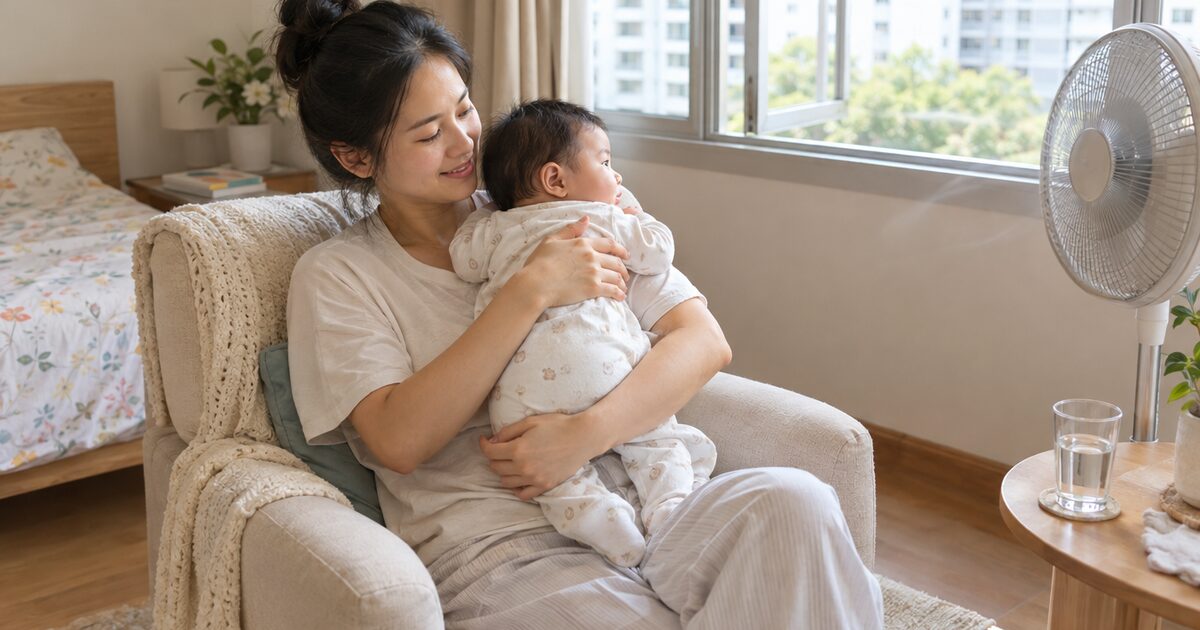
- Switch on the fan or air-con. KKH's doctors say there's no harm in it if you and your baby are comfortable, and it may even help prevent heat rash in our hot, humid climate.
- Sleep in light cotton, not thick layers. Cleveland Clinic suggests light cotton pyjamas and cotton sheets, and HealthHub says thick clothing in our climate may cause heat rash.
- Lay a bath towel under you and put a second case on your pillow. Cleveland Clinic suggests both, so a wet patch doesn't mean changing the whole bed.
- Keep a spare top and a dry towel by the bed. An NHS page for new mums suggests this so you can get dry and warm again quickly.
- Drink water through the day and keep a glass by the bed. Cleveland Clinic says heavy sweating can dehydrate you, and KKH advises enough fluids, especially while you're breastfeeding.
- Take a warm shower when you feel sticky. HealthHub says warm baths are encouraged for hygiene and comfort in the hot weather, and our confinement shower guide covers hair washing and fans after a bath.
- Keep feeding your baby as usual. KKH advises feeding on demand every two to three hours, night feeds included, and Cleveland Clinic says breastfeeding can keep the sweats going a little longer.
- Check your temperature if you feel shivery or unwell. KKH's going-home advice says to see your doctor for a fever or chills after the birth.
- Mention the sweats at your postnatal check, which HealthHub says is usually 4 to 6 weeks after delivery. Cleveland Clinic suggests seeing your doctor sooner if they last longer than three weeks.
Why you sweat so much after giving birth
Two changes overlap in the first weeks. First, your hormone levels fall fast once your baby is born. Cleveland Clinic explains that low estrogen makes your hypothalamus, the part of your brain that works like a thermostat, believe you're too hot. It tells your body to cool down, and you sweat.
Second, you're getting rid of water. Cleveland Clinic says your blood volume rises by about 50% in pregnancy, and night sweats may be one way your body sheds the extra fluid. KKH says your kidneys also make more urine in the first few weeks after the birth to clear it. If your feet are swollen too, our swollen feet after birth guide covers that side of it.
You're also sleeping in warm, humid air, often dressed and covered for confinement, so you notice it more. Cleveland Clinic cites research in which about 35% of new mothers reported night sweats. If you were sweaty in pregnancy too, our pregnancy heat guide explains that stage.
How long night sweats last after birth
Cleveland Clinic says they tend to be worst in the first two weeks. Your hormones take a few weeks to settle back to their pre-pregnancy levels, and once they do, the sweats usually stop. An NHS page for new mums says the same, and adds that they can last longer if you're breastfeeding.
Cleveland Clinic explains why. Prolactin, the hormone that makes breast milk, keeps estrogen low, and low estrogen drives the sweating. Mums who formula feed get night sweats too, but theirs usually end sooner.
Cleveland Clinic suggests checking with your doctor if the sweats last longer than three weeks. The NHS page says to see a GP if you feel unwell with them, or if they're a big problem or go on a long time. Our six-week postnatal check guide lists other questions to take along.
Fans, air-con and keeping warm in confinement
Many families keep a new mum warm during confinement, with long sleeves, thick covers and no fan or air-con. KKH lists the belief that you mustn't expose yourself or your baby to wind drafts or air-conditioning among common confinement myths.
KKH's answer is clear. Its doctors say there's no harm in the fan or air-con if you and your baby are comfortable, and it may help prevent heat rash. HealthHub says thick clothing in our climate may cause heat rash. If your mum or mother-in-law is worried, show her what KKH says, and keep a light layer within reach for yourself. If an itchy rash shows up anyway, our hives after giving birth guide helps you work out what it is.
Some families also cut back on plain water during confinement. KKH advises enough fluids, especially if you're breastfeeding, and you're losing more than usual through sweat. Our confinement drinks guide covers teas and tonics, and our confinement myths guide goes through other customs.
When sweating is more than hormones
Most postpartum sweating is the normal kind. A few patterns point to something else.
| What you notice | What it can mean | What to do |
|---|---|---|
| Soaked sheets in the first few weeks, but you feel well | Normal hormone and fluid changes (Cleveland Clinic) | Cool room, cotton, a towel and water |
| Sweats that last longer while you breastfeed | Normal: prolactin keeps estrogen low (Cleveland Clinic) | Keep feeding and drinking |
| Sweats with a fever, chills or shivering | Possible infection (KKH, Cleveland Clinic) | See your doctor promptly |
| A red, painful patch on a breast, with shivers | Possible breast infection (KKH) | Seek medical attention or call a lactation consultant now |
| Foul-smelling discharge, or a red, oozing wound | Possible infection (KKH) | Go back to your hospital |
| Always hot, with a racing heart, shaky hands or weight loss | Possible overactive thyroid (SGH) | Ask your GP or gynae about a thyroid check |
| Sweats with panic or constant worry | Possible anxiety (Cleveland Clinic) | Talk to your doctor |
| Strong sweats after three weeks | Worth checking (Cleveland Clinic) | See your GP or gynae |
Cleveland Clinic lists thyroiditis among the conditions that can cause night sweats. SGH's endocrinologists name increased sensitivity to heat, a faster heart rate, hand tremors and sudden, unexplained weight loss as signs of an overactive thyroid. Our postpartum hair loss guide explains when a thyroid test makes sense after birth.
Anxiety can cause night sweats too, Cleveland Clinic says. If worry or panic is part of your nights, our postpartum anxiety guide covers what helps and who to see in Singapore.
Medicines can also cause night sweats, Cleveland Clinic notes. If you think one of yours is behind it, ask the doctor who prescribed it. Cleveland Clinic also advises speaking to a doctor before you take any supplement while breastfeeding.
When to see a doctor
Sweats on their own, while you feel well, are usually the normal kind. Get seen for any of these:
- A fever or chills. KKH's going-home advice lists both among the reasons to see your doctor after the birth.
- A breast that's red and painful, or feeling shivery or feverish. KKH says to seek medical attention or call a lactation consultant straight away, and our mastitis guide explains more.
- Foul-smelling discharge, or bleeding, redness or pus around your stitches or caesarean wound. KKH says these can be signs of infection.
- Feeling hot all the time with a racing heart, shaky hands or weight loss you can't explain. SGH lists these among the signs of an overactive thyroid.
- Feeling unwell with the sweats, or sweats that are a big problem. An NHS page for new mums says to see a GP for either.
- Night sweats that last longer than three weeks, as Cleveland Clinic advises.
Start with your gynae's clinic, the hospital where you delivered, or a polyclinic. If you delivered at KKH, its Urgent O&G Centre at Basement 1 of the Women's Tower is a 24-hour walk-in centre that sees post-pregnancy problems. For an emergency, KKH says to call 995 or go to an emergency room. Our postnatal recovery guide has the full list of red flags after birth.
Frequently asked questions
Are postpartum night sweats normal?
Yes. Cleveland Clinic calls them a normal and natural reaction to changing hormones, and says it's common to wake up soaked in the first few weeks after having a baby. They need a doctor when they come with a fever, chills or pain.
How long do night sweats last after birth?
Cleveland Clinic says they're usually worst in the first two weeks and stop once your hormones settle, which takes a few weeks. They can last longer while you breastfeed. Check with your doctor if they go on for more than three weeks.
Why am I sweating so much after giving birth, even in the day?
An NHS page for new mums says the hormone changes after pregnancy can make you sweat in the day as well as at night. Your body is also clearing extra fluid, and KKH says your kidneys make more urine in the first few weeks to get rid of it. Singapore's heat makes all of it easier to notice.
Does breastfeeding cause postpartum sweating?
It can make the sweats last longer. Cleveland Clinic says prolactin, the hormone that makes breast milk, keeps estrogen low, and low estrogen drives the sweating. Keep feeding and drink enough, as KKH advises. Our breastfeeding support guide covers where to get help with feeds.
Can I use the fan or air-con during confinement?
Yes. KKH's doctors say there's no harm if you and your baby are comfortable, and that it may help prevent heat rash in Singapore's climate. HealthHub gives the same advice.
Can night sweats after birth be a thyroid problem?
Usually they're just your hormones settling. Cleveland Clinic lists thyroiditis among other causes, though, and SGH names heat sensitivity, a fast heartbeat, shaky hands and sudden weight loss as signs of an overactive thyroid. If you have those too, ask your doctor about a thyroid check.
- KKH (HealthXchange), Confinement after pregnancy: 12 myths and facts (read 6 Nov 2026)
- KKH (SingHealth), Going home after your delivery in KKH (read 6 Nov 2026)
- KKH, Urgent O&G Centre (read 6 Nov 2026)
- KKH, Appointments (read 6 Nov 2026)
- HealthHub, First days of our lives with baby (read 6 Nov 2026)
- SGH Endocrinology, Thyroid disorders (read 6 Nov 2026)
- Cleveland Clinic, Postpartum night sweats (read 6 Nov 2026)
- NHS Just One Norfolk, Early days after the birth (read 6 Nov 2026)
Back pain after pregnancy: why it happens, feeding and carrying tips, safe stretches and when to see a physio
Back pain after pregnancy is common. Feeding, carrying and lifting tips from Singapore hospitals, gentle stretches, red ...
7 min read
C-section in Singapore: planned or emergency, what happens on the day, costs and recovery
C-section in Singapore: the day, MOH bills by hospital and recovery tips week by week, with wound infection signs, scar ...
24 min read
How to check a confinement nanny agency's licence with MOM
Check a confinement nanny agency's licence in MOM's directory: each step, the fields it shows, the work permit and what ...
7 min read