

Confinement myths: what Singapore's doctors say, and a plan for home
In this article
You can let go of most confinement myths. KKH's doctors say it's fine to bathe and drink plain water, and that a fan or air-con does no harm. HealthHub says most confinement practices have little or no solid scientific basis. What's worth keeping is the rest and the help at home.
DIY confinement at home, step by step
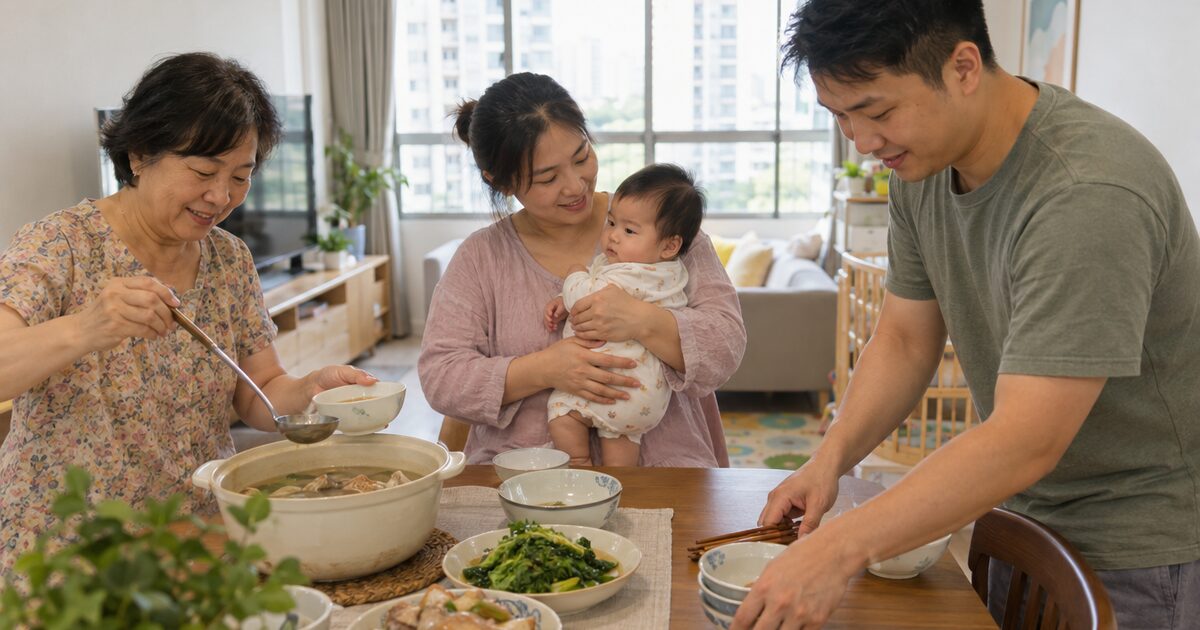
Confinement at home works when everyone knows their job, so sort these out with your family before the birth if you can.
- Decide who will cook, whether it's family or confinement food delivery. HealthHub's advice is a balanced plate of fruit, vegetables, grains, protein foods and dairy each day.
- Share the night feeds with your husband, since HealthHub says fathers can take on night-time care too, such as nappy changes and settling the baby.
- Let someone else settle your baby after each feed if you latch directly. HealthHub suggests family members put the baby back to sleep so you can get back to sleep yourself.
- Hand the housework to family, as HealthHub suggests, so you aren't carrying it while you heal.
- Make your husband the one who handles visitors. HealthHub suggests saying no to visitors until you have a more comfortable routine.
- Book his paternity leave as early as you can. MOM says eligible working fathers, self-employed ones included, can get up to 4 weeks of Government-Paid Paternity Leave, and our leave calculator helps you plan the dates.
- Keep the check-ups in one shared calendar, with our six-week check guide for questions. KKH books your postnatal follow-up before you go home, and HealthHub says the check is usually 4 to 6 weeks after delivery.
- Give your husband the paperwork while you rest, with our after-birth admin checklist to work through.
- Walk a little more each day, since HealthHub suggests a gentle exercise routine like this to start. After a caesarean, KKH says not to lift heavy objects for at least two months.
- Watch your mood with your husband's help. HealthHub says the blues usually start in the first week and last no more than two weeks, so tell your doctor if low mood goes on longer.
Confinement myths and what the hospitals say
These are the beliefs families pass on most, with what KKH's doctors and HealthHub say about each. Keep any custom that helps you rest. Our confinement guide for Singapore covers how Chinese, Malay and Indian families each keep the month.
| Myth | What the hospitals say | What to do instead |
|---|---|---|
| No bathing, or wind gets into your bones | KKH: no basis. Regular baths cut skin and wound infections | Shower in warm water |
| No fan or air-con | KKH: no harm if you and your baby are comfortable. It may prevent heat rash | Keep the room comfortable and wear light clothes |
| No plain water | KKH: drink enough, especially if you breastfeed | Keep water where you feed |
| Stay in bed for a month | HealthHub suggests gentle exercise like walking | Take short walks at home |
| Eat only 'heating' food, meat and liver | KKH: a balanced diet matters more than any one food | Eat rice, meat, fruit and vegetables |
| No fruit or vegetables | HealthHub: they help heal wounds and stitches | Aim for 2 servings of each a day |
| Papaya fish soup boosts milk | KKH: traditionally linked to milk. HealthHub: latching and expressing work best | Enjoy it, and feed or express often |
| Plenty of wine, sesame oil and herbs | KKH: no medical reason. Fine in moderation, but too much can reach your milk | Keep portions modest |
| No reading or crying | KKH: no scientific basis | Read, rest and say how you feel |
| Herbal soup before birth is always safe | HealthXchange: some herbs in pregnancy can cause miscarriage or harm the baby | Ask your gynae first |
Myths about your body after the birth
The bathing rule comes from an old belief that water lets "wind" into the body. KKH's doctors say there's no basis to it, and that regular baths lower the risk of skin and wound infections. Our guide to showering during confinement covers hair washing and stitches.
Plain water is fine too. KKH's doctors advise drinking enough, especially if you're breastfeeding. Your kidneys make more urine in the first few weeks anyway, to clear the extra fluid from pregnancy. For teas and tonics, see what to drink during confinement.
In Singapore's heat, a fan or air-con helps. KKH's doctors see no harm if you and your baby are comfortable, and say it may even prevent heat rash. HealthHub adds that thick clothing in our climate can cause it.
You don't need to stay in bed all month either. HealthHub suggests a gentle routine like walking. For your baby's first trips out, see when a newborn can go outside.
Food myths, from heating food to avocado
Most food rules rest on one belief: birth leaves you "cooled", so you need "heating" foods such as meat. KKH's doctors say a well-balanced diet matters more than specific food types, especially while you breastfeed. HealthHub adds that meat and liver alone won't meet your needs. Our easy confinement recipes include wine-free options and a one-week menu.
Fruit and vegetables often get cut because TCM counts many of them as "cooling". HealthHub says they should still be an integral part of your diet, as they help heal wounds and stitches and their fibre keeps your bowels working. If your family follows TCM, HealthHub lists neutral choices such as carrots, spinach, apples and papaya.
Many families cook papaya fish soup for milk, and KKH lists unripe papaya and fish as foods traditionally linked to more breast milk. HealthHub says traditional recipes such as black chicken and wine have no proven benefit for supply. The best way to make more milk, it says, is to latch your baby when needed and express regularly. Our breast milk supply guide has more, and our confinement soup recipes include papaya fish soup.
None of the KKH or HealthHub confinement pages we checked names avocado as a food to limit. HealthHub's Nutrition Hub lists avocados as a source of monounsaturated fat, the kind that helps lower "bad" LDL cholesterol. The foods that do need care, like alcohol in cooking, are in foods to avoid during confinement.
Herbal soups before and after the birth
Some families give herbal soups in late pregnancy to prepare for the birth. Check with your gynae before you drink one. HealthXchange's guide to TCM in pregnancy says Chinese medicine should only be used on your doctor's advice. It warns that herbs used wrongly can cause miscarriage or harm the baby.
After the birth, ask first too. HealthHub says to see a registered TCM physician before any traditional herbal preparation, so you know it's safe while breastfeeding. KKH's breastfeeding FAQ advises avoiding traditional or herbal remedies while you breastfeed, as your baby's system is still immature. Our confinement herbs guide covers dang gui and ginseng, and TCM postnatal care and jamu covers both traditions after birth.
Myths about crying and your mood
Some families say reading or crying in confinement harms your eyes later. KKH's doctors say this belief has no scientific basis, so read if you want to and cry if you need to.
Tears in the first weeks are common. HealthHub says the postnatal blues usually begin in the first week after delivery and last no more than two weeks. It also suggests sharing your worries with your husband so he can help.
Low mood that lasts longer than two weeks can become postnatal depression, HealthHub says. The signs it lists include self-blame and pulling away from family and friends. Thoughts of harming yourself or your baby mean speaking to your doctor straight away. Our postnatal depression guide lists help in Singapore.
When to see a doctor
Don't wait for your check-up if you notice any of these. Call your doctor or the hospital where you delivered, and see our postnatal recovery guide for the full list of warning signs.
- Heavy bleeding or clots, or swelling and pain around your stitches or caesarean wound that won't ease: HealthHub says to see your doctor immediately.
- KKH says to see your doctor if bleeding suddenly gets heavy again after easing, or if vaginal discharge looks like pus or smells foul.
- Bleeding, redness or pus around a caesarean wound, or a fever: KKH says to return to the hospital.
- A red, painful patch on your breast, or feeling shivery or feverish: KKH says to get medical help or see a lactation consultant straight away (see our mastitis guide).
- HealthHub says to speak with your doctor immediately about low mood that lasts more than two weeks, or any thought of harming yourself or your baby.
KKH's Urgent O&G Centre is a 24-hour walk-in centre that sees post-pregnancy conditions, at Basement 1 of the Women's Tower. For significant abdominal pain or heavy bleeding, KKH says to go there or to your nearest emergency department. In an emergency, call 995, as KKH advises.
Frequently asked questions
Does papaya soup help breast milk?
KKH lists unripe papaya and fish among foods traditionally linked to more breast milk. HealthHub says the best way to raise your supply is to latch your baby when needed and express regularly. So have papaya fish soup if you enjoy it, and keep feeding often.
Can I eat avocado during confinement?
Yes, as part of a balanced diet. HealthHub says fresh fruit belongs in your postpartum diet even though TCM counts many fruits as "cooling". Its Nutrition Hub lists avocados as a source of monounsaturated fat. If your family prefers neutral fruits, HealthHub's list includes apples and papaya.
Is pre-partum herbal soup safe before delivery?
Ask your gynae before you drink it. HealthXchange's TCM guide says Chinese medicine in pregnancy should only be used on your doctor's advice, and that herbs used wrongly can cause miscarriage or harm the baby. Bring the herb list to your next check-up.
Is TCM confinement safe while breastfeeding?
Check every herb first. HealthHub says to see a registered TCM physician before taking herbal preparations while you breastfeed, and KKH advises avoiding them. Tell your doctor about anything you plan to take.
What is the husband's role during confinement?
He takes as much off you as he can. HealthHub says fathers can help with night-time care of the baby, and suggests saying no to visitors until you have a routine. He can also run the chores and the appointments, and keep an eye on your mood. Our guide to sharing nights with a newborn has shift plans.
How are Malay, Indian and Chinese confinement practices different?
Mostly in length and detail. HealthHub gives 30 days for Chinese mothers, 40 days for Indian mothers and 44 days for Malay mothers. KKH's doctors note that Malay and Chinese diets both avoid "cooling" foods and favour "heating" ones. Our confinement guide compares the three side by side.
- HealthHub, Postpartum nutrition: your road to recovery (read 6 Nov 2026)
- HealthHub, First days of our lives with baby (read 6 Nov 2026)
- HealthHub, Baby has come home: dealing with changes (read 6 Nov 2026)
- HealthXchange (KKH), Confinement after pregnancy: 12 myths and facts (read 6 Nov 2026)
- KKH, Breastfeeding: frequently asked questions (read 6 Nov 2026)
- SingHealth (KKH), Going home after your delivery in KKH (read 6 Nov 2026)
- KKH, Urgent O&G Centre (read 6 Nov 2026)
- HealthXchange (SingHealth), Traditional Chinese medicine and pregnancy: herbs (read 6 Nov 2026)

Back pain after pregnancy: why it happens, feeding and carrying tips, safe stretches and when to see a physio
Back pain after pregnancy is common. Feeding, carrying and lifting tips from Singapore hospitals, gentle stretches, red ...
7 min read
C-section in Singapore: planned or emergency, what happens on the day, costs and recovery
C-section in Singapore: the day, MOH bills by hospital and recovery tips week by week, with wound infection signs, scar ...
24 min read
How to check a confinement nanny agency's licence with MOM
Check a confinement nanny agency's licence in MOM's directory: each step, the fields it shows, the work permit and what ...
7 min read