

Postnatal exercises at home: a gentle routine with your baby nearby, and when to stop
In this article
Postnatal exercises at home can start small, on a mat with your baby beside you. Begin with pelvic floor squeezes, deep tummy work and pelvic tilts, then add walks with the pram. KKH encourages new mums to do some postnatal exercise during confinement, alongside plenty of rest. Leave sit-ups, planks and running for later, and stop if your bleeding gets heavier or a move starts to hurt.
How to do postnatal exercises at home, step by step
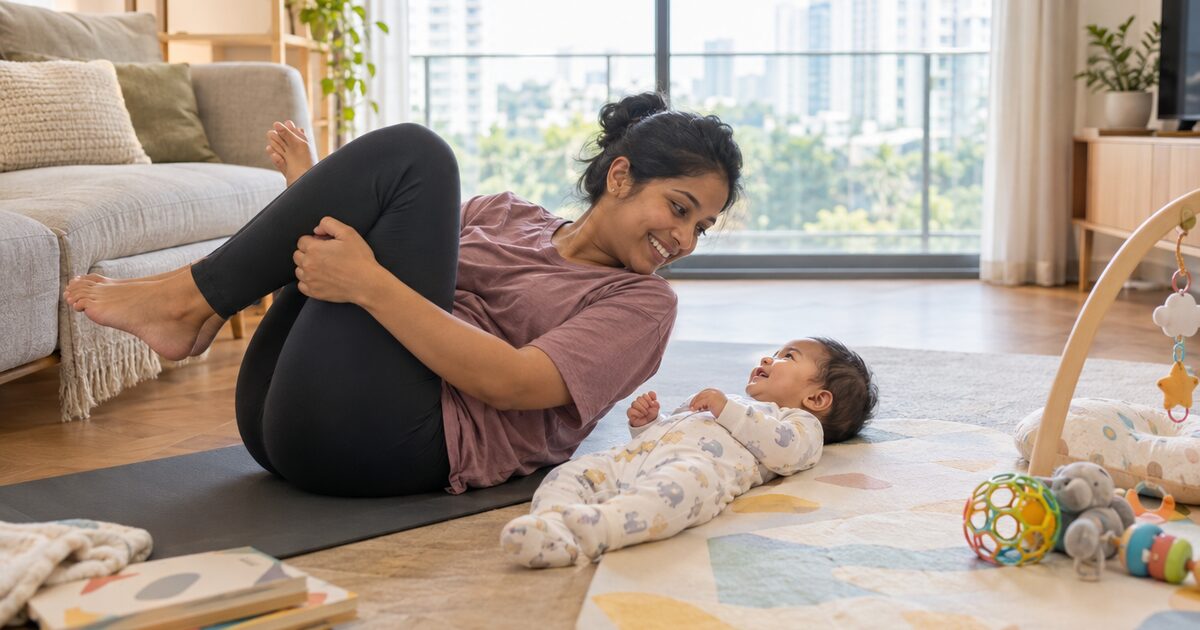
- Clear a spot on the floor and put your baby on a play mat or in the cot, where you can see them. HealthHub says to pick a spacious area free of trip hazards, keep a water bottle nearby, and skip the session if you feel unwell.
- Squeeze your pelvic floor as if you're stopping a wee, then let go. KKH suggests holding for three seconds and relaxing for three, building up to 10-second holds; our pelvic floor guide has the full routine.
- Breathe normally while you squeeze. The NHS says not to pull your stomach in at the same time.
- Lie on your side, knees bent, and breathe out as you draw your lower tummy in like a corset and squeeze your pelvic floor. The NHS says to hold for a count of 10, up to 10 times.
- Add pelvic tilts: lie on your back with knees bent, tighten your lower tummy and gently roll your tailbone up so your lower back flattens. The Royal Women's Hospital in Melbourne says to repeat it as many times as feels comfortable.
- Roll onto your side before you get up from the floor or bed, then push up with both hands. The Royal Women's Hospital says this log roll supports your stomach muscles.
- Squat or kneel to pick your baby up from the mat, keeping your back straight, as the NHS advises. For the first six weeks, the Royal Women's Hospital says to lift nothing heavier than your baby.
- Walk with your baby in the pram or a carrier once walking feels comfortable, with your back straight. HealthHub says to raise your walking speed bit by bit once you're ready for moderate exercise.
- Build up slowly. HealthHub says to start slow and then gradually increase how long and how often you exercise.
- Ask about a women's health physiotherapist at your postnatal check if you leak, ache or still see a gap down your tummy. A KKH senior physiotherapist says a full postnatal programme usually starts six to eight weeks after the birth.
What each exercise works, and when to stop
Each move has its own job. If one hurts more as you go, or your bleeding gets heavy again, stop it and tell your doctor. The table draws on KKH, the NHS and the Royal Women's Hospital.
| Exercise | What it works | Stop and check if |
|---|---|---|
| Pelvic floor squeezes | The muscles that stop urine leaking | You still leak once your baby is three months old |
| Deep tummy draw-in | Posture and back support | The gap down your tummy is still obvious at 8 weeks |
| Pelvic tilt | The lower back curve that deepens in pregnancy | The pain gets worse as you go |
| Walking with the pram | Your general health and fitness | Bleeding gets heavy again after it had eased |
| Sit-ups, planks and running | Wait: no high-impact work in the first 12 weeks | You leak when you cough or jump with a full bladder |
That last test comes from the Royal Women's Hospital. Before high-impact exercise, cough or jump with a full bladder. If no urine leaks, you're ready for more.
Tummy gap after birth: what helps diastasis recti
Diastasis recti is a gap between the two long muscles down the front of your tummy. A KKH senior physiotherapist describes it as the connective tissue between the six-pack muscles pulling apart. Postnatal physiotherapy treats it.
The NHS says the gap is common, usually about 2 finger widths, and normally closes by the time your baby is 8 weeks old. Regular pelvic floor and deep tummy exercises, like steps 2 to 4 above, can help make it smaller.
To start with, the NHS advises avoiding sit-ups, planks and high-impact exercise, plus straining on the toilet and heavy lifting. Keep to that until your doctor or physio has checked the gap. To check it yourself, use the finger test in our guide to exercise after giving birth, which also sets out when each kind of birth can start.
Fitting exercise into confinement, with family at home
Confinement often means plenty of rest at home, and KKH agrees rest matters. It advises resting your back and catching some rest when your baby sleeps. The same KKH page encourages postnatal exercise to firm up your tummy, hips and thighs. A short floor routine fits both.
Pelvic floor squeezes need no mat. The NHS says you can do them lying down, sitting or standing, and with practice, anywhere. Sitting on the toilet is a handy reminder, as long as you do them after you've finished.
If a helper or grandparent is home, ask them to hold the baby while you do the floor routine or go for a walk. The NHS suggests changing nappies on a raised surface, kneeling beside a bed or sofa, and never leaving your baby alone up there.
If your family keeps you and the baby indoors during confinement, start with laps of the flat. When you do head out, our guide on when a newborn can go outside covers heat and sun, and confinement myths looks at other customs. After a C-section, KKH says to avoid strenuous activity that may cause injury or pain; our C-section recovery guide covers safe tummy moves.
Classes and gyms for new mums in Singapore
KKH runs regular postnatal exercise classes at the hospital on weekends. Call its Patient Education Centre on 6394 1268 to ask about them.
Back pain, leaks and prolapse are common problems that postnatal physiotherapy treats, a KKH senior physiotherapist says. A full programme can last up to a year. It includes learning to feed and lift your baby with less strain on your back and pelvis.
Thinking of a public gym? ActiveSG's rules say children under 12 can't enter its gyms, so you'll need someone to mind the baby. ActiveSG also suggests new users ask the fitness instructor for a gym orientation.
At home, HealthHub suggests a mix of cardio, strength, balance and flexibility, such as low-impact aerobics, modified Pilates and postnatal yoga. For classes, our guides to postnatal yoga and postnatal Pilates cover when to start and what to ask a studio. If weight is part of your goal, see losing weight after giving birth for a realistic pace.
When to see a doctor
Stop exercising and get checked if you notice any of these. They're reasons to see a doctor, not a diagnosis.
- Bleeding that gets heavy again after it had eased. KKH says to see your doctor; our postpartum bleeding guide shows what's normal week by week.
- Heavy vaginal bleeding or bad tummy pain. KKH says to get medical attention right away at its Urgent O&G Centre or your nearest emergency department.
- Perineal pain that is severe or getting worse. KKH lists this as a reason to see your doctor.
- Bleeding, redness or pus around a C-section wound, or a fever. KKH says to return to the hospital.
- Leaking urine once your baby is three months old. The Royal Women's Hospital suggests a women's health physiotherapist or GP; see leaking urine after pregnancy.
- A heavy feeling or a bulge in your vagina. A KKH senior physiotherapist describes pelvic organ prolapse as the bladder, womb or bowel dropping into the vagina; read more in prolapse after childbirth.
- A gap down your tummy that's still obvious 8 weeks after the birth. The NHS says to see your doctor, who can refer you to a physiotherapist.
- Breathlessness or very heavy bleeding. SCDF lists both as emergencies: call 995.
If you delivered at KKH, its Urgent O&G Centre in Basement 1 of the Women's Tower is a 24-hour walk-in centre that sees post-pregnancy problems. If you delivered elsewhere, call that hospital or your gynae's clinic. For an emergency, call 995. Our guide to postnatal recovery after birth has the full list of red flags.
Frequently asked questions
What are safe diastasis recti exercises after birth?
Start with pelvic floor squeezes and the deep tummy draw-in from steps 2 to 4. The NHS says regular pelvic floor and deep stomach exercises can help make the gap smaller. Skip sit-ups and planks to start with, and ask for a physiotherapist if the gap is still obvious at 8 weeks.
Is ab separation after pregnancy normal?
Yes, it's common. The NHS says the two long tummy muscles often part by about 2 finger widths in pregnancy, and the gap usually closes by the time your baby is 8 weeks old. A KKH senior physiotherapist says postnatal physiotherapy treats it.
What should I avoid with a tummy gap after birth?
The NHS advises avoiding sit-ups, planks, high-impact exercise, straining on the toilet and heavy lifting to start with. Roll onto your side to get out of bed, and for the first six weeks lift nothing heavier than your baby, as the Royal Women's Hospital suggests.
Can I do a postpartum workout at home in the first week?
Yes, a gentle one. The Royal Women's Hospital says pelvic floor and deep tummy exercises can start when you feel ready, as long as your pain doesn't increase. It also says to avoid strenuous and high-impact exercise, such as weights, sit-ups or running, for the first 12 weeks.
Are there gyms for new mums in Singapore?
KKH runs postnatal exercise classes at the hospital on weekends; call its Patient Education Centre on 6394 1268. ActiveSG gyms don't allow children under 12, so plan for someone to mind the baby. Postnatal yoga and Pilates classes are another option, and our guides explain when to start.
Can I exercise during confinement?
Yes, gently. KKH advises plenty of rest during confinement and also encourages postnatal exercise to firm up your tummy, hips and thighs. Pelvic floor squeezes and the lying-down moves above fit around feeds and naps.
- KKH (SingHealth), Going Home After Your Delivery in KKH (read 6 Nov 2026)
- KKH, Urgent O&G Centre (read 6 Nov 2026)
- SGH, What is contributing to Singapore's physiotherapy upswing? (KKH senior physiotherapist on postnatal physiotherapy) (read 6 Nov 2026)
- HealthHub, The Post-Partum Weight Loss Journey (read 6 Nov 2026)
- ActiveSG (Sport Singapore), ActiveSG Rules and Regulations: Gymnasium (read 6 Nov 2026)
- SCDF, Emergency Medical Services (read 6 Nov 2026)
- NHS (UK), Your post-pregnancy body (read 6 Nov 2026)
- The Royal Women's Hospital Melbourne, Exercise after birth (read 6 Nov 2026)
Back pain after pregnancy: why it happens, feeding and carrying tips, safe stretches and when to see a physio
Back pain after pregnancy is common. Feeding, carrying and lifting tips from Singapore hospitals, gentle stretches, red ...
7 min read
C-section in Singapore: planned or emergency, what happens on the day, costs and recovery
C-section in Singapore: the day, MOH bills by hospital and recovery tips week by week, with wound infection signs, scar ...
24 min read
How to check a confinement nanny agency's licence with MOM
Check a confinement nanny agency's licence in MOM's directory: each step, the fields it shows, the work permit and what ...
7 min read