

How to raise kind, empathetic kids: what helps at each age
In this article
To raise kind, empathetic kids, show them what kindness looks like and give them words for feelings. Name your own feelings and theirs, thank the people who help you, and let your child help too. Harvard's Making Caring Common project says children are born with the capacity for empathy, but it grows with practice and guidance.
How to raise kind, empathetic kids, step by step
- Name your own feelings out loud. "I'm frustrated the lift is slow, so I'm taking a big breath."
- Before you fix anything, name your child's feeling. MOE suggests lines like "It sounds like you're feeling anxious" and asks parents to validate what a child feels.
- Point out other people's feelings as they happen: "That baby is crying. Maybe he's hungry." Families for Life says more feeling words help children understand what others go through.
- Thank people where your child can hear you: your helper, the hawker uncle, the bus driver. Harvard's project notes that children see it when adults treat a server or a mail carrier as if they're invisible.
- Play pretend with a soft toy that has feelings. KKH's child development team says doll play helps children practise sharing and relate to how others feel.
- Read picture books together and pause to ask, "How does she feel? Why?" Harvard's project suggests noticing kind and unkind acts together, in daily life or in a book.
- Give your child real jobs at home. Families for Life suggests age-appropriate chores, and the CDC says most 4-year-olds like to be a helper.
- Say what you saw when your child is kind: "You gave Mei Mei the red crayon, and she's smiling." Families for Life suggests making compliments a family habit.
- If your child hurts someone, calm them first, then help them fix it. Harvard's project suggests you stop, take a deep breath and count to five together.
- Agree on the same words with everyone who cares for your child. Families for Life asks parents to stay consistent, so children don't get mixed messages.
How empathy grows by age
Empathy often shows up in play first, then in how your child treats people. The table pulls from KKH's doll play guide, the CDC's milestones and MOE's aims for preschool and primary school. The CDC says a milestone is something most children, 75% or more, can do by that age. Treat the ages as a rough guide.
| Age | What you may see | How to build it |
|---|---|---|
| 18 months | Hugs, feeds or puts a doll to bed (KKH) | Give the doll a voice: "Teddy is sleepy." |
| 2 to 2.5 years | Treats a doll as alive and says it's hungry (KKH) | Ask what the doll needs, then help it together |
| 3.5 years | Gives a doll a feeling, like being scared of the dark (KKH) | Ask how a book character feels, and why |
| 4 years | Comforts a friend who is hurt or sad, and likes to help (CDC) | Give small jobs and thank them for helping |
| 4 to 5 years | Acts out scenes and says what the doll thinks and feels (KKH) | Role-play a fight over a toy, then fix it |
| End of preschool | Shows care and respect for others, and shares and plays (MOE) | Ask the teacher how your child treats others |
| Primary school | Learns that empathy means caring about other people's feelings and views (MOE) | Talk through a classmate's side of the story |
If your child seems unkind, look at what they're feeling. Harvard's project says children often do have empathy, but anger, shame or envy can block it. Calm the feeling first, then talk about the other child.
Teaching emotional intelligence starts with feeling words
Emotional intelligence starts with knowing what you feel, so begin with four words: happy, sad, angry and scared. As your child grows, add frustrated, worried, proud and left out. Families for Life says a bigger set of feeling words helps children express themselves and understand others.
When your child is upset, listen first. MOE suggests giving big feelings space and time before you give advice. It offers lines like "I'm sorry that you are having a hard time with this." Your calm voice shows your child what empathy sounds like.
For talking about worries and signs of stress, see our guide to child mental health in Singapore.
Kindness with helpers, grandparents and neighbours
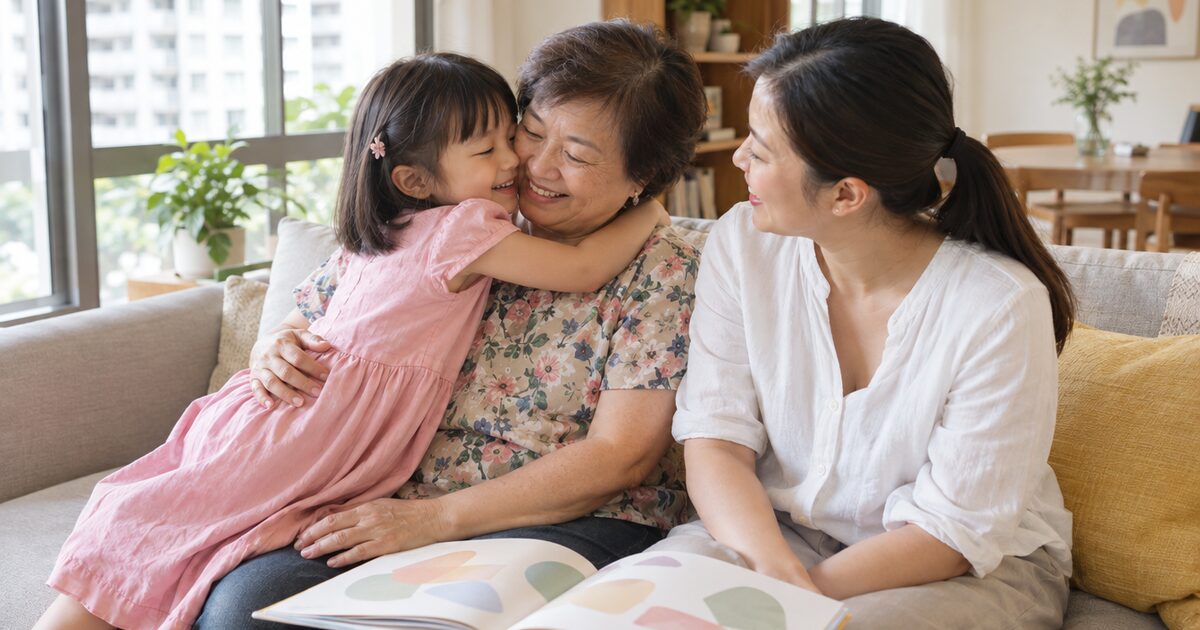
If a helper or grandparents care for your child, your child learns kindness from them too. Let your child hear how you speak to your helper: her name, please and thank you.
MOE asks parents to show care and appreciation to older family members, and to encourage children to thank their grandparents. A drawing for Ah Gong or a call to Nai Nai counts.
Agree on two or three shared lines with every carer, like "Gentle hands" and "How do you think she feels?" Families for Life warns against mixed messages, such as bad-mouthing others in front of children.
HDB life gives you small chances every day, like holding the lift for a neighbour or greeting the cleaner at the void deck. Clear your tray together at the hawker centre. Harvard's project calls this widening your child's circle of concern beyond family and friends.
What preschool and primary school teach
MOE's Nurturing Early Learners framework shapes the preschool curriculum for children aged 4 to 6. Its four core values are respect, responsibility, care and honesty. By the end of preschool, it hopes children can share and play with others, and show care and respect for others.
In primary school, MOE's Character and Citizenship Education covers empathy in its Family Education lessons. Children learn that empathy means care for other people's feelings, thoughts and points of view, and they practise active listening.
At the parent-teacher meeting, ask about kindness as well as marks. Harvard's project suggests asking teachers whether your child is a caring member of the class.
When your child hurts someone
If your child grabs, pushes or says something mean, stay calm before you correct. MOE calls this connection before correction. Understand your child first, then guide them to repair the relationship.
A quick "sorry" is a start. Help your child look at the other child's face and offer a fix, like a tissue, a turn or a hug if it's wanted. "Ah Ma's foot hurts. What can we do?" Then say sorry yourself when you get it wrong. Families for Life says to apologise to your child and explain.
Families for Life describes the balance as loving and firm. Our guide to parenting styles covers why warmth with clear limits works, and discipline without shouting shows how to set those limits. For hitting and biting, read child hitting and aggressive behaviour. For toy fights, see how to teach a toddler to share and sibling rivalry.
When to get help
These signs are reasons to talk to your GP, polyclinic doctor or paediatrician. Only a professional can assess your child. NUH's Child Development Unit says to speak with your child's doctor if you notice a red flag or have any concern about development.
- No pretend play by 2.5 years (NUH).
- By 3 years, doesn't play with other children or toys, or can't tell what others feel from their faces (NUH).
- By 4 years, ignores other children or doesn't respond to people outside the family (NUH).
- Loses a skill they once had, at any age (NUH and the CDC).
- Behaviour problems at home or preschool, or trouble getting along with other children. KKH's Department of Child Development helps preschoolers with these after a referral from your family doctor.
Ask your child's preschool teacher what they see, too. KKH's psychologists may ask the teacher for information. If some of these signs fit, read early signs of autism and raise them at your child's next developmental check. For a school-age child, our child mental health guide covers school counsellors.
Frequently asked questions
How do I teach my child emotional intelligence?
Start with feeling words. Name what you feel and what your child seems to feel, and add new words as they grow. Families for Life says more feeling words help children express themselves and understand others. Listen before you advise, as MOE suggests.
How do I teach kids empathy when they're only 2?
Use play. KKH says doll play helps children relate to how others feel, and its guide lists treating a doll as alive at 2 years. Give a soft toy feelings and needs, and let your child care for it. Name real feelings as they happen, too.
How do I raise kind kids?
Tell them kindness matters as much as happiness. Harvard's project suggests swapping "The most important thing is that you're happy" for "The most important thing is that you're kind and that you're happy." Then give them chances to help, and notice it when they do.
At what age do children show empathy?
Harvard's project says children are born with the capacity for empathy, and it grows over years. KKH's guide shows children giving a doll feelings at about 3.5 years. The CDC says most 4-year-olds comfort a friend who is hurt or sad.
Should I make my child say sorry?
Sorry is a start. Help your child calm down, notice how the other child feels and offer a fix. MOE suggests guiding children to restore the relationship. Show them how by apologising when you get things wrong, as Families for Life advises.
What if my helper and the grandparents do it differently?
Agree on two or three shared lines and one plan for grabbing and hitting. Families for Life says being consistent avoids confusing children. Write the lines down for your helper, and thank the grandparents for what they already do.
- Ministry of Education, How to parent with empathy (Family Education infographic) (read 6 Nov 2026)
- Ministry of Education, Nurturing Early Learners (NEL) Framework (read 6 Nov 2026)
- Families for Life, Kindness starts young (read 6 Nov 2026)
- KK Women's and Children's Hospital, Department of Child Development: Doll play (read 6 Nov 2026)
- KK Women's and Children's Hospital, Psychological assessment and intervention (read 6 Nov 2026)
- National University Hospital, Child Development Unit: Concerned about your child's development? (read 6 Nov 2026)
- CDC, Milestones by 4 years (read 6 Nov 2026)
- Harvard Graduate School of Education, Making Caring Common: 5 tips for cultivating empathy (read 6 Nov 2026)
ADHD in children in Singapore: early signs, assessment and support
ADHD in children in Singapore: how it differs from a lively preschooler, when doctors assess it, the polyclinic route an...
9 min read
Asthma in children in Singapore: signs, inhalers and what to do in an attack
Asthma in children in Singapore: the signs, reliever and preventer inhalers, using a spacer, the action plan, and when t...
8 min read
Balanced diet for toddlers in Singapore: plates, servings, sugar, tea and salt
A balanced diet for toddlers in Singapore: HPB's plate, daily servings for ages 1 to 6, hawker picks, and the advice on ...
9 min read