

How to teach your toddler to share, and help them make friends
In this article
You teach a toddler to share by starting with turns. Pass toys back and forth, use a timer when two children want the same thing, and say what you saw when your child waits or hands something over. It comes slowly, and that is expected: ECDA places parallel play, where children play side by side without talking, at ages 2 to 3, and Families for Life says many 3 to 5 year olds still find it hard to wait or give up a favourite toy.
How to teach your toddler to share, step by step
- Start with turns. Roll a ball back and forth and say "My turn, your turn." Families for Life says play is a good way to teach turn-taking.
- Share in front of your child and say it out loud: "I'm giving Papa half my kaya toast." Families for Life says children learn by watching adults.
- Bring out a timer when two children want one toy. Families for Life suggests a few minutes each, then you help them swap when it rings.
- Name the wait and give them something to do: "Aisha has the scooter now. You're next. Let's dig while we wait." Families for Life suggests naming both children's feelings and the idea of waiting.
- Leave the toy in your child's hands instead of making them give it up. Families for Life advises staying calm and guiding children to a fair answer, not forcing them to share on the spot.
- Tell your child exactly what they did: "You gave Arjun a turn. Look, he's smiling." Families for Life suggests praise for waiting patiently as well as for sharing.
- Put a few special toys away before a friend comes over. Families for Life also suggests telling your child which toys are for sharing.
- Stay close, and step in fast if a grab turns into a push. The AAP says to stop a child from hurting others and move them away from the group if they don't calm down quickly.
- Give every adult who minds your child the same words and the same timer rule, so your helper, the grandparents and the preschool teacher all say "My turn, your turn."
What sharing looks like at each age
Sharing asks a small child to wait, give something up and see another child's side, and those skills grow with play. ECDA's Beanstalk sorts play into four stages by age. Here is what each stage means for sharing.
| Age | How your child plays | What sharing looks like |
|---|---|---|
| 0 to 2 years | Plays alone, with a toy or a board book (ECDA) | Turns with you, like a ball passed back and forth |
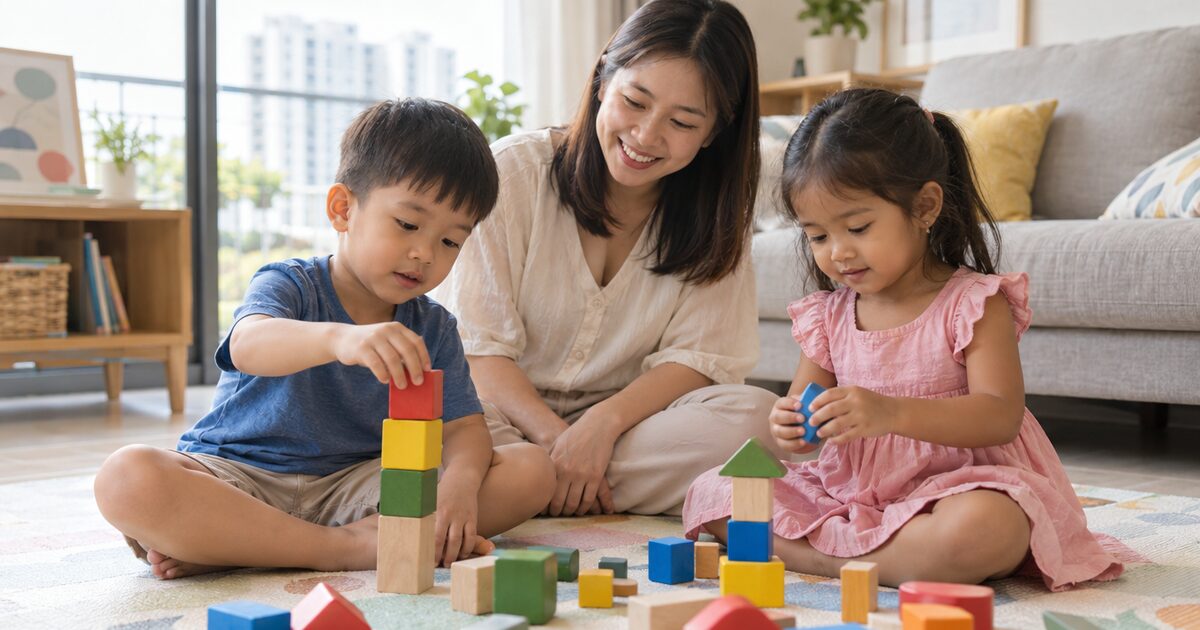
| 2 to 3 years | Plays next to other children with the same toys, without talking to them (ECDA) | Watches and picks up social cues and words (ECDA). You run the turns |
| 3 to 4 years | Plays side by side and chats, but each child does their own thing (ECDA) | Can settle a toy fight by taking turns or trading, with your help (AAP). Waiting is still hard (Families for Life) |
| 4 to 6 years | Plays together on one plan, like building a block tower (ECDA) | Learns teamwork, self-control and how others see things (ECDA). Starts to pick friends (AAP) |
So when your 2-year-old holds on tight to a toy, that fits the stage. Aim for turns now and fuller sharing later. Our guide to learning through play has activities for each stage, and toddler milestones covers the checks in the Child Health Booklet.
How to plan a toddler playdate
A first playdate works best small and short, with one thing the children can do side by side.
- Invite one or two children. Raising Children Network says starting with 1 to 2 friends can work well if your child is slow to warm up.
- Set an end time before they arrive and finish while everyone still wants more. Raising Children Network says tired children find it harder to cooperate.
- Put special toys out of sight first, in a bedroom cupboard or behind a closed door if your flat is small.
- Set out one activity, such as painting or blocks. Families for Life says side-by-side play like this lets toddlers share a space without the pressure of taking turns.
- Keep a snack on hand, which Families for Life says keeps the mood light.
- Stay nearby without hovering. Families for Life says stepping in too fast gives toddlers fewer chances to sort out small hiccups themselves.
Short of space at home? Meet at the playground downstairs. ECDA says playgrounds suit the stage where children share equipment without a shared plan. Our playgrounds guide lists places to try.
How to help your child make friends
Families for Life says toddlers don't yet understand that friendship takes sharing and turns, and that playing together at home builds those skills. Role play with soft toys is an easy start: let a teddy ask your child politely for a turn, then let your child answer.
At the playground, help your child watch first and then join in. Raising Children Network suggests pointing out what other children are doing so your child can see a way in. Give them a short line to try:
- "Can I play too?"
- "Can I have it after you?"
- "Do you want to dig with me?"
- A wave and "Hi" counts. Families for Life says to celebrate small steps like waving hello or sitting near another child.
Some toddlers like to watch for a while before they join. Families for Life says this is normal and advises against pushing. If your child holds back with new people, see our guide to a toddler who is shy with strangers.
At preschool, ask the teacher who your child plays with and how they get on. Families for Life calls teachers partners in supporting friendships. Then invite a classmate over. Raising Children Network says playdates with preschool friends can help a child feel more confident there. For the bigger picture on empathy, see how to raise kind kids.
One set of words for every adult who minds your child
If a helper or grandparents look after your child as well as a preschool, agree on one plan. HealthHub advises clear and consistent boundaries, and Families for Life asks grandparents to keep to the parents' rules on discipline. Your turn-taking rules belong on that list.
Sit down together and agree on the words you use, the timer, and what happens when a child grabs. Agree too that a squabble gets settled by the timer, not by taking a toy away to hand to a visiting cousin. A note on the fridge helps a new helper, and our new helper checklist covers the first weeks. For toy fights between brothers and sisters, see our sibling rivalry guide.
When to get help
Families for Life says toy squabbles are a normal part of childhood. These signs are reasons to talk to a doctor, not a diagnosis. Only a doctor can assess your child.
- By 3 years, your child doesn't play with other children or with toys (NUH Child Development Unit).
- By 4 years, your child ignores other children or doesn't respond to people outside the family (NUH).
- By 4 years, your child can't tell how others feel from their faces (NUH).
- Your child prefers to be alone, or has trouble understanding other people's feelings. HealthHub lists both among signs to raise with your doctor. Our guide to early signs of autism explains more.
- Your child loses a skill they had, at any age (NUH).
- Another child keeps hurting or leaving out your child at preschool. Raising Children Network says a parent or teacher should step in if it looks like bullying. See bullying in preschool for what to do.
Start with your family doctor, a polyclinic doctor or your paediatrician. HealthHub says they can do a developmental assessment and may refer your child to the Child Development Unit at NUH or the Department of Child Development at KKH. Ask the other adults who care for your child, including the preschool teacher, what they see. HealthHub says this shows the doctor how your child does in different settings. Our paediatrician map lists clinics across Singapore.
Frequently asked questions
At what age can a toddler share?
Turn-taking comes first. ECDA places parallel play at ages 2 to 3, when children play beside each other with little contact. The AAP says 3-year-olds can settle disputes by taking turns or trading toys, with an adult's encouragement. Families for Life says many 3 to 5 year olds still find waiting hard.
Should I force my toddler to share?
No. Families for Life advises staying calm and guiding children to a fair answer instead of forcing a hand-over. Use a timer, or find another toy while your child waits. It's fine to keep a few special toys just for your child.
How long should toddler playdates be?
Short enough that everyone leaves wanting more. Raising Children Network says tired children find it harder to cooperate and suggests setting a time limit. Start with one or two friends and one activity.
How do I help my child make friends at preschool?
Ask the teacher who your child plays with, then invite that child over. Practise a join-in line at home, like "Can I play too?" Families for Life also suggests role play with soft toys and picture books about friendship and sharing.
What do I do when my toddler grabs toys?
Step in, give the toy back to the child who had it, and say what comes next: "Mei is using it. You're next." The AAP suggests giving your child the words they need and a simple fix, like drawing for the first turn or finding another toy. If grabbing turns into hitting, see our guide to hitting and aggressive behaviour.
- Families for Life (MSF), Sharing and Learning to Share: Young Children (read 6 Nov 2026)
- Families for Life (MSF), Toddlers Making Friends (read 6 Nov 2026)
- Families for Life (MSF), How to Grandparent in Style (read 6 Nov 2026)
- ECDA Beanstalk, Learning Through Play at Their Own Pace (read 6 Nov 2026)
- HealthHub, Is My Child Developing Well? (read 6 Nov 2026)
- NUH Child Development Unit, Concerned About Your Child's Development? milestones poster (read 6 Nov 2026)
- American Academy of Pediatrics (HealthyChildren.org), Social Development in Preschoolers: Learning How to Share and Cooperate (read 6 Nov 2026)
- Raising Children Network, Preschooler friendships: how they develop and tips to help (read 6 Nov 2026)
ADHD in children in Singapore: early signs, assessment and support
ADHD in children in Singapore: how it differs from a lively preschooler, when doctors assess it, the polyclinic route an...
9 min read
Asthma in children in Singapore: signs, inhalers and what to do in an attack
Asthma in children in Singapore: the signs, reliever and preventer inhalers, using a spacer, the action plan, and when t...
8 min read
Balanced diet for toddlers in Singapore: plates, servings, sugar, tea and salt
A balanced diet for toddlers in Singapore: HPB's plate, daily servings for ages 1 to 6, hawker picks, and the advice on ...
9 min read