

How to get your child to love reading: a Singapore plan from toddler to K2
In this article
- How to get your child to love reading, step by step
- A reading plan from toddler to K2, with help from NLB
- When to teach your child to read
- Books in two languages, and grandparents who read
- Screens, ebooks and the NLB app
- Best children's books in Singapore: where to find the lists
- When to get help
- Frequently asked questions
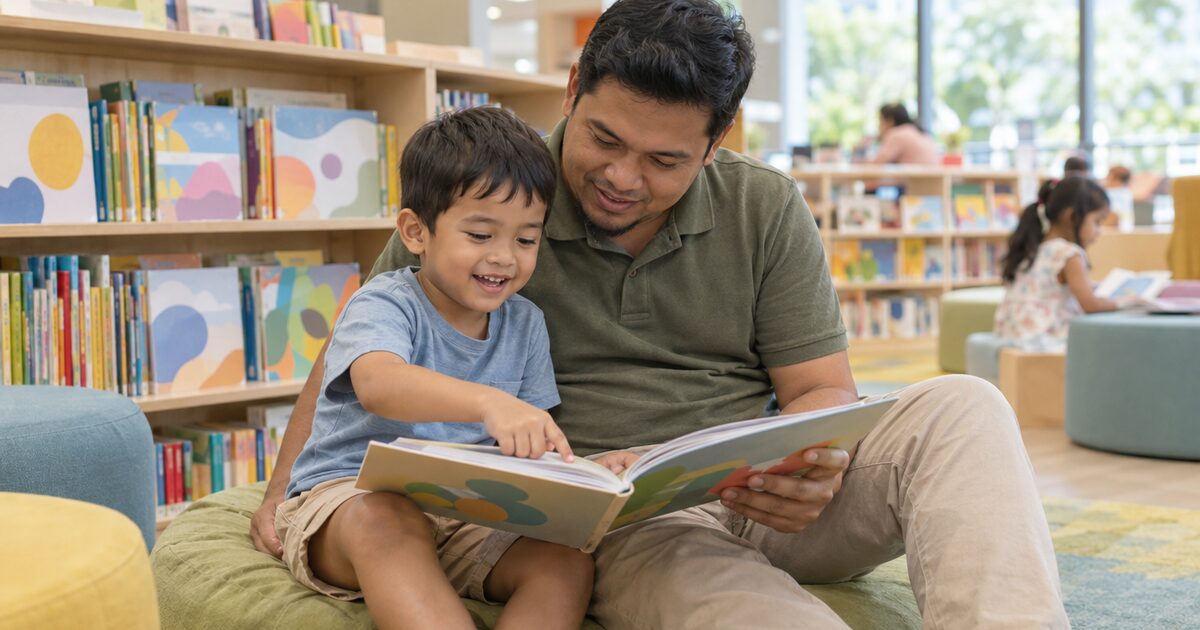
Read aloud with your child every day, and let them pick the book. That's how to get your child to love reading long before they can read the words. Add regular library trips, and stop while your child still wants more. Decoding words comes later. MOE's own goal for preschoolers is reading "with enjoyment and understanding".
How to get your child to love reading, step by step
- Read aloud every day, even when it's one short book. Raising Children Network suggests at least one book a day, and the AAP suggests 20 to 30 minutes with the TV off at a preschooler's bedtime.
- Let your child choose the book, and now and then put something new beside their pick.
- Read the favourites as often as your child asks. The AAP says babies love the same book again and again, and Raising Children Network says many preschoolers "read" a favourite story from memory.
- Talk about the pictures as you go, pointing at things and asking "What do you think happens next?" Then hand it over: the AAP suggests letting your child tell the story from the pictures, with you as the audience.
- Make the library part of your week, since it's dry when it rains. HealthHub lists NLB storytelling sessions and screen-lite programmes for children aged 0 to 12.
- Read in your home language too, because Raising Children Network says to use whatever language you're most comfortable speaking. Grandparents can read in Mandarin, Malay, Tamil or dialect.
- Let your child catch you reading the paper or writing a shopping list. Raising Children Network says simple reading and writing like this builds a home where literacy grows.
- Keep it pressure-free, and stop when your child wriggles off; the AAP says you don't need to finish the book. MSF's Families for Life notes some children aren't ready to read on their own before 5 or 6, and pushing can backfire.
A reading plan from toddler to K2, with help from NLB
Use this as a rough map, not a timetable. The book types come from Raising Children Network, and the lists and programmes are NLB's own. In NLB children's sections, look for the Early Literacy shelves, with names like Songs & Rhymes or Emergent Readers.
| Age | Books that suit | What you may see | NLB help |
|---|---|---|---|
| 1 to 3 years | Sturdy pages and lift-the-flap books. Stories with rhyme and repetition that you can read in 4 to 5 minutes. | Brings you favourite books and names things in the pictures. May pretend to read by turning the pages. | NLB's Suggested Reads has lists for 0 to 3, and one of them is Mother Tongue books. |
| 3 to 5 years | Alphabet and counting books, plus simple stories about family life and going to school. | Points out letters in their name. Retells favourite stories in their own words. | Storytelling and screen-lite sessions at branches. The "I Can Be..." Storytime Series runs from age 4. |
| 4 to 6 years | Picture books about family and friendship, from NLB's lists for 4 to 6. | May know some or all letter sounds at 5 to 6. By 6, starts reading simple stories with words that sound the way they're spelled. | Early READ Storytime for 4 to 6 year olds. kidsREAD clubs for children aged 4 to 8 from lower-income families. |
Your child can join the library as a baby. NLB started its Born to Read, Read to Bond programme in November 2001 so babies a day old could become members. For how to sign up and what you can borrow, see our guide to children's libraries in Singapore. For play ideas that go with the books, see learning activities for preschoolers.
When to teach your child to read
There's no set day to start. Raising Children Network says reading skills develop at different ages in different children. The groundwork comes from what you already do: talk, sing, rhyme and read aloud.
MOE's Nurturing Early Learners framework shapes preschool teaching for children aged 4 to 6. Its English goals include listening "for enjoyment and information" and reading "with enjoyment and understanding". For writing, it counts "letter-like shapes" and "invented" spelling alongside conventional spelling. MOE says teachers and parents both help children work towards these goals.
Raising Children Network says that at 5 to 6, children may know some or all of the letter sounds. By 6, they start reading simple stories with words that sound the way they're spelled. At the start of Primary 1, teachers screen for language and literacy, MOE says. Children who need a boost join the Learning Support Programme: half an hour of English a day, in groups of 8 to 10.
For letters, sounds and the signs your child is ready for phonics, see our phonics guide. For pencils and first letters, see how to teach your child to write, and for the move to school, the Primary 1 preparation checklist.
Books in two languages, and grandparents who read
MOE's preschool goals include that children "enjoy and show an interest in" their Mother Tongue Language. The habits above work the same way in any Mother Tongue.
NLB's 0 to 3 Languages list has Chinese, Malay and Tamil books, shelved under Early Literacy Languages. Raising Children Network says to read and tell stories in the language you're most comfortable speaking. So if Ah Ma reads in Hokkien and you read in English, your child hears both.
Picture books work without reading the words, too. A helper or grandparent who doesn't read English can still point at the pictures and talk about them. For more on two languages at home, see raising a bilingual child in Singapore.
Screens, ebooks and the NLB app
The Singapore Integrated 24-Hour Activity Guidelines advise no screen time before 18 months, and less than 1 hour a day after that. When a toddler is sitting still, the guidelines would rather you share a song or a story than a screen. The AAP says digital books don't give the same parent-child back-and-forth as print.
NLB's early-literacy sheets point parents to the NLB Mobile app for more resources. If you read ebooks there, read them together and skip ones with games or animations, as Raising Children Network suggests. For limits by age, see managing screen time for kids.
Best children's books in Singapore: where to find the lists
We don't rank books. Two Singapore sources do the choosing for you.
NLB's Raise A Reader: Suggested Reads page, updated Oct 2026, groups books by age and theme. The 0 to 3 lists include one of touch-and-feel books and one in Mother Tongue languages. The 4 to 6 lists are on family and friendship. Each book comes with its section and call number, so you can find it on the shelf.
The Singapore Book Council gives the Hedwig Anuar Children's Book Award every two years to a children's book by a Singapore citizen or PR. The 2026 picture book winner is Street Puppy Masjid Cat by Moniza Hossain, illustrated by Wastana Haikal. In 2024 it was Grandma's Tiger by Alan John and Quek Hong Shin. The council's page lists past winners and shortlists too.
Ready to buy or borrow? See where to buy children's books in Singapore.
When to get help
Some signs are worth raising with your polyclinic, GP or paediatrician. NUH's Child Development Unit lists these among its red flags:
- Your 3-year-old can't turn the pages of a board book one page at a time.
- Your 4-year-old can't speak in 4 to 5 word sentences, or can't retell a favourite story.
- Your child, at any age, loses a skill they once had.
Raising Children Network adds two at age 4: not liking to be read to, and not being able to talk about a story you've read together. HealthHub says your family doctor, polyclinic doctor or paediatrician can do a developmental assessment. They may refer a preschooler to NUH's Child Development Unit or KKH's Department of Child Development. Only that team can tell you what's going on.
For reading-related signs, see dyslexia signs in preschoolers. For late talking, see toddler speech milestones and delay.
Frequently asked questions
When should I teach my child to read?
Start with read-alouds from birth. The AAP recommends shared reading from birth through at least kindergarten. Raising Children Network says children may know letter sounds at 5 to 6 and read simple stories by 6. MOE's preschool goals stress reading for enjoyment, and Primary 1 teachers screen for children who need extra help.
What are the best children's books in Singapore?
We don't rank them. Start with NLB's Suggested Reads lists, sorted by age, and the winners and shortlists of the Hedwig Anuar Children's Book Award, which goes to Singapore authors. NLB gives each book's call number, so you can find it at your library.
How long should I read to my toddler each day?
Aim for a daily habit rather than a set time. Raising Children Network suggests at least one book a day, and stopping when your toddler has had enough. For preschoolers, the AAP suggests 20 to 30 minutes with the TV off at bedtime.
My toddler won't sit still for a story. What can I do?
Raising Children Network says some days your toddler won't want to read for long, and that's OK, while the AAP says a baby who looks away or arches their back is asking for a break, and it's fine to stop there. Try a short flap book, or read aloud while your toddler plays nearby.
Can grandparents read to my child in Mandarin or dialect?
Yes. Raising Children Network says to read in the language you're most comfortable speaking, and MOE wants preschoolers to enjoy their Mother Tongue. NLB has a reading list for 0 to 3 year olds with books in all three Mother Tongue languages.
Do ebooks and audiobooks count?
They can help, as long as you use them together. The AAP says digital books don't give the same parent-child back-and-forth as print, so stop now and then to talk about the story. Raising Children Network suggests ebooks without games or animations, and not letting them replace paper books.
- Ministry of Education, Preschool curriculum: Nurturing Early Learners (NEL) Framework (read 6 Nov 2026)
- Ministry of Education, Learning support in primary schools (read 6 Nov 2026)
- National Library Board, Raise A Reader: Suggested Reads (read 6 Nov 2026)
- NUH Child Development Unit, Developmental milestones red flags poster (read 6 Nov 2026)
- KKH and College of Paediatrics and Child Health, Singapore Integrated 24-Hour Activity Guidelines for Early Childhood, summary (read 6 Nov 2026)
- HealthHub, Is my child developing well? (read 6 Nov 2026)
- Singapore Book Council, Hedwig Anuar Children's Book Award (read 6 Nov 2026)
- Raising Children Network, Reading with toddlers (read 6 Nov 2026)
ADHD in children in Singapore: early signs, assessment and support
ADHD in children in Singapore: how it differs from a lively preschooler, when doctors assess it, the polyclinic route an...
9 min read
How to boost brain development in your child from 1 to 6: what works and what's marketing
Everyday ways to boost brain development in your child from 1 to 6, the brain foods sources back, and what Singapore gui...
9 min read
Childhood obesity in Singapore: healthy weight habits for the whole family
Childhood obesity in Singapore, for parents of under-7s: how doctors check weight, the family habits that help, and when...
8 min read