

Balanced diet for toddlers in Singapore: plates, servings, sugar, tea and salt
In this article
- How to build a balanced day for your toddler, step by step
- How much should a toddler eat? HPB's daily servings
- Healthy kids meals in Singapore, with less salt
- Sugar in kids food and drinks
- Can kids drink tea or kopi?
- One plan for grandparents, helpers and preschool
- When to get help
- Frequently asked questions
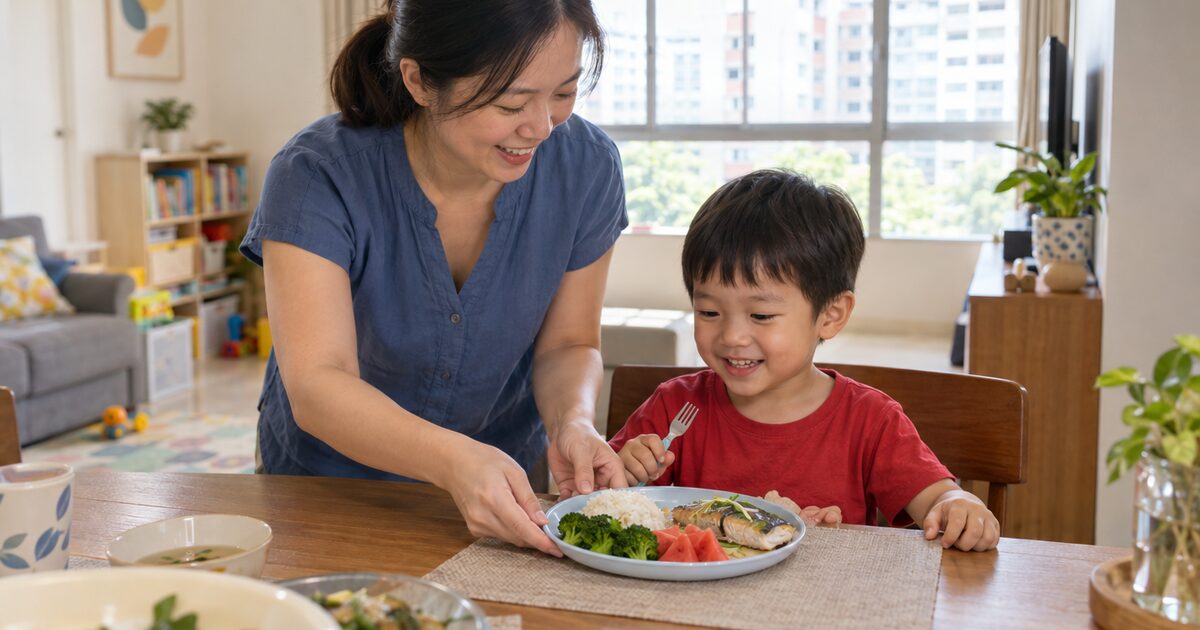
A balanced diet for toddlers is the same healthy food you eat, on a smaller plate. HPB's My Healthy Plate fills half the plate with fruit and vegetables, a quarter with wholegrains and a quarter with meat and others. Give water to drink, leave out sweet drinks, tea and kopi, and ask for sauces on the side.
How to build a balanced day for your toddler, step by step
- Set regular times for meals and snacks. Singapore's 24-hour activity guidelines for young children ask for a structured routine and family meals.
- Use a child-sized plate. HealthHub suggests an 8-inch plate for ages 3 to 6, and a 10-inch plate from age 7.
- Fill half the plate with fruit and vegetables, a quarter with wholegrains and a quarter with meat and others. That's HPB's My Healthy Plate, the same split you use.
- Make the rice quarter wholegrain. For ages 3 to 6, HealthHub says that's about half a bowl of wholegrain rice, 1 thosai or 2 slices of wholemeal bread.
- Put all four food groups in each meal and at least two in each snack, as HealthHub advises for preschoolers.
- Offer water as the everyday drink, since the 24-hour guidelines say no sugar-sweetened or caffeinated drinks before age 2 and as few as possible after.
- Flavour food with garlic and coriander instead of extra sauce. HPB says herbs and spices add taste without adding salt.
- Serve small portions and give more if your child asks. HealthHub says the brain needs about 20 minutes to register fullness, so let your child set the pace.
- Clear the table after about 30 minutes, which HealthHub says is fine, and skip the backup meal, since cooking something else doesn't help a child try new food.
- Share the plan with everyone who feeds your child. The guidelines say caregivers decide what, when and how food is served at home.
How much should a toddler eat? HPB's daily servings
HPB counts food in servings. NUH prints the number of servings a day by age, and a toddler needs fewer of them than a school-age child.
| Food group | Servings a day: age 1 to 2, then 3 to 6 | One serving looks like |
|---|---|---|
| Brown rice and wholemeal bread | 2 to 3, then 3 to 4 | Half a bowl of brown rice or beehoon, 2 slices of wholemeal bread, 1 thosai or 2 chapatis |
| Fruit | Half to 1, then 1 | 1 small apple or orange, 1 wedge of papaya, or 10 grapes or longans |
| Vegetables | Half, then 1 | Three-quarters of a mug of cooked leafy vegetables |
| Meat and others | 2, then 2 | A palm-sized piece of fish or lean meat, 2 small blocks of soft bean curd, 5 medium prawns or 3 eggs |
| Of those, dairy or calcium-rich food | 1 and a half, then 1 | 2 glasses of milk (500ml) |
The servings come from NUH's healthy eating guide; the serving sizes come from HPB's toddler guide on HealthHub.
Spread across a day, that's less food than it sounds. NUH's example day for a 1.5-year-old is 2 slices of bread plus a third of a bowl each of rice and noodles. It adds half a small apple, a third of a cup of cooked vegetables and half a palm of meat or fish, with 500ml of milk and 175g of yoghurt.
A 5-year-old's example day has more: 2 slices of bread, half a bowl each of rice and noodles, 4 plain biscuits and a banana. The rest is half a cup of vegetables, a palm of meat or fish, and 250ml of milk with 175g of yoghurt. NUH notes these are for the average child, and some children need different portions.
Appetite swings from day to day. HPB's toddler guide calls the servings recommendations and asks you not to force your child to finish the plate. Milk has its own guide, when a toddler can drink cow milk, and so does water for babies and toddlers. Still under 1? Start with starting solids.
Healthy kids meals in Singapore, with less salt
You don't need separate toddler food. HealthHub says a preschooler should sit at the family table and eat the same healthy food you eat, and most Singapore meals fit the plate with small changes.
- Chicken rice: pick steamed chicken and take the skin off, as HPB advises for poultry, then add a plate of greens.
- Fish soup with rice or beehoon: the fish and vegetables fill two parts of the plate and the rice the third. Ask the stall for less salt.
- Thosai or chapati with dhal: HealthHub counts 1 thosai or 2 chapatis as one wholegrain serving, and lentils belong to meat and others.
- Economy rice: one lean meat or tofu with two vegetables, brown rice if the stall has it, and gravy on the side.
- At home: steamed fish and brown rice, with greens stir-fried in ginger and garlic, which HealthHub suggests in place of oyster sauce.
- At the wet market: fresh fish, eggs and tau kwa, plus seasonal fruit like papaya. HPB's toddler guide favours fresh food over processed meat.
Sauces are an easy place to cut salt. HealthHub says one tablespoon of light soy sauce holds 860mg of sodium, 45% of the daily recommended intake, while sambal belacan has 690mg and oyster sauce 580mg.
Habits that help:
- Taste before you season, as HealthHub suggests, and skip the extra soy sauce on dry noodles.
- Ask for sauce or gravy on the side, and dish out your child's portion before the chilli goes in.
- Cook with fresh fish or tofu. HPB says fresh food has natural flavour of its own, so it needs less salt and sauce.
- Keep luncheon meat and hot dogs for rare days, since HPB lists them as overly processed food to avoid.
Wondering about chilli and curry? Read spicy food for kids. Packing food for preschool or a day out? Our lunch box ideas for kids can help. For softer meals, there's toddler porridge and congee.
Sugar in kids food and drinks
Drinks are the easiest sugar to cut. The 24-hour guidelines say sugar-sweetened drinks shouldn't be given before age 2, and should be avoided as much as possible after that. HPB's toddler guide counts fruit juice as a sweetened drink and calls water the best choice; if your child finds water plain, add a few slices of lemon or cucumber.
For a preschooler who has juice, HealthHub says to choose 100% juice with no added sugar, keep it to 1 cup (125ml) a day, and offer fresh fruit where you can.
Food carries sugar too. The guidelines say cutting back on added sugar and honey, as well as sweet drinks, lowers the risk of overweight and tooth decay in children. HPB asks you to go easy on kaya and jam. Kecap manis, the sweet sauce in mee goreng, has 7.6g of sugar per tablespoon, HealthHub says.
Ordering bubble tea? Our bubble tea guide covers sugar levels at the counter. Snack labels are in healthy snacks for kids, and the childhood obesity guide lists the sugar in common kopitiam drinks.
Can kids drink tea or kopi?
Hold off on tea and kopi until at least age 12. In a reply to MPs for Parliament's sitting on 7 October 2026, MOH said local paediatric advice is that children under 12 should avoid caffeine. The 24-hour guidelines also rule out caffeinated drinks before age 2.
Teh and kopi both carry caffeine, so at the kopitiam, order plain water for your child. If a grandparent likes to share a sip, explain that the advice covers that sip too.
One plan for grandparents, helpers and preschool
Your child may eat with several adults in a week. The 24-hour guidelines say caregivers decide what, when and how food is served at home. They also ask caregivers to follow a toddler's hunger and fullness cues without pressure, and not to use food as a reward.
Agree on these with everyone who feeds your child:
- The plate: half fruit and vegetables, a quarter wholegrains, a quarter meat and others.
- The drinks: water and plain milk only.
- The pace: small portions, seconds if asked, no finishing the bowl.
- No sweets to stop crying or as a reward for eating.
- Sauce on the side, at home and at the stall.
New food takes patience. HealthHub says you may need to offer it 15 times or more before a toddler is willing to try it. If your child eats well for grandma but not for you, our fussy eaters guide has ideas, and HealthHub suggests letting your child help wash the vegetables (see cooking with kids).
When to get help
See your GP or polyclinic, and bring the Child Health Booklet, if you notice any of these. They're among the common feeding problems NUH says its feeding and nutrition clinic sees:
- Poor weight gain
- Very small meals, or refusal of food or milk
- Only a small range of foods accepted
- Coughs, chokes or gags at meals or with drinks
- Frequent vomiting with feeds
- Difficulty chewing food
Worried about weight? Ask your doctor to plot height and weight on the booklet charts. For a child under 2, our baby growth percentile calculator reads those numbers, and from age 6 the kids BMI calculator gives HPB's weight band. A special diet or supplements are your doctor's or dietitian's call, so ask before you start one. Our vitamins for toddlers guide covers supplements.
Frequently asked questions
How much should a toddler eat in a day?
NUH's guide gives a 1- to 2-year-old 2 to 3 servings of brown rice and wholemeal bread a day, plus half to 1 serving of fruit and half a serving of vegetables. Meat and others is 2 servings, of which 1 and a half are dairy. From 3 to 6, it's 3 to 4 servings of rice and bread, 1 each of fruit and vegetables, and 2 of meat and others.
Can kids drink tea?
Not until 12. MOH says local paediatric advice is for children under 12 to avoid caffeine, and teh and kopi both contain it, so give water or plain milk instead.
How much sugar in kids food is too much?
Singapore's 24-hour guidelines put it as habits: no sugar-sweetened drinks before 2, as few as possible after, and less added sugar and honey. HPB adds fruit juice to the sweet drinks to skip for toddlers. Sweet sauces and spreads such as kecap manis and kaya count too.
What are healthy kids meals in Singapore when we eat out?
Pick dishes that split into the plate, like steamed chicken rice with greens or fish soup with beehoon. Thosai with dhal works too, as does economy rice with two vegetables and one lean meat. Ask for sauce on the side and give water to drink.
Does my toddler have to finish everything on the plate?
No. HPB's toddler guide says not to force your child to finish, and to let them eat at their own pace. Offer small portions, and vegetables first when they want more.
- HealthHub (HPB), 5 Ps to Practising Good Nutrition for Your Child (read 6 Nov 2026)
- HealthHub (HPB), Nutritional Requirements for Toddlers 25-36 Months Old (read 6 Nov 2026)
- HealthHub (HPB), Nutrition for Pre-Schoolers Aged 3-4 Years (read 6 Nov 2026)
- HealthHub (HPB), Healthy Cooking with Sauces (read 6 Nov 2026)
- KKH, Singapore Integrated 24-Hour Activity Guidelines for Early Childhood, summary (read 6 Nov 2026)
- MOH, Protecting children and youths from caffeine overconsumption, written reply for Parliament, 7 Oct 2026 (read 6 Nov 2026)
- NUH, Healthy Eating for Children (Khoo Teck Puat - National University Children's Medical Institute) (read 6 Nov 2026)
- NUH, Interdisciplinary Feeding and Nutrition Clinic (read 6 Nov 2026)
ADHD in children in Singapore: early signs, assessment and support
ADHD in children in Singapore: how it differs from a lively preschooler, when doctors assess it, the polyclinic route an...
9 min read
Asthma in children in Singapore: signs, inhalers and what to do in an attack
Asthma in children in Singapore: the signs, reliever and preventer inhalers, using a spacer, the action plan, and when t...
8 min read
How to boost brain development in your child from 1 to 6: what works and what's marketing
Everyday ways to boost brain development in your child from 1 to 6, the brain foods sources back, and what Singapore gui...
9 min read