

Sensory processing in children: what's common and when to get help
In this article
Sensory processing in children is how the brain takes in sound, touch, sight, taste, smell and movement, then decides how to react. Lots of young children cover their ears at a loud noise or tug at a scratchy label now and then. It's worth seeing a doctor when the reactions happen often, in many places, and get in the way of eating, dressing, sleep or play. Start by noting patterns, make small changes at home, and take your notes to your GP or polyclinic.
What to do if noise, textures or clothes bother your child, step by step
- Note what bothers your child, where it happened and what your child did. KKH's occupational therapists suggest starting by talking with your child about the sensations they like and dislike.
- Believe the discomfort, even when a label or a sound seems small to you. KKH's Department of Child Development says to take it seriously.
- Warn your child before a hard moment, such as a crowded MRT ride or a neighbour's drilling. KKH says less-liked sensations are easier when they're predictable, so say what will happen and when.
- Add new sensations one at a time, at your child's pace. KKH suggests starting with familiar things and never forcing anything your child isn't ready for.
- Give your child a way to turn things down. KKH suggests letting your child control loud sounds, and Raising Children Network lists sound-blocking headphones as one option.
- Set up a quiet corner at home with soft light and little clutter. KKH says some children need a calm spot to go to when they can't cope.
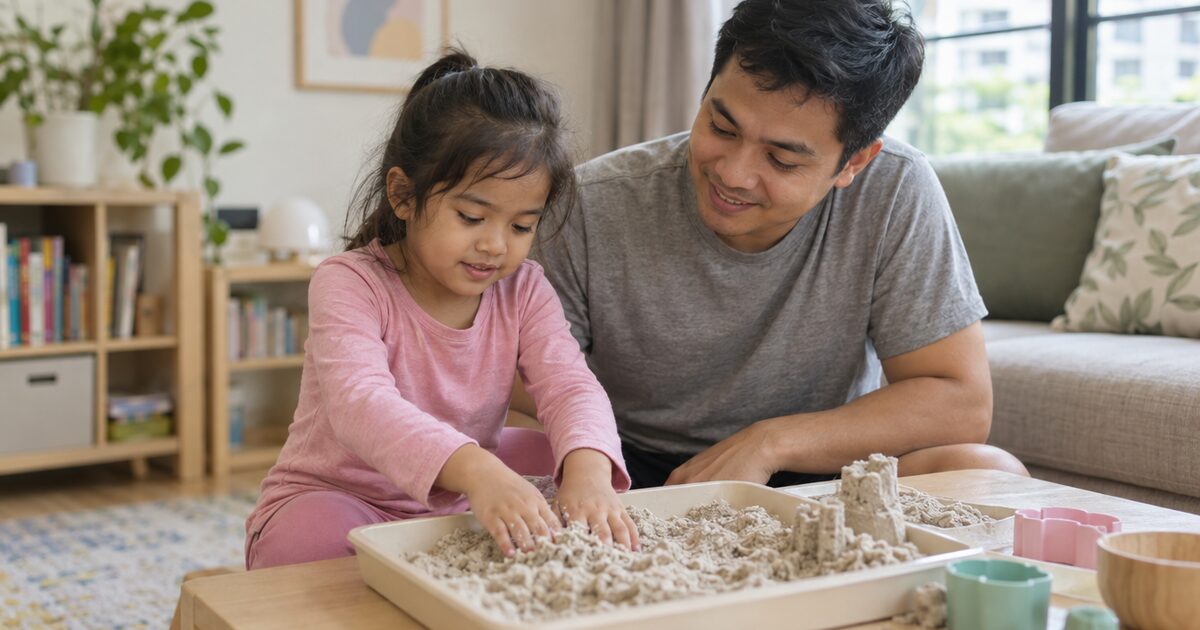
- Build sensory play into your week with sand at the playground or playdough at home. KKH says toddlers often enjoy messy play and rough and tumble play; our guide to learning through play has more.
- Share your notes with the grandparents, your helper and the preschool teacher so the warnings stay the same. HealthHub suggests talking to other caregivers and teachers to see how your child copes in different settings.
- See your GP, polyclinic doctor or paediatrician if the reactions happen most days or get in the way of daily life. HealthHub says they can assess your child's development, and KKH's occupational therapists see children with sensory processing difficulties on referral.
What sensory processing means
Your child learns about the world through touch, hearing, sight, taste and smell. KKH adds three senses that are easy to miss: body awareness, balance and movement, and inner signals such as hunger and thirst. The brain sorts all this input and picks a response. With practice, KKH says, it gets faster and the responses become automatic.
A child who is over-responsive, or hypersensitive, feels some sensations too strongly. KKH's example is the soft hum of an air-conditioner. Most people tune it out, but it can bother a child with sensitive hearing, who may then avoid things or seem distracted.
A child who is under-responsive, or hyposensitive, may not notice what others do. They might not react when you speak at a normal volume. KKH says some of these children seek extra input, like fidgeting or moving a lot, because their senses need more to respond.
Raising Children Network says some children show a mix of both. KKH adds that a child who has trouble telling sensations apart may seem clumsy, have poor balance and trip more often.
What's common by age, and when it's a reason to ask
KKH's occupational therapists list the sensory responses you might see as children grow. Milestones are ranges, so treat this as a rough guide.
| Age | What KKH says you may see | What it can look like at home |
|---|---|---|
| Birth to 6 months | Calms when carried or gently rocked; uses hands and mouth to check out objects | Settling in a carrier, mouthing a rattle |
| 6 to 12 months | Enjoys being lifted and moved through the air; finger-feeds a range of food textures | Giggling when lifted, picking up soft finger foods |
| Toddler | Enjoys messy play and rough and tumble play | Sand at the neighbourhood playground, splashing in the bath |
| Preschool | Gets better with scissors, zippers, buttons and utensils; tries swings, slides and climbing; puts on shoes and socks | Getting ready for preschool, the HDB playground |
| School age | Sensory systems are almost mature, so the child can pay attention in class and join in sports and games | Sitting through lessons in Primary 1 |
Raising Children Network says most children have trouble with sensory information sometimes. It becomes a concern when reactions happen often or for long periods, and get in the way of learning, behaviour or getting along with others. KKH's Department of Child Development gives licking or biting toys beyond the age of two years as one example of sensory seeking. For the wider picture at each age, see our guide to toddler milestones in Singapore or log progress in the baby milestone tracker.
Is sensory processing disorder a diagnosis?
You'll see the label sensory processing disorder online. A policy statement from the American Academy of Pediatrics (AAP) says it generally should not be diagnosed, because there is no universally accepted framework for diagnosing it. Raising Children Network says the term isn't a recognised disorder in Australia either.
Your child's reactions are still real. The AAP says trouble with sensory information shows up in many conditions, including autism, ADHD, developmental coordination disorder and childhood anxiety. KKH says sensory processing issues are more common in children with autism, and HealthHub lists unusual reactions to how things sound, smell, taste, look or feel among the signs of autism. That's why the AAP says other conditions should always be considered in a full assessment. Our guides to early signs of autism and ADHD in children cover those signs.
Raising Children Network says sensory processing difficulties affect up to 1 in 6 children. On therapy, the AAP says occupational therapy using sensory-based activities may be one part of a wider treatment plan. It also says research on sensory integration therapy is limited and inconclusive, and that doctors can teach families how to judge whether a therapy is working. Ask your child's therapist how you'll both tell.
Everyday Singapore triggers and small fixes
Many hard moments happen in places Singapore families go every week. A little planning makes them easier.
- Crowded malls and MRT trains wear some children out. Raising Children Network says children with sensory difficulties may get anxious on public transport and tired in shopping centres. Go when it's quieter and plan a way out. Raising Children Network also describes therapists starting with a few minutes in a noisy shop and adding time from there.
- Drilling from a neighbour's HDB renovation is hard to escape. KKH notes that some children are frightened by sounds like vacuum cleaners and motors. Tell your child when the work next door will start, and spend the loudest part at the park connector if you can.
- Haircuts are a common flashpoint, and KKH says children who are sensitive to touch often fuss at hair washing and cutting. Try the same barber each time, and let your child see and hear the clippers before they touch hair.
- The jump from hot pavements to a cold, air-conditioned mall can upset a child who is sensitive to temperature, which Raising Children Network lists as a sign. KKH lists tags and seams on clothes too, so cut out labels and let your child choose which soft top to wear.
- Food textures and smells can narrow what a child will eat, and KKH lists this as a possible sign. Our fussy eater guide has mealtime ideas.
- Outings sometimes end in a meltdown, and KKH says some children with strong sensory reactions throw tantrums during outings. Our toddler tantrum guide covers what to do in the moment.
When to see a doctor
Book a visit with your GP, polyclinic doctor or paediatrician if you notice any of these:
- The reactions show up consistently across settings, such as at home, at preschool and on outings (KKH).
- They significantly affect daily life, and meals, dressing or sleep get much harder (KKH).
- Strong emotional reactions carry on even after you've tried the steps above (KKH).
- Your child barely reacts to pain, or can't tell when they're hungry, full or need the toilet (KKH Department of Child Development).
- Your child doesn't respond to their name by 12 months, or their speech is delayed. HealthHub lists both as possible signs of autism.
Your doctor can check your child and refer you on. HealthHub says children not yet in primary school may be referred to NUH's Child Development Unit or KKH's Department of Child Development. KKH says family and polyclinic doctors can refer a child to KKH when needed. If your child later needs early intervention, our guide to early support for special needs children explains the options.
Sensory differences on their own are not an emergency. If your child is hurt or unwell and needs urgent care, KKH says to go to the nearest paediatric emergency department, such as KKH or NUH Children's Emergency. In an emergency, call 995.
Frequently asked questions
How do I know if my child has sensory processing disorder?
You can't tell at home, and the AAP advises doctors not to use that label on its own. What you can do is note what bothers your child, how often, and how much it gets in the way. Take those notes to your GP or polyclinic doctor, who can assess your child and refer on if needed.
Is it normal for a toddler to hate loud noises?
Often, yes. Raising Children Network says most children have trouble with sensory information sometimes. What matters is how often it happens and whether it stops your child doing everyday things. If the fear shows up most days or lasts a long time, mention it to your doctor.
Does a sensory processing disorder child always have autism?
No. The AAP lists autism, ADHD, developmental coordination disorder and childhood anxiety among the conditions where sensory difficulties show up. KKH says sensory issues are more common in children with autism, but sensory differences alone don't tell you the cause. Only a doctor or specialist team can assess that.
How do I get occupational therapy for my child in Singapore?
Start with your GP or polyclinic. KKH says community doctors can refer a child for assessment by its General Paediatrics Service, and its occupational therapists care for children with sensory processing difficulties. The therapist looks at how your child manages everyday tasks, then plans support around what gets in the way.
Will my child grow out of sensory processing difficulties?
Some children do. Raising Children Network says these difficulties might get better by themselves over time, and that therapy and support can help with what your child finds hard now. In the meantime, warnings before loud sounds and a quiet corner are the everyday supports KKH suggests.
- KK Women's and Children's Hospital, Understanding sensory processing and its impact on the daily life of families with children (read 6 Nov 2026)
- KKH Department of Child Development, Coping with sensory processing issues (read 6 Nov 2026)
- KK Women's and Children's Hospital, Senses: sensory defensiveness (read 6 Nov 2026)
- KK Women's and Children's Hospital, How to use the Children's Emergency wisely (read 6 Nov 2026)
- HealthHub, Is my child developing well? (read 6 Nov 2026)
- American Academy of Pediatrics, Sensory integration therapies for children with developmental and behavioral disorders, policy statement (read 6 Nov 2026)
- Raising Children Network, Sensory processing disorder and difficulties (read 6 Nov 2026)
ADHD in children in Singapore: early signs, assessment and support
ADHD in children in Singapore: how it differs from a lively preschooler, when doctors assess it, the polyclinic route an...
9 min read
How to boost brain development in your child from 1 to 6: what works and what's marketing
Everyday ways to boost brain development in your child from 1 to 6, the brain foods sources back, and what Singapore gui...
9 min read
Childhood obesity in Singapore: healthy weight habits for the whole family
Childhood obesity in Singapore, for parents of under-7s: how doctors check weight, the family habits that help, and when...
8 min read