

Learning through play for your toddler: a daily set-up for ages 1 to 3
In this article
Learning through play is one of the main ways your toddler picks up new skills, and it works best when you set things up and let your child lead. Keep a few open-ended things within reach, give sand and water a regular turn, and talk about what your child does. ECDA says that through play, children learn problem-solving and how to work with others. A corner of the flat and the playground downstairs are all the space you need.
How to set up learning through play at home, step by step
- Follow your toddler's lead. Watch what they reach for, then join in. ECDA's Early Years Development Framework (EYDF) tells educators to follow each child's lead and give them time to work through problems in play.
- Put out a few open-ended things at a time, like blocks or a cardboard box. The EYDF asks for materials that differ in shape, colour, size, texture, sound and smell.
- Store the rest. Zero to Three suggests a few toys out, the others out of sight, swapped after a week or so.
- Talk about what your child is doing in short phrases: "You filled the cup. Now it's full." Harvard's Center on the Developing Child says naming what a child sees, does or feels builds language connections, even before they can talk.
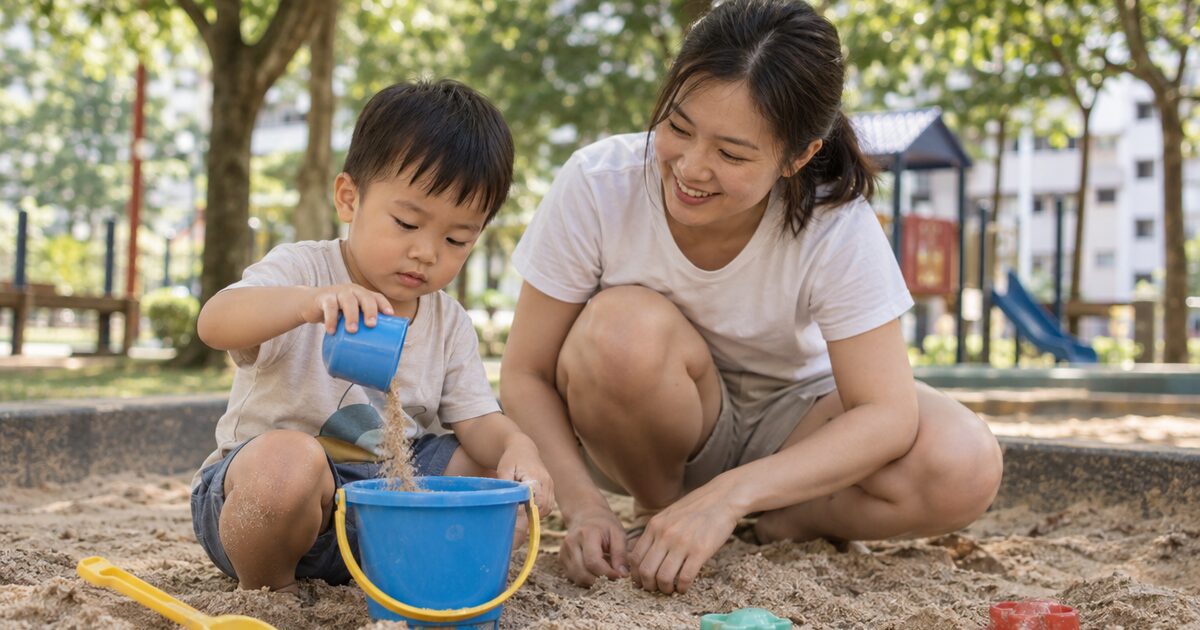
- Give sand and water a regular slot, in the bath, a basin on the floor or the playground sandpit. The EYDF lists toddlers using scoops and containers to pour, dig, fill and sieve. Stay within arm's reach near water, as Raising Children Network advises.
- Join in pretend play. HealthHub suggests cooking with toy utensils or combing a doll's hair at 19 to 24 months, and ECDA suggests a make-believe tea party with dolls.
- Head outdoors every day you can, as HealthHub suggests. The void deck works on wet days. If the heat gets to you, ECDA's tip is to go out at a cooler time.
- Show the grandparents and your helper the same set-up. HealthHub suggests chatting with your toddler during playtime, in whatever language your helper or grandparents use with your child.
- Keep screens out of playtime. MOH's 2025 guidance on HealthHub is no screen use under 18 months except video calls, and under 1 hour a day from 18 months to 6 years, outside school.
What each kind of play builds
The EYDF is ECDA's guide for infant and toddler care, and it counts children from 18 months to below 4 years as toddlers. Here's what the sources say everyday toddler play builds. For babies under 1, see bonding with baby through play.
| Kind of play | What it looks like at 1 to 3 | What it builds |
|---|---|---|
| Sand and water | Scoops, cups and a sieve in sand or a basin | Testing ideas and solving problems (EYDF); fine motor skills and hand-eye coordination (Raising Children Network) |
| Blocks and stacking | A tower built, knocked down and built again | Grasp and release, patience and perseverance (EYDF) |
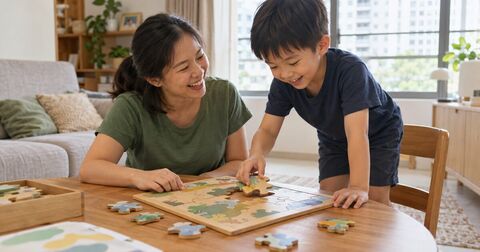
| Puzzles and shape sorters | Fitting shapes; the EYDF lists 3- to 4-piece puzzles for toddlers | How things fit together, hand-eye coordination and fine motor skills (Zero to Three) |
| Pretend play | A teddy fed with a spoon, a block used as a phone | Seeing another person's view and working through feelings (ECDA); language and early reading skills (Zero to Three) |
| Art and dough | Chunky crayons on paper, playdough squeezed flat | A way to show feelings (EYDF); fine motor skills (Zero to Three) |
| Playground play | Climbing, sliding, a wait for the swing | Facing challenges, taking turns and following rules (ECDA) |
| Helping with chores | Laundry sorted by colour, shoes back on the rack | Cooperation (Zero to Three) |
You may see your child play beside another child with the same toys and not talk. ECDA says they're still watching and picking up social cues and words.
How much of the day should be free play, and how much led by you? Our guide to free play vs structured play covers that balance. For activity lists for ages 3 to 6, see learning activities for preschoolers.
Open-ended toys: what they are and what to offer
An open-ended toy is one your child can play many different games with. Zero to Three's example is a set of wooden blocks that becomes a road, a zoo, a bridge or a spaceship. It says toys like this spark imagination and build problem-solving and logical thinking. MOE's Nurturing Early Learners portal suggests blocks, art supplies and recycled materials.
Open-ended toys by type, from Zero to Three, HealthHub and Raising Children Network:
- Building: wooden or foam blocks, stacking cups, nesting cups
- Filling and pouring: plastic bowls, cups, scoops, containers with holes
- Pretend play: dress-up clothes, play food and plastic dishes, dolls, toy keys, a child-size broom
- Making marks: chunky crayons, playdough, paint and a large brush, chalk
- Moving: balls to kick and throw, cushions to climb, a big box to crawl through
- From home, free: cardboard boxes, pieces of cloth, old clothes
Zero to Three's test: "The more a toy does, the less your child has to do." A toy your child just sits and watches is entertainment, it says, more than learning.
In an HDB flat, one low basket or shelf with a few things is enough. Raising Children Network suggests a play space as simple as a cloth over 2 chairs, or a big box with a door cut in the side. Keep it where your child can reach it. The EYDF expects toddlers to help clean up.
HealthHub says toys shouldn't be breakable or have sharp parts or splinters, and should be easy to clean. Our toy safety guide covers age labels and the choking check. To try toys before you buy, see the toy library guide, or where to buy toys for shops and preloved options.
Sandpit play: what your child gets and how to keep it clean
The EYDF files sand and water play under play that tests ideas and solves problems. Raising Children Network adds fine motor skills and hand-eye coordination, and says sand play often turns into pretend play. HealthHub says walking on sand or grass helps toddlers develop balance.
ECDA says scoops and containers for sand and water suit both solo and group play. So a shared sandpit lets your child be near other children with no pressure to play together. If your estate playground or a nearby park has sand, add it to your week; our playgrounds guide lists places to try.
Hygiene and safety, from HealthHub, the NHS, the AAP and Raising Children Network:
- Wash hands after outdoor play and before eating.
- Teach your child not to eat sand or soil.
- Look over public sand first and skip it if animals have used it. The NHS says to keep animal poo out of sandpits and playgrounds.
- Cover a sand tub at home when it isn't in use. Let wet sand dry out before you cover it, because the AAP says wet sand can harbour bacteria.
- Rake home sand regularly to clear out debris and clumps.
- Choose non-toxic play materials, since toddler fingers end up in mouths.
Play therapy at home: what it is, and what you can do
Play therapy is a clinical treatment run by trained therapists. NUH describes it as a psychotherapeutic approach where play is the main way a child expresses themselves, with the therapist taking a child-centred, non-directive approach. It suits children of all ages, NUH says, particularly those aged 3 to 10. NUHS lists anxiety, behaviour, family changes and a hospital stay among the issues it can help with.
NUHS says practising as a play therapist takes a Postgraduate Diploma in Play Therapy with 200 supervised clinical hours.
What you can do at home is child-led play with your full attention. NHS Lothian's speech and language therapists call it special time. Their version:
- Set aside 10 minutes, just you and your child.
- Turn off the TV and radio, and put your phone down.
- Let your child choose what to play, then follow what they do with the toy.
- Comment on what you see, with few questions.
- Stop at 10 minutes. NHS Lothian says a short slot is easier to keep up regularly.
Special time isn't therapy. If your child's feelings or behaviour worry you, tell your GP or polyclinic doctor. At NUH, an appointment with the paediatric psychology team, which includes play therapists, needs a referral from a paediatrician or child psychiatrist.
When to get help
How your child plays is one of the things doctors look at. NUH's Child Development Unit lists these play-related red flags. They're reasons to see a doctor, not a diagnosis:
- At 1 year: plays with parts of a toy instead of the whole toy, such as only the wheels of a car
- At 2 years: doesn't copy actions or words
- At 2 and a half years: has no pretend play, or has poor eye contact
- At 3 years: doesn't play with other children or toys
- At any age: loses a skill they had
NUH says to speak with your child's doctor straight away if you notice a red flag or have any concern, so start with your polyclinic or GP. Our toddler milestones guide explains the checks and referral routes. Related reads: sensory processing in children, if sand or noise bothers your child a lot, and toddler speech milestones and delay.
Frequently asked questions
What does learning through play mean for a toddler?
Your child learns by doing. They stack, pour, pretend and climb. ECDA's EYDF says learning takes place in daily routines, and through play with people, materials and the space around them. The American Academy of Pediatrics calls play brain building and a key to executive function skills.
What are good open ended toys for toddlers?
Toys your child can use in many ways. Zero to Three lists blocks, stacking cups, and sand and water play. Raising Children Network says cardboard boxes, pieces of material and old clothes count too.
What are the sandpit playground benefits for kids?
The EYDF counts sand and water play as early problem-solving for toddlers. Raising Children Network adds fine motor skills and hand-eye coordination. Wash hands afterwards and skip sand that animals have used.
Can I do play therapy at home?
Not as such. NUH describes play therapy as a psychotherapy run by trained play therapists, and its team needs a referral from a paediatrician or child psychiatrist. At home you can offer child-led special time. NHS Lothian suggests 10 minutes where your child chooses and leads.
How long should I play with my toddler each day?
No source gives a set time for play itself. HealthHub's guide is at least 180 minutes of physical activity a day for ages 1 to 6, spread through the day, and much of that is play. Our toddler exercise and active play guide shows how to fit it in.
- ECDA, Early Years Development Framework (EYDF) 2023 (read 6 Nov 2026)
- ECDA Beanstalk, Learning through play at their own pace (read 6 Nov 2026)
- ECDA Beanstalk, More than mere child's play (read 6 Nov 2026)
- MOE Nurturing Early Learners, Engaging children in learning through purposeful play (read 6 Nov 2026)
- HealthHub, The beginner's guide to taking care of your toddler: 19 to 24 months (read 6 Nov 2026)
- NUH, Paediatric Psychological Services (read 6 Nov 2026)
- NUH Child Development Unit, Developmental milestones poster (read 6 Nov 2026)
- Zero to Three, Tips for choosing toys for toddlers (read 6 Nov 2026)
ADHD in children in Singapore: early signs, assessment and support
ADHD in children in Singapore: how it differs from a lively preschooler, when doctors assess it, the polyclinic route an...
9 min read
How to boost brain development in your child from 1 to 6: what works and what's marketing
Everyday ways to boost brain development in your child from 1 to 6, the brain foods sources back, and what Singapore gui...
9 min read
Childhood obesity in Singapore: healthy weight habits for the whole family
Childhood obesity in Singapore, for parents of under-7s: how doctors check weight, the family habits that help, and when...
8 min read