

How to boost brain development in your child from 1 to 6: what works and what's marketing

In this article
To boost brain development in your child, you don't need classes or apps. A young brain grows on ordinary days of talk and play, with enough sleep and good food and not too many screens. Harvard's Center on the Developing Child says more than 1 million new neural connections form every second in the first few years of life. This guide covers the steps, the foods that sources link to the brain, and what the evidence says about brain-training apps.
How to boost your child's brain development, step by step
- Answer when your child points or babbles, and name what they're looking at. Harvard calls this serve and return, and says naming what a child sees or feels builds language connections before they can even talk.
- Read with your child, and sing and tell stories too. For toddlers who are sitting still, the Singapore 24-hour activity guidelines suggest singing, reading, storytelling or imaginative play, and our guide on how to get your child to love reading has ideas by age.
- Play together, and let your child lead some of it. Harvard says playful games help children learn to focus and to control impulses, and learning through play has toddler ideas.
- Get your child moving for at least 180 minutes a day in total, as the Singapore guidelines advise from age 1. From 3, at least 60 of those minutes should be moderate to vigorous; see toddler exercise and active play.
- Protect sleep, because HealthHub says well-rested children learn and remember better. The Singapore guidelines give 11 to 14 hours a day at 1 to 2 years, 10 to 13 hours at 3 to 5 and 9 to 11 hours at 6, and the kids bedtime calculator turns that into a bedtime.
- Build meals on My Healthy Plate, with half the plate vegetables and fruit, a quarter wholegrains and a quarter meat and others. Put fish and eggs on the menu often.
- Keep screens small. MOH's 2025 guidance is none under 18 months except video calls, then less than 1 hour a day outside school up to age 6, and none at meals or in the hour before bed.
- Keep a steady routine. The 24-hour guidelines ask for regular meal and snack times and a consistent bedtime, and our toddler sleep guide shows how to set one up.
- When your child asks why, sometimes ask back: "What do you think?" MOE asks parents to encourage children to explore and ask questions.
- Bring grandparents and your helper in on all of this. ASHA, the US speech and hearing association, says to talk with a child in the language you're most comfortable using, and HealthHub suggests sharing your screen rules with every carer.
Why talk and play beat any product
Harvard's Center says brains are built from the bottom up. The connections that form early are the base for later ones, and the builder it names is back-and-forth with a caring adult. Raising Children Network, a parenting site supported by the Australian Government, says children's brains make connections faster in the first 5 years than at any other time.
In Singapore, that caring adult is often a grandparent or a helper as well as you. Raising Children Network says relationships with other family members and carers matter for development too. So if Grandma speaks Hokkien or your helper speaks Tagalog, let them chat away. ASHA says using more than one language doesn't confuse children or cause speech or language delays. Our guide to raising a bilingual child in Singapore covers how to mix languages at home.
Brain foods for kids: what the sources say
No food makes a child smarter on its own. HealthXchange, SingHealth's health site, says a balanced diet across the major food groups supports growth, and that in turn aids a child's intellectual growth. Within that diet, its dietitians name these foods for what they bring to the brain.
| Food | Nutrient | What HealthXchange links it to |
|---|---|---|
| Oily fish such as salmon, sardines and mackerel | Omega-3 fat (DHA) | DHA is one of the building blocks of brain tissue |
| Eggs | Choline, in the yolk | Brain and memory function |
| Lean meat, poultry and fish | Iron and zinc | Iron helps carry oxygen to the brain; the body absorbs iron from animal foods more easily |
| Grains, vegetables, dried fruit and iron-fortified cereal | Plant iron | Same job as above; serve with fruit or lightly cooked vegetables rich in vitamin C to absorb more |
| Milk, cheese and yoghurt | Calcium | Part of the brain's electrical signalling system |
| Nuts and seeds | Vitamin E, B vitamins, iron and zinc | Shown to be important for brain function |
| Wholegrains such as oats | Carbohydrate, fibre and B vitamins | A steady supply of glucose for brain energy |
| Colourful fruit and vegetables | Antioxidants | Protect the brain against oxidative stress |
| Water | Fluid | Staying hydrated helps a child stay alert and concentrate |
Cooking matters too. HealthXchange says steaming or baking fish keeps most of its omega-3, while deep-frying can destroy much of it. Young children should eat eggs fully cooked. It also passes on US FDA advice for young children to avoid high-mercury fish such as shark, swordfish, king mackerel, tilefish and big eye tuna, and says batang (Spanish mackerel) is fine at 1 serve a week.
Make water the main drink; HealthHub calls it the best for your child's growing body. If meals are a struggle, our fussy eater guide covers that side. This is a food list, not a supplement list. HealthHub's advice on iron is not to self-medicate with supplements unless your doctor advises it.
Brain training for kids: what apps and games can do
Plenty of apps promise a smarter child. The American Academy of Pediatrics (AAP) says most tablets, computer games and apps sold as educational aren't, and most drill memory skills such as ABCs and shapes. What children need for school, it says, is impulse control, managing emotions and flexible, creative thinking. There's no one app that will teach your child to read.
Singapore's guidance points the same way. The 24-hour guidelines say interactive, non-screen activities promote a toddler's cognitive and social development. HealthHub's Parent Hub adds that free play is more valuable for a young child's developing brain than electronic media, and that your child learns far more reading a book with you than watching videos alone.
So the brain training with real backing at this age is play. Harvard says games and playful activities help children learn to focus, hold things in memory and control impulses. Some to try:
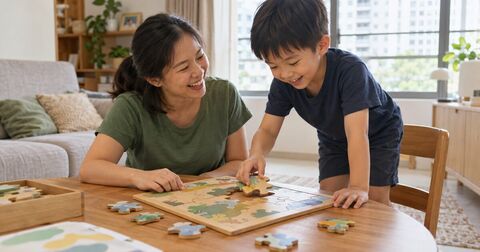
- For 1 to 2-year-olds, CDC suggests shape sorters, matching games and simple puzzles.
- For 2 to 3-year-olds, it suggests follow the leader and pretend play.
- A cardboard box or a pad of paper does the job of a toy; the AAP says high quality does not mean expensive.
- When it's too hot to play outside, HealthHub suggests board games or a book indoors.
If you do use an app, MOH's guidance is to pick educational, age-appropriate content and watch it together, then talk about what you saw. Our screen time guide has house rules that make limits easier to keep.
How to raise a curious child
MOE's Nurturing Early Learners framework counts a sense of wonder and curiosity among the habits preschoolers should build. It asks parents to encourage children to explore and ask questions beyond school. Day to day, that can look like this:
- You don't have to answer every question. Raising Children Network says your child doesn't need you to give them all the answers, because finding things out for themselves is a big part of learning.
- CDC suggests a trip to the park or a bus ride to grow a toddler's curiosity, and in Singapore the wet market, the void deck and the MRT count too.
- HealthHub suggests letting toddlers walk on the grass and step on leaves; our playground guide lists places to start.
- Let your child help in the kitchen, such as washing the fruit and vegetables, as HealthHub suggests.
- Offer small choices, like what to wear or which snack to have, which CDC recommends for preschoolers.
- NLB runs screen-lite programmes for ages 0 to 12, from storytelling to hands-on workshops, that HealthHub says spark curiosity. Our children's libraries guide has the details.
For more hands-on ideas, try our easy science experiments or learning activities for preschoolers. If you're weighing classes against free time, read free play vs structured play.
When to get help
Fill in the checklist in your child's Child Health Booklet before each check-up, as HealthHub asks. Raise any concern with the doctor, who will assess your child and advise on next steps. NUH's Child Development Unit lists red flags worth raising, including:
- Losing a skill they once had, at any age.
- Not speaking in 2-word phrases at 2 years.
- No pretend play, or poor eye contact, at 2.5 years.
- Not playing with other children or toys at 3 years.
HealthHub says your family doctor, a polyclinic doctor or your paediatrician can do a developmental assessment. Before primary school, the doctor may refer your child to NUH's Child Development Unit, which sees children from birth to 7, or to KKH's Department of Child Development. ECDA runs early intervention for children with developmental needs. KidSTART makes home visits to families with fewer resources and children under 6. Our toddler milestones guide has the full red flag list by age.
Frequently asked questions
How can I boost my child's brain development at home?
Talk and read with your child often, play together, and keep them moving for at least 180 minutes a day, as the Singapore guidelines advise. Protect sleep and keep screens within MOH's limits.
What are the best brain foods for kids?
HealthXchange names oily fish for DHA, eggs for choline, lean meat for iron and zinc, and dairy for calcium, along with nuts, seeds, wholegrains and colourful fruit and vegetables. Serve them as part of a balanced plate, and steam or bake fish rather than deep-frying it.
Does brain training for kids work?
Most apps sold as educational aren't, the AAP says, and they mostly drill ABCs and shapes. Harvard says ordinary games and play help children learn to focus and control impulses.
How do I raise a curious child?
Let your child explore, ask questions and find some answers alone, which MOE's preschool framework asks parents to encourage. Trips to the park or the library help, and so does cooking together.
Does chicken essence or a supplement help a child's brain?
HealthXchange says the benefit of chicken essence for a child's IQ and brain development is inconclusive, and the studies are generally small and run by the product company. Ask your polyclinic or GP before you give your child any supplement.
Does screen time affect a toddler's brain development?
HealthHub says young children learn best from real-world play, reading and time with family, and screens cut into that time. MOH's guidance is no screens under 18 months except video calls, and less than 1 hour a day outside school from 18 months to 6.
- College of Paediatrics and Child Health Singapore (hosted by KKH), Singapore Integrated 24-Hour Activity Guidelines for Early Childhood, summary (read 6 Nov 2026)
- HealthHub Parent Hub, Screen use for babies and toddlers, with MOH's Guidance on Screen Use in Children (2025) (read 6 Nov 2026)
- HealthXchange (SingHealth), Top 10 foods for a child's brain development (read 6 Nov 2026)
- HealthHub, Nutrition for toddlers 25 to 36 months (read 6 Nov 2026)
- NUH Child Development Unit, Concerned about your child's development? Developmental milestones poster (read 6 Nov 2026)
- MOE, Nurturing Early Learners (NEL) Framework (read 6 Nov 2026)
- Center on the Developing Child at Harvard University, Brain architecture (read 6 Nov 2026)
- American Academy of Pediatrics, HealthyChildren.org: Toy buying tips for babies and young children (read 6 Nov 2026)
ADHD in children in Singapore: early signs, assessment and support
ADHD in children in Singapore: how it differs from a lively preschooler, when doctors assess it, the polyclinic route an...
9 min read
Childhood obesity in Singapore: healthy weight habits for the whole family
Childhood obesity in Singapore, for parents of under-7s: how doctors check weight, the family habits that help, and when...
8 min read
Dyslexia signs in preschool: what to watch for and how Primary 1 support works
Early dyslexia signs in preschool, like trouble with rhymes or letter sounds, what to do about them, and how MOE screens...
8 min read