

Baby waking at night: what's normal by age, and what to do
In this article
Your baby waking at night is normal for most of the first year. KKH says newborns wake every three to five hours to feed, and SingHealth says many babies don't sleep through until they're more than three to six months old. If the waking gets worse or never eases, check hunger, comfort and the room first. Then look at naps and bedtime.
What to do when your baby keeps waking, step by step
- Pause for a few minutes before you go in, once your baby is past three months. SingHealth says most babies can soothe themselves back to sleep from three to six months, and HealthHub says to go in only if the crying carries on.
- Check for hunger. KKH says newborns wake every three to five hours for feeds, and SGH says many babies feed more often in growth spurts around 2, 4 and 6 months.
- Check for comfort: a wet nappy, trapped wind, or a baby who feels too hot or too cold. HealthHub suggests burping your baby if you didn't after the last feed.
- Check the room. KKH wants it quiet and dark at a comfortable temperature, which SingHealth puts at about 25 degrees C for newborns.
- Feed or change your baby quickly and quietly. HealthHub says to skip the talking and play, and to use a dim night lamp only when you need one.
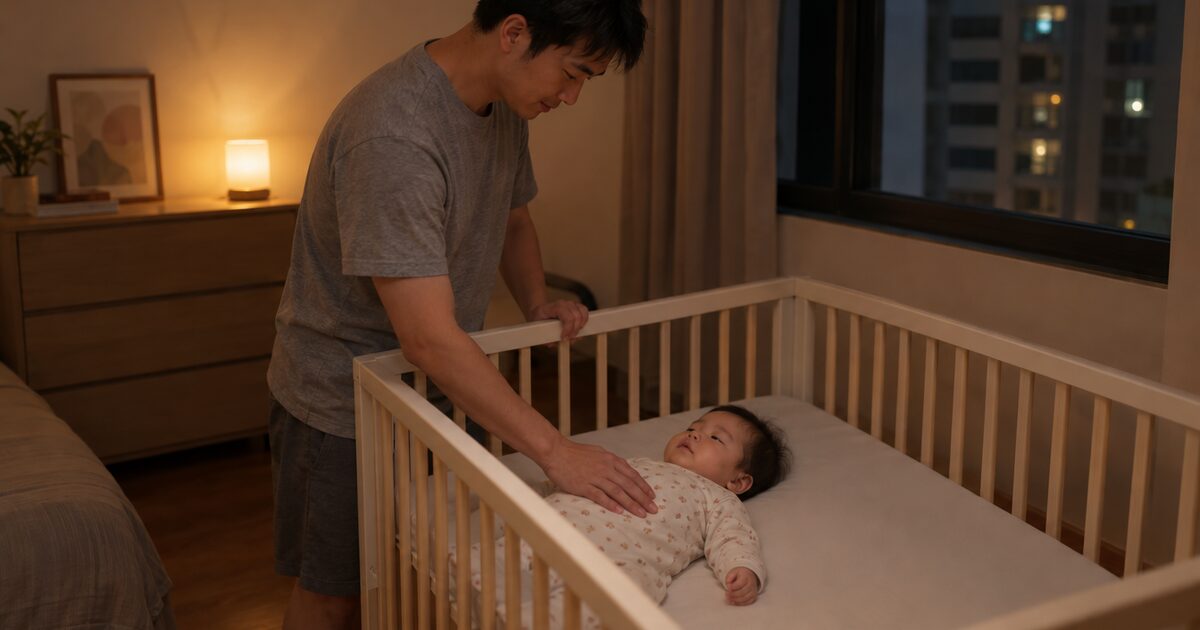
- Settle your baby on their back in their own cot. KKH says to comfort without picking your baby up, and SingHealth suggests gentle patting that stops once your baby goes quiet. Our safe sleep guide has the full set of rules.
- Add up the day's sleep. The Singapore 24-hour activity guidelines suggest 14 to 17 hours a day up to three months, and 12 to 15 hours from four to 11 months, naps included. Our sleep schedule by age shows how that splits into naps.
- Look at how bedtime ends. KKH says a baby rocked or fed to sleep will expect the same each time they wake, so put your baby down drowsy but still awake. Our guide on how to get your baby to sleep sets up the routine.
- Keep a sleep log. HealthHub offers one, and it helps you spot patterns in naps and nights. Bring it if you see your GP or polyclinic.
How often babies wake at night, by age
Babies surface at the end of each sleep cycle. HealthHub says young babies' cycles last 50 to 60 minutes, and they may need help settling into the next one. By 7 to 12 months the cycles are closer to an adult's, so waking happens less often.
| Age | Sleep a day, naps included | Night waking the sources describe | Night feeds |
|---|---|---|---|
| Up to 3 months | 14 to 17 hours | Wakes every 3 to 5 hours to feed (KKH). Breastfed babies may sleep 2 to 3 hours at a stretch (SingHealth). | Needed round the clock, as stomachs are small (HealthHub) |
| 4 to 6 months | 12 to 15 hours | Longer stretches, but most still wake at least once a night (HealthHub) | Tapering. KKH says most healthy babies don't need overnight feeds from 5 to 6 months. |
| 7 to 12 months | 12 to 15 hours | Less frequent waking as sleep cycles mature (HealthHub) | Not needed for growth after 6 months (SingHealth). Breastfed: Raising Children says to think about night weaning from 12 months. |
So what does sleeping through the night mean? KKH uses it for about nine to ten hours, or waking only once, and says most healthy babies can do this from five to six months. SingHealth adds that all babies wake on their own a few times a night. The goal is a baby who settles again without you.
From 1 year, the guidelines suggest 11 to 14 hours a day. Our toddler sleep guide picks up from there.
Why your baby keeps waking
In the early months it's mostly hunger. Later, it's often how your baby falls asleep. KKH says a baby who needs rocking or feeding to fall asleep wakes often and can't settle again without it. It estimates this affects 25 to 50 percent of babies aged 6 to 12 months.
KKH also names colic and illness. A new sleep place can do it, and so can milestones like pulling to stand or separation anxiety. HealthHub adds teething pain and colds, and says starting infant care can unsettle sleep too. For sore gums, see our teething guide. If good sleep falls apart suddenly around 4 months, our sleep regression guide covers what to expect.
Night weaning and dream feeds
Singapore's hospitals say most healthy babies can do without night feeds from about six months. KKH puts it at five to six months. SingHealth says night feeds aren't needed for growth after six months and may disrupt sleep. HealthHub says there's no hurry if you're happy to keep feeding at night.
Check with your GP or polyclinic first if you're breastfeeding, or if your baby was small or isn't gaining well. KKH's figure is for healthy babies, and HealthHub links weaning to a baby who is developing well. SGH says latching or pumping often, overnight included, helps build a good milk supply. Australia's Raising Children Network says night weaning a breastfed baby before 12 months can reduce your supply, and gives 6 months for formula-fed babies.
Raising Children's way to phase feeds out is to take 2 to 5 minutes off a breastfeed every second night. For a bottle, cut 20 to 30 ml every second night, and stop once you're down to 60 ml or less. Settle your baby another way after each shorter feed. Our feeding guide by age covers night feeds before then.
A dream feed is one you give a sleeping or half-asleep baby just before your own bedtime. The idea is a longer stretch after it. SGH's infant feeding booklet does not recommend it. It says dream feeding lacks scientific evidence, and that dripping milk into the mouth of a baby in deep sleep is a choking risk. SGH says to feed only a baby who is alert and sucking actively. HealthHub also says not to push extra milk, or add cereal or solids, to make a baby sleep longer.
Early waking
We found no Singapore hospital or HealthHub page on babies who wake too early. Light is the place to start. HealthHub says darkness helps a stirring baby drift back to sleep, and morning sunlight tells the brain it's time to get up. So keep the room dark until you want the day to start, then open the curtains.
Corridor lights and early sun often reach the cot in an HDB flat. A blackout curtain helps. So does moving the cot away from the window. Keep the wake-up time steady as well: the Singapore guidelines ask for regular sleep and wake times from 1 year, and KKH suggests a fixed bedtime and wake-up time for older children.
Night waking in a Singapore flat
Start with the temperature. SingHealth suggests a room at about 25 degrees C, with the cot away from any draught, so point the aircon or fan away from the cot. For clothes, HealthHub's guide is the layers you're wearing plus one light layer, such as a muslin wrap or a wearable blanket. Our guide to dressing a baby for the heat has more.
If a helper or grandparent does some nights, agree on one routine. HealthHub suggests the same bedtime routine whoever carries it out. KKH says to be consistent every night, especially when more than one caregiver is involved. Write the plan down. Note how long to wait before you go in, and when to wake you.
Sharing a room with a sibling? Our sleep training guide has a section on shared rooms, and the methods if you want to try one.
Some families settle a baby in a yao lan. HealthHub says baby hammocks, sarongs and yao lans aren't safe for unsupervised sleep, especially once babies can roll. For every sleep, put your baby on their back in their own cot, close to your bed.
For your own sleep, see our guide to sleep deprivation in new parents.
When to get help
Frequent night waking is worth raising with your GP or polyclinic on its own. KKH lists it among its reasons to see a doctor. Go sooner for any of these:
- Snoring or difficulty breathing at night (KKH). Our snoring guide explains what's normal.
- Excessive sleepiness during the day (KKH)
- A fever, or being much fussier than normal (HealthHub). For a newborn, SingHealth says to see a doctor if the temperature is above 37.5 degrees C.
- Crying for a long time with no sign of calming down, which HealthHub says can mean colic or illness
- Feeding poorly or sleepier than usual, with fewer wet nappies or none in 12 hours (SGH)
- Weight that slopes down the growth chart in your baby's health booklet (SGH)
If the waking comes from sleep habits, KKH says your doctor may refer your child to a paediatric sleep specialist. If your baby is struggling to breathe, go to the Children's Emergency at KKH or NUH, or call 995. Thinking of paying for help? Read our sleep consultant guide first.
Frequently asked questions
Why does my baby keep waking at night?
In young babies it's mostly hunger, since KKH says newborns wake every three to five hours to feed. Later, the usual cause is a baby who needs rocking or feeding to fall asleep, and needs it again at each waking. Colds, sore gums and new skills add to it.
When do babies sleep through the night?
KKH says most healthy babies can sleep about nine to ten hours, or wake only once, from five to six months. SingHealth says many don't sleep through until they're more than three to six months old. HealthHub says most babies of 4 to 6 months still wake at least once a night.
How do I get my baby to sleep through the night?
Put your baby down drowsy but still awake, and keep night feeds quick and dim. KKH says a baby who can fall asleep alone at bedtime is more likely to settle again after waking. Our baby sleep schedule tool suggests nap and bed times by age.
When can I start night weaning my baby?
KKH says most healthy babies don't need overnight feeds from five to six months, and SingHealth says they aren't needed for growth after six months. Raising Children warns that night weaning before 12 months can lower a breastfeeding mum's supply. Check with your GP or polyclinic first, especially if your baby was small at birth.
Should I dream feed my baby?
SGH doesn't recommend it. Its feeding booklet says dream feeding lacks scientific evidence, and that dripping milk into the mouth of a baby in deep sleep is a choking risk. If your baby wakes hungry, feed them when they're alert and sucking well.
Why is my baby waking too early?
Check the light first. HealthHub says darkness helps a stirring baby go back to sleep and sunlight signals the start of the day, so block corridor light and early sun. We found no Singapore guidance on early waking itself. If nights are poor too, take a sleep log to your polyclinic.
- KKH, Good Sleep Habits for Children (read 6 Nov 2026)
- KKH, Sleep Onset Association Type (Behavioural Insomnia of Childhood) (read 6 Nov 2026)
- KKH, Singapore Integrated 24-Hour Activity Guidelines for children under seven years launched (read 6 Nov 2026)
- SingHealth, Common Sleep Conditions in Infants, Children and Adolescents (read 6 Nov 2026)
- SingHealth, Caring for Your Newborn Baby (read 6 Nov 2026)
- SGH, Infant Feeding Booklet, Department of Neonatal and Developmental Medicine (read 6 Nov 2026)
- HealthHub (Health Promotion Board), Parent Hub: 0-2 Years - Baby Sleep (read 6 Nov 2026)
- Raising Children Network, Night weaning and phasing out night feeds (read 6 Nov 2026)
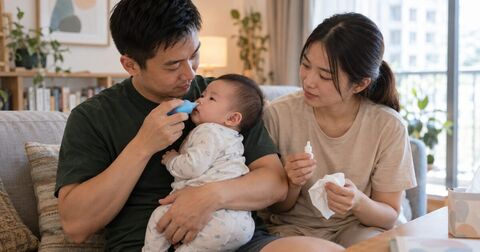
Baby blocked nose: how to clear it, and which breathing sounds need a doctor
Baby blocked nose? Saline drops, then gentle suction, as KKH and NUH advise. Plus a table of noisy breathing sounds and ...
8 min read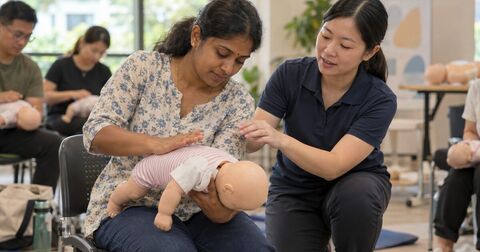
Baby Choking First Aid: What Every Singapore Parent Should Know
Baby choking first aid in Singapore: spot true choking, do infant back blows and chest thrusts, know when to call 995, a...
11 min read
Baby colic, reflux and gripe water: what Singapore doctors advise and when to worry
Baby colic and reflux in Singapore: what KKH, NUH and HealthHub say about gripe water and gas drops, how to soothe cryin...
12 min read