

Cloth diapers in Singapore: what they cost against disposables, washing them in our humidity and where to buy
In this article
Cloth diapers in Singapore cost more on day one and less over the first year. A full-time stash of 24 pocket diapers from local brand The Tiny Otter is $837.60, while disposables at FairPrice cost about 25 to 50 cents each, and Pampers says a newborn can use up to 10 a day. That works out to roughly $720 to $1,450 of disposables in the first year, against a cloth stash that lasts until potty training. The catch is laundry: a pre-wash every day or two, a main wash every few days, and drying that copes with our humidity. If you're not sure, rent a trial pack first; The Tiny Otter and The Nappy Nook, a cloth diaper library, rent three diapers for two weeks for $15.
Cloth vs disposable diapers: the cost
These prices were read on sellers' own websites on 11 October 2026.
| Option | What you pay | Notes |
|---|---|---|
| Disposable tape diapers, newborn and small | $0.25 to $0.57 each at FairPrice | At 10 a day, about $75 to $170 a month |
| Disposable pants, large to XXL | About $0.40 to $1 each at FairPrice | At 6 to 7 a day, about $72 to $210 a month |
| Pocket cloth diapers | $22.95 at Little Lalang to $34.90 at The Tiny Otter; 24 Tiny Otter pockets is $837.60 | Plus detergent, water and electricity |
| Prefolds and covers | Prefolds from $7.25 each, one-size covers $23.25 at Little Lalang | Our example of 24 prefolds and 6 covers: $313.50 |
| Trial rental | $15 for 2 weeks, plus a $20 refundable deposit | 3 pocket diapers or 3 pull-ups, with inserts |
To estimate a year of disposables, we used Pampers' chart of how many diapers babies use per day in each size: up to 10 a day in newborn size, 9 in size 1, 8 in size 2 and 7 in size 3. Over 12 months that's about 2,900 diapers, or roughly $720 at 25 cents each and $1,450 at 50 cents. The cloth figures leave out washing costs, which depend on your machine. A cheaper prefold setup pays for itself within months; a pocket stash takes most of the first year, and both can go on to a second child if they're kept in good condition. Our baby cost estimator puts diapers in the context of your other first-year costs.
The types of cloth diaper
| Type | How it works | Price we saw at Singapore sellers |
|---|---|---|
| Prefold or flat with a cover | A rectangle of cotton folded around the baby, under a waterproof cover | Prefolds from $7.25, flats $8.25, covers $21.25 newborn and $23.25 one-size (Little Lalang) |
| Pocket diaper | A waterproof shell with a pocket you stuff with absorbent inserts | $22.95 (Little Lalang) to $34.90 (The Tiny Otter) |
| All-in-two | A cover with inserts that snap or lay in, so you can reuse the cover | Sold by Clothe In Love; reusable nappy pant $28.90 and an 8-pad kit $68.90 (the baby closet) |
| All-in-one | Shell and absorbent layers sewn together, the closest to a disposable | Sold by Clothe In Love |
| Pull-ups and trainers | Pull on like underwear, for active toddlers and toilet training | Bamboo trainers $26.95 (Little Lalang) |
| Swim diaper | Holds poo in the pool, not wee | $24.90 (The Tiny Otter) |
For a newborn, pockets and all-in-twos are easiest on a changing table. The Tiny Otter says pull-ups suit a toddler who won't lie down, and that the childcare centres here that accept cloth prefer pull-ups, because staff can change a child standing up. Ask your infant care centre before you buy a full stash. Sizes matter too: many cloth diapers are one-size with snaps, while disposables go by weight, and our diaper size calculator shows when a disposable size will be outgrown.
Washing cloth diapers in Singapore's humidity
The Tiny Otter warns that soiled diapers left more than 3 days before a wash risk mould, smell and ammonia, so the routine is about frequency and air. Here is its wash routine:
- Take the inserts out of the pocket. Spray or brush poo into the toilet. Breastfed poo dissolves in water, so you can skip this step while your baby is only on breast milk.
- Put diapers in a dry pail with holes, so they get air. Don't soak them.
- Pre-wash every 1 to 2 days: the shortest cycle, 40 to 60 degrees C, half a dose of an ordinary detergent. If the main wash is more than 3 days away, pre-wash daily.
- Main wash every 1 to 4 days: the longest cotton cycle, 40 to 60 degrees C, a full dose. Fill the drum two-thirds to three-quarters when wet. Top it up with baby clothes or small towels if needed.
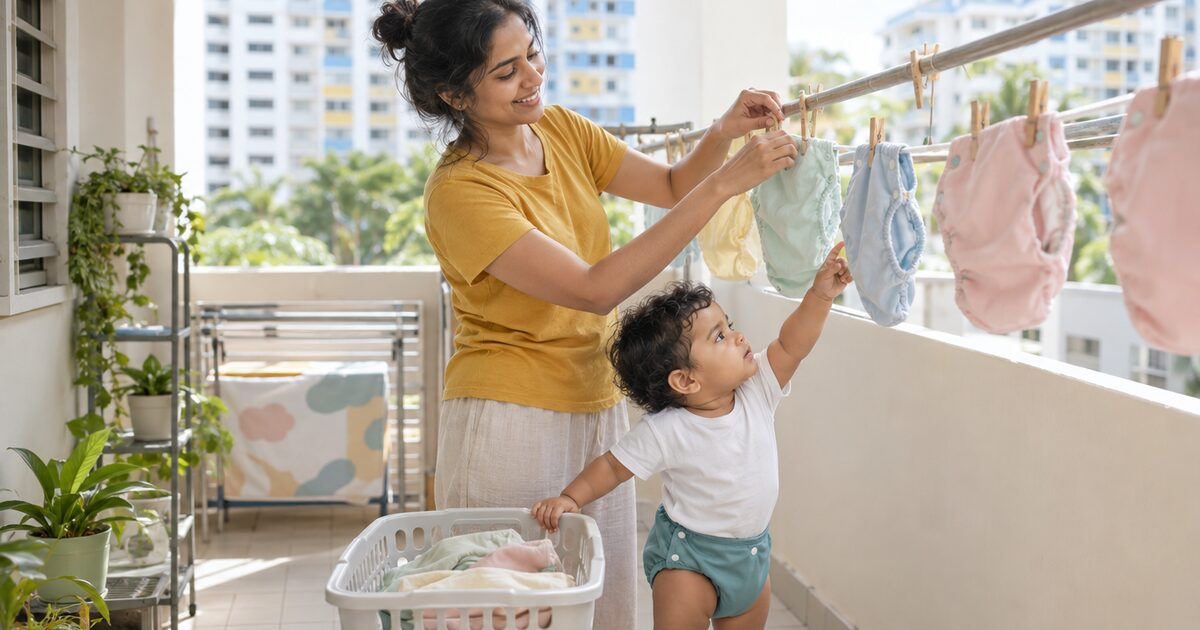
- Dry inserts in the sun or a dryer, and dry the waterproof shells in the shade so the coating lasts.
The Tiny Otter advises against baby detergents, which may not clean out heavy soiling, and says a front-loader needs a low-suds detergent. On rainy weeks, a dryer or a dehumidifier in the drying room keeps inserts from staying damp. Wash new inserts once or twice before use; natural fibres only reach full absorbency after 6 to 8 washes, so change more often, about every 1 to 2 hours, in the first weeks.
How many cloth diapers you need
For one baby in cloth full time, The Tiny Otter suggests 24 diapers, assuming 6 a day and a main wash every third day, or 30 to 36 if you'd rather wash less often. Add two dry pails (one for soiled diapers, one for pre-washed ones waiting for the main wash), about 24 cloth wipes, 10 spare inserts for heavy wetters and nights, and a wet bag for outings.
Cloth diaper starter kit
Diapers
Washing
Out and about
Cloth diapers and diaper rash
Neither type is automatically better for rash. SingHealth says the most common cause is irritation by urine and stools, especially when diapers aren't changed often, with friction from a tight diaper as another cause, and that most rashes clear with regular changes and a barrier cream. HealthHub advises changing a diaper whenever it's soiled. With cloth, that means changing about every 2 to 3 hours, The Tiny Otter's usual gap, and rinsing detergent out well, because leftover detergent can irritate skin. Our guide to diaper rash covers home care and the signs of a yeast rash that needs a doctor.
Where to buy cloth diapers in Singapore
| Shop | What it sells |
|---|---|
| The Tiny Otter | Local brand: pocket diapers, pull-ups, one-size covers, swim diapers, wet bags and cloth wipes, plus wash and fitting guides |
| Little Lalang | Prefolds, flats, covers and bamboo trainers; 74 cloth diaper products listed |
| the baby closet | Reusable nappy pants and nappy pad kits |
| Clothe In Love | All-in-one and all-in-two diapers, covers and laundry products |
| The Nappy Nook | A cloth diaper library: rent before you buy, booked through its Facebook group |
Buy two or three styles before committing to 24, since fit varies with your baby's shape. For a wet bag that fits your outings, see our guide to diaper bags, and for the rest of the newborn list, where to buy baby essentials in Singapore.
Frequently asked questions
Are cloth diapers cheaper than disposables in Singapore?
Usually, over a year. Disposables at FairPrice cost about 25 to 50 cents each, around $720 to $1,450 for a first year of roughly 2,900 diapers. A 24-diaper pocket stash is $837.60 at The Tiny Otter and a prefold setup about $310, before washing costs.
How many cloth diapers do I need?
About 24 for one baby full time, if you do a main wash every third day, or 30 to 36 to wash less often, says The Tiny Otter.
Can I use cloth diapers at infant care?
Not every centre accepts cloth, so ask before you buy. The Tiny Otter says centres that accept cloth prefer pull-ups.
How do I dry cloth diapers when it rains?
Dry inserts in a dryer, or indoors with a fan or dehumidifier, and dry waterproof shells in the shade. Don't leave damp diapers in a closed pail.
Do cloth diapers cause less diaper rash?
Not on their own. SingHealth says rash mostly comes from urine and stools left on the skin, so changing often matters more than the type of diaper.
- The Tiny Otter - Washing guide (read 11 October 2026)
- The Tiny Otter - First-timer guide: stash size and trial rental (read 11 October 2026)
- The Tiny Otter - Original pocket diaper, $34.90 (read 11 October 2026)
- Little Lalang - Cloth diapers collection (read 11 October 2026)
- Little Lalang - Keeper cover, $21.25 newborn and $23.25 one-size (read 11 October 2026)
- the baby closet - Reusable nappies (read 11 October 2026)
- Clothe In Love - Cloth diapers and laundry (read 11 October 2026)
- FairPrice - Diapers search, prices per piece (read 11 October 2026)
- Pampers - Diaper size chart and diapers per day (read 11 October 2026)
- SingHealth - Common neonatal rashes: diaper dermatitis (read 11 October 2026)
- HealthHub - The beginner's guide to taking care of your baby: 0 to 6 months (read 11 October 2026)

Art Jamming in Singapore: A Family Guide to Painting and Art Fun
Your parent's guide to art jamming in Singapore: what it is, the best ages, studio vs cafe vs at-home, what to bring, ro...
11 min read
Baby Fairs in Singapore: A Parent's Guide to Deals, Dates and Smart Shopping
A practical guide to baby fairs in Singapore: where they run, what to buy and skip, how to spot real deals, what to brin...
10 min read
When to stop swaddling, and choosing baby swaddles and sleep sacks for Singapore's heat
When to stop swaddling your baby: the rolling and startle signs, a week-by-week move to a sleep sack, and how to choose ...
8 min read