

TCM postnatal care and jamu in Singapore: checking practitioners, products and timing
In this article
TCM postnatal care and jamu are part of confinement in many Chinese and Malay homes: herbal tonics, warming drinks, massage and tummy binding. You can keep the custom and keep it safe by checking three things. Is the TCM physician on the board's register? Does HSA check the product? Has your wound healed? Tell your doctor what you plan, because KKH asks new mums to see a doctor before taking any traditional or complementary medicine.
How to plan TCM postnatal care and jamu, step by step
- Tell your gynae what you plan, from herbal soups to a jamu drink to a binder. KKH's going-home advice says to consult a doctor if you wish to take any traditional or complementary medicine.
- Look up the TCM physician on the TCM Practitioners Board register before the first visit. The board registers two groups: TCM physicians, who can also practise acupuncture, and acupuncturists.
- Read the label on any herbal pills or capsules. HSA says every Chinese proprietary medicine must have an English label with the product name, batch number, expiry date, active ingredients and dosage.
- Ask where a jamu product comes from. HSA doesn't approve Malay and Indian traditional medicines for import or sale, so pass on unlabelled packs, big claims and anything a friend brought back from overseas.
- If you're breastfeeding, say so at every visit. KKH doctors say substances in herbs might go into breast milk, and these may worsen jaundice in a newborn who already has it.
- Wait for your wound to heal before massage, heat or binding. KKH says a perineal tear usually heals in two to three weeks, and its doctors say to wait a month after a caesarean.
- Keep heat and pressure gentle, and stop a session that hurts. KKH doctors say massage and heat therapies should be done in moderation to prevent burns and injuries.
- See a doctor and bring the product with you if you feel unwell after taking it, as HSA advises. HSA also warns that suddenly stopping a product with a hidden steroid can cause withdrawal symptoms, so let the doctor say how to stop.
What TCM postnatal care and jamu usually involve
Chinese confinement rests on the belief that birth leaves a mother cooled and in need of heating foods, KKH doctors write. Families cook herbal soups and tonics, and some mums see a TCM physician for herbs or acupuncture. Our guide to confinement herbs goes through each tonic in turn. If you want the wider picture of what each community does during confinement, read the confinement guide.
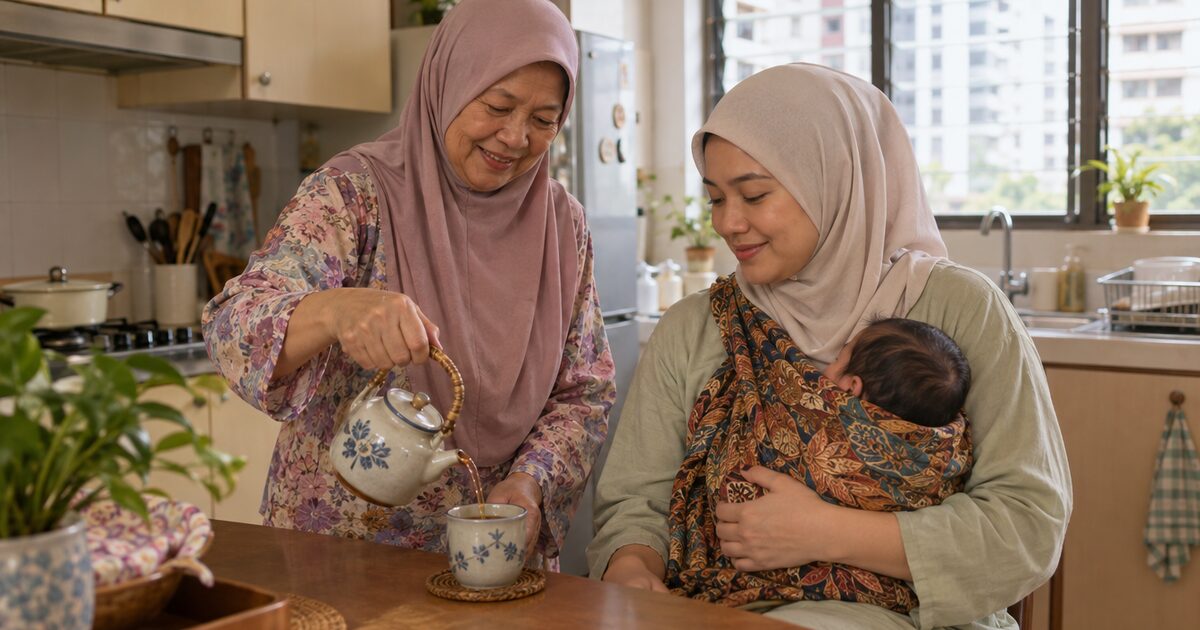
Malay postnatal care has its own set of practices. In an article on Families for Life, KKH doctors list six: tuku, a daily tummy massage with a ball-like metal object; mengurut badan, massage by an experienced masseuse; barut, a tight wrap around the waist; salai, lying on a warmed wooden apparatus; air akar kayu, tonic drinks made from medicinal plants; and pantang, a list of foods and drinks to avoid. Tight tummy binding is also called berbengkong. And jamu is the special drink some Malay mothers take after birth, in the belief that labour opens the pores and jamu keeps the body warm.
The same doctors say these practices have never been proven scientifically, but that some benefits are possible. What they ask is that each one is done gently and at the right time. Our confinement myths page sorts the rules doctors back from the ones you can drop.
Checking the person treating you
Registration of TCM practitioners in Singapore falls under the Traditional Chinese Medicine Practitioners Act 2000. A TCM physician on full registration can practise on their own. One on conditional registration works in an approved TCM clinic under the supervision of a fully registered practitioner, the board says.
Search the name on the board's website before you book. A postnatal masseuse or jamu therapist is a different role, and the register lists only TCM physicians and acupuncturists. So ask a therapist about their training and tell your gynae what the sessions include. Our guide to paediatric TCM explains how registration works in more detail.
Checking herbs, pills and jamu products
HSA treats Chinese proprietary medicines and Malay or Indian traditional medicines differently. That difference tells you what to check before you take something.
| Product | What HSA says | What you can check |
|---|---|---|
| Chinese proprietary medicine: tablets, capsules, pills | Each one needs HSA product listing approval, with no western medicine compounds or heavy metals over set limits | An English label with name, batch number, expiry date, ingredients and dosage |
| Jamu and other Malay or Indian traditional medicines | No HSA approval needed to import or sell; added steroids are banned and heavy metals have limits | Who made it and where it was sold; skip packs that promise a quick fix |
| Packs from overseas, a friend or an unknown seller | HSA found a jamu sold for pain relief that hid piroxicam and paracetamol | Show it to your doctor before you take it |
That jamu case is in an HSA alert. A woman in her 70s, whose relative had bought it overseas, took it for two weeks and was admitted to hospital with sudden swelling of her legs and face. HSA's rule is that complementary health products are not allowed to contain western medicinal ingredients, and the alert asks buyers to be careful with products that make exaggerated claims.
Massage, heat and binding after a tear or a caesarean
Timing depends on how you gave birth. KKH says a perineal tear usually heals in two to three weeks. After a caesarean, KKH doctors say the Malay practices should be delayed for a month so they don't disrupt the healing wound. KKH also asks you to avoid strenuous activity that may cause injury or pain while the wound heals.
Heat is the other thing to watch. KKH doctors name burns and injuries as the risk when massage and heat therapies are overdone. Ask for less heat and lighter pressure if anything feels too hot or sore, and loosen the binder if it hurts.
Booking home massage for new mums? Our postnatal massage guide covers timing by birth type and the questions to ask before you book. If your family uses herbal baths, our guide to showering during confinement covers bathing with stitches or a wound.
If you're breastfeeding
Herbs are where breastfeeding mums need the most care. KKH doctors write that herbs contain substances they are not fully aware of, that these might go into breast milk, and that they may affect the liver and worsen jaundice in a newborn who already has it. KKH's going-home advice also asks breastfeeding mothers to avoid alcoholic drinks, which includes tonic wines.
Bring the herb pack or its label to your own doctor or your baby's check-up before you start. If your baby has jaundice, ask the baby's doctor first; our newborn jaundice guide explains why. Our guide to medicine safe while breastfeeding covers how to check any remedy, and foods to avoid during confinement covers the diet rules.
When to see a doctor
Stop the massage or binding and see your doctor if you notice any of these. KKH's signs come from its going-home advice for new mothers.
- Pus-like or foul-smelling discharge from the vagina (KKH)
- Bleeding from your tear or episiotomy, or severe or increasing pain there (KKH)
- Fever or chills (KKH)
- Bleeding, redness or pus around a caesarean wound, which KKH says may mean infection and a return to the hospital
- Bleeding (lochia) that suddenly gets heavy after it had been easing (KKH)
- A burn or new injury after heat or massage, the risk KKH doctors warn about
- Feeling unwell after a herbal pill, tonic or jamu: HSA says to see a doctor and bring the product
Call your gynae's clinic or the hospital where you delivered first. KKH's Urgent O&G Centre, at Basement 1 of Women's Tower, is a 24-hour walk-in centre that sees post-pregnancy conditions. For significant tummy pain or heavy bleeding, KKH says to get immediate care there or at your nearest hospital emergency department. Call 995 for a life-threatening emergency; SCDF's examples include excessive bleeding, breathlessness and loss of consciousness. Our postnatal recovery guide has the full list of warning signs after birth.
Frequently asked questions
When can I have a jamu massage after birth?
It depends on how you gave birth. KKH says a perineal tear usually heals in two to three weeks, and KKH doctors say to wait a month after a caesarean. Ask your gynae to check the wound first.
Is home massage for new mums safe?
KKH doctors say Malay postnatal practices may bring some benefits if they're done in moderation, to prevent burns and injuries. Tell the therapist about stitches or a caesarean scar before you start. Stop the session if it hurts, and see your doctor if a wound looks red or starts to bleed.
Is jamu in Singapore checked by HSA?
Not before it's sold. HSA says Malay and Indian traditional medicines need no HSA approval for import, manufacture or sale, though it bans added steroids and limits toxic heavy metals. It has found a jamu sold for pain relief that hid piroxicam and paracetamol, so check the source and tell your doctor before you take any.
Can I do TCM confinement while breastfeeding?
Check the herbs first. KKH doctors say substances in herbs might go into breast milk and can worsen jaundice in a newborn. See a registered TCM physician who knows you're breastfeeding, and tell your own doctor what you take.
Which postnatal TCM herbs are safe?
The hospital pages we read don't give a safe list, and KKH asks you to consult a doctor before any traditional or complementary medicine. Our confinement herbs guide covers the common tonics and the cautions Singapore sources give for each.
- Traditional Chinese Medicine Practitioners Board, Registers of TCM practitioners (read 6 Nov 2026)
- Health Sciences Authority, How Chinese Proprietary Medicines are regulated by HSA (read 6 Nov 2026)
- Health Sciences Authority, Regulatory overview of traditional medicines (read 6 Nov 2026)
- Health Sciences Authority, HSA alerts public to two illegal products claiming to treat pain and multiple medical conditions (read 6 Nov 2026)
- SingHealth and KKH, Going home after your delivery in KKH (read 6 Nov 2026)
- KK Women's and Children's Hospital, Urgent O&G Centre (read 6 Nov 2026)
- Families for Life, Confinement practices and myths, by KKH doctors (read 6 Nov 2026)
- Singapore Civil Defence Force, Emergency Medical Services (read 6 Nov 2026)
Back pain after pregnancy: why it happens, feeding and carrying tips, safe stretches and when to see a physio
Back pain after pregnancy is common. Feeding, carrying and lifting tips from Singapore hospitals, gentle stretches, red ...
7 min read
C-section in Singapore: planned or emergency, what happens on the day, costs and recovery
C-section in Singapore: the day, MOH bills by hospital and recovery tips week by week, with wound infection signs, scar ...
24 min read
How to check a confinement nanny agency's licence with MOM
Check a confinement nanny agency's licence in MOM's directory: each step, the fields it shows, the work permit and what ...
7 min read