

Cooking with kids: kitchen tasks by age, easy recipes and safety
In this article
- How to cook with your toddler or preschooler, step by step
- Kitchen tasks for toddlers and preschoolers, by age
- Why cooking with kids helps at mealtimes
- Kitchen safety for kids in a small Singapore kitchen
- First aid for a burn in the kitchen
- Easy recipes to cook with kids
- When to get help
- Frequently asked questions
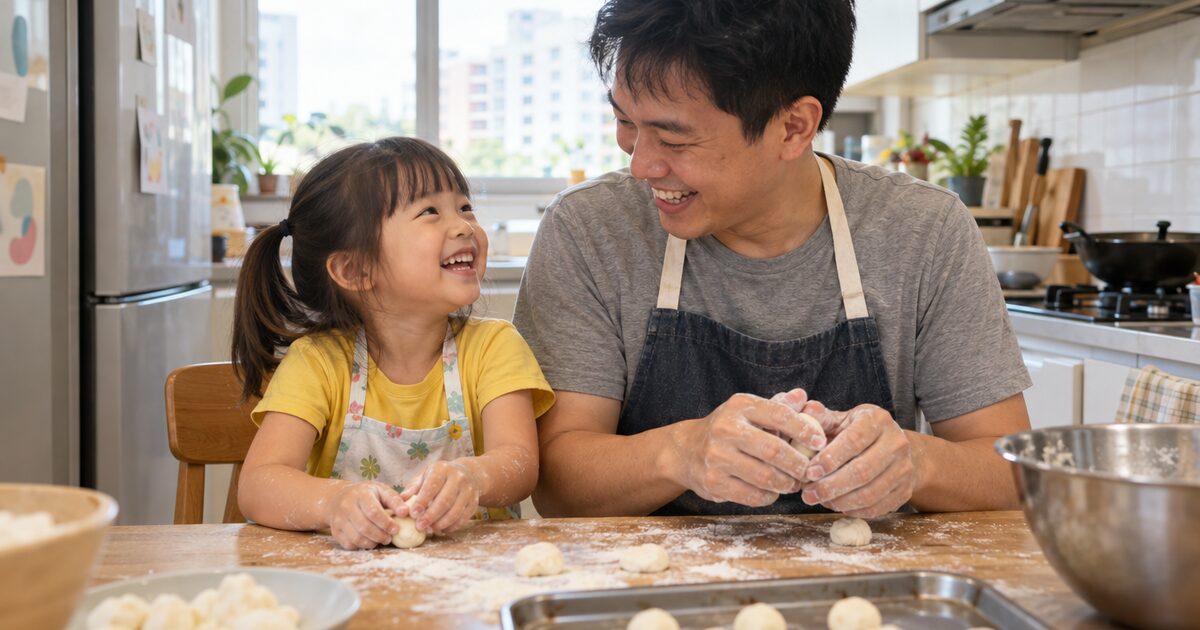
You can start cooking with kids while they're toddlers. Give one short job with no heat, like washing fruit or stirring a bowl, and keep the hob and the knives for yourself. Wash hands together first, and taste only food that's cooked or ready to eat. By school age, Raising Children Network says, your child can help make fried rice or pancakes while you stay on the hot parts.
How to cook with your toddler or preschooler, step by step
- Pick one short recipe where your child's part needs no heat, such as a fruit salad or a sandwich. Raising Children Network's advice is to match the task to your child's skills and attention span.
- Set up a spot away from the hob. Raising Children Network suggests a sturdy step stool at the counter, though in a narrow HDB kitchen the dining table is often the safer place.
- Wash hands together with soap and water. SFA says to wash before and after handling food, and again after touching raw egg.
- Put out only what the recipe needs, measured into small bowls. Push knives and the kettle to the back.
- Give one job at a time, and show it once before your child has a go.
- Keep the hot and sharp jobs yours, because Raising Children Network says even school-age children need help with the hob and hot liquids.
- Taste and talk as you go: count the spoons out loud and name the colours. Taste only food that's cooked or ready to eat, as the CDC's advice is never to eat raw batter or dough.
- Stop while it's still fun, and thank your child for helping.
- Clean up together. HealthHub says doing the cooking and the clearing up as a team builds good feelings about food.
Kitchen tasks for toddlers and preschoolers, by age
Match the job to what your child can do today. The tasks in this table come from Raising Children Network and HealthHub, and the last column is the part you keep.
| Age | Jobs your child can try | Jobs that stay yours |
|---|---|---|
| 2 to 3 | Wash fruit and vegetables, fetch things from the fridge, hand you utensils, stir, toss a salad | Knives, the hob, the kettle and anything hot. Stay in the kitchen the whole time |
| 4 to 5 | Wash vegetables, measure and add ingredients (HealthHub, from age 3), layer a sandwich, mash, set the table, help clear up | The hob and sharp knives. Child-friendly utensils are fine with you beside them |
| 6 and up | Choose fruit and vegetables, pack their own lunch box, help make fried rice or pancakes, do the dishes | The oven, the hob and hot liquids. Watch closely when they use a sharp knife |
Raising Children Network says most children can understand simple rules from about 3 to 4, like not touching hot surfaces or sharp knives, but they still need you watching the whole time they cook. KKH suggests giving small choices too, such as letting your child pick the spread on a sandwich.
If you want play ideas outside the kitchen, our learning through play guide sets up a whole toddler day.
Why cooking with kids helps at mealtimes
Raising Children Network says children are more likely to try food they've helped cook. KKH suggests letting children wash vegetables or set the table, so mealtimes start on a good note.
There's maths in it too. Raising Children Network points out that counting teaspoons or measuring liquid builds maths skills, while reading a recipe together builds vocabulary. Our math skills by age guide has more counting games for home.
Cooking together is a good start for a picky eater, and our fussy eaters guide covers what to do at the table itself.
Kitchen safety for kids in a small Singapore kitchen
In many HDB kitchens the hob and the rice cooker sit an arm's length apart. KKH's burn prevention advice is to keep children out of the kitchen with safety gates and play pens. So do your child's part at the table, then carry the hot part to the stove yourself.
- Keep hot drinks and hot pots well out of reach, as KKH advises. Swap the tablecloth for placemats, since KKH says a toddler can pull the cloth and tip hot food onto themselves.
- Choose a flask or airpot with a child safety lock, as KKH suggests. Push the rice cooker to the back with its steam vent facing the wall.
- Say hot out loud and wait for your child to step clear before you carry a pot to the sink. Raising Children Network names this as a kitchen hazard.
- Give your child a blunt, child-friendly knife for soft food, and keep yours at the back of the counter.
- Soft-boiled eggs with kaya toast are a local habit, SFA notes, but it advises young children to avoid raw eggs. Cook eggs until the yolk and white are firm, and wash hands with soap after cracking them.
- Most flour is raw, the CDC says, and its germs die only when it's baked or cooked. That includes pancake batter and homemade play dough, so kueh dough waits for the pot too and nobody licks the bowl.
- Keep raw meat well away from your child's spot. SFA says to keep raw food apart from cooked food and to give it a separate chopping board. It also says not to wash raw meat, since that spreads bacteria.
- If your child has a food allergy, keep that food off the counter. HealthHub says a reaction can also happen from touching it.
Our baby-proofing checklist covers the latches and gates.
If your helper or a grandparent cooks with your child, give them the same rules. Hot jobs stay with the adult, and eggs for a young child are cooked firm. KKH says one adult should be watching a toddler at all times, and that adults working as a team helps prevent burns. Agree who that adult is before the pot goes on.
First aid for a burn in the kitchen
Cool running water is the first aid that matters most. KKH found that half the children who came to the hospital with burns had no first aid before they arrived.
- Hold the burn under gently running cool water for 20 minutes, KKH says. Keep going even if blisters form.
- Cover a small burn with a non-stick dressing, such as non-woven gauze. Keep a pack in your first aid kit.
- Leave out the kitchen remedies. KKH says no toothpaste, oil or soy sauce on the wound, and no tissue or kitchen paper either.
- Get medical help straight away for a blistering burn bigger than 10 times the size of your child's hand, or one on the face, hands or genitals. After cooling it, KKH says you can cover it with clean cling wrap and wrap your child in a clean towel or sheet to keep warm, then call an ambulance on 995.
- For a smaller burn that blisters, or if you're not sure how deep it is, see your GP or polyclinic. For urgent problems, go to KKH or NUH Children's Emergency.
Easy recipes to cook with kids
These five are our own ideas. Your child does most of the work in each one with no heat, and everything is easy to find at a wet market or supermarket. Check for allergies first.
| Recipe | Your child's job | Your job |
|---|---|---|
| Fruit skewers | Thread soft fruit like banana, papaya and watermelon onto short, blunt sticks | Cut the fruit small. For a toddler, skip the sticks and make a fruit rainbow on a plate |
| Shaped sandwiches | Mash egg, spread it, add cheese or cucumber, press a cookie cutter | Boil the eggs until firm and peel them |
| Glutinous rice balls (tang yuan or ondeh-ondeh) | Knead the dough and roll small balls | Boil them, and cool them before anyone bites. No tasting the raw dough |
| Onigiri-style rice balls | Shape warm rice in cling wrap around cooked salmon flakes or tuna | Cook the rice and let it cool until it's warm, not hot |
| Banana pancakes | Mash the banana, crack the egg into a cup, stir the batter | Wash hands after the egg, cook them in the pan, keep raw batter out of mouths |
For school days, our lunch box ideas for kids pack these up, and healthy snacks for kids has HPB's snack rules. Our balanced diet for toddlers guide shows how a whole plate adds up.
When to get help
- An itchy mouth, hives, swelling of the face, eyes or lips, tummy pain or vomiting after a food can be an allergy, HealthHub says. It usually shows within minutes up to 2 hours of eating. Stop the food and see your doctor. Egg is the most common food allergen for children in Singapore. Our child allergy symptoms guide has more.
- Call 995 if your child gasps for air, wheezes, has a swollen tongue, or has trouble swallowing or talking, HealthHub advises.
- See your GP or polyclinic if fussy eating worries you daily for two weeks or more, KKH advises. KKH says children who eat fewer than 20 types of food can be at risk of faltering growth.
Frequently asked questions
What kitchen tasks can toddlers do?
Raising Children Network lists washing fruit and vegetables, fetching things from the fridge, handing you utensils, and stirring or tossing a salad. Keep each job short so it ends before your toddler loses interest, and stay in the kitchen with them the whole time.
What are good cooking activities for preschoolers?
Raising Children Network suggests recipes your child can build, like layering a sandwich or spooning yoghurt and fruit into a cup. HealthHub adds washing vegetables and measuring and adding ingredients from age 3. Rolling glutinous rice balls is another good one.
What are easy recipes to cook with kids?
Try fruit skewers, shaped sandwiches, glutinous rice balls, onigiri-style rice balls or banana pancakes. Your child does the rolling and spreading, and you do the cutting and the hob.
How do I teach kitchen safety for kids?
Start with two rules: hot things and sharp knives are for grown-ups. Raising Children Network says most 3 to 4 year olds can understand rules like these, but they still need you watching. Say hot out loud each time you move a pot.
Can my child eat raw cookie dough or a soft-boiled egg?
Not yet. The CDC says raw dough and batter can carry germs until they're baked or cooked. SFA advises young children to avoid raw eggs, so cook eggs until the yolk and white are firm.
At what age can my child use a knife?
From about 3 to 4, Raising Children Network suggests starting with child-friendly utensils, with you watching the whole time. A blunt knife on a banana is a good first try, and school-age children still need close supervision with sharp knives.
- KK Women's and Children's Hospital, Critical to perform first aid immediately after sustaining a burn (read 6 Nov 2026)
- KK Women's and Children's Hospital, How parents can help children overcome fussy eating (read 6 Nov 2026)
- HealthHub, Nutrition for pre-schoolers aged 3 to 4 years (read 6 Nov 2026)
- HealthHub, What are common food allergies? (read 6 Nov 2026)
- Singapore Food Agency, Raw eggs (read 6 Nov 2026)
- Singapore Food Agency, A recipe to ensure safe food for all (read 6 Nov 2026)
- CDC, Raw flour and dough (read 6 Nov 2026)
- Raising Children Network, Cooking with kids and teens: recipe ideas and practical tips (read 6 Nov 2026)
ADHD in children in Singapore: early signs, assessment and support
ADHD in children in Singapore: how it differs from a lively preschooler, when doctors assess it, the polyclinic route an...
9 min read
Asthma in children in Singapore: signs, inhalers and what to do in an attack
Asthma in children in Singapore: the signs, reliever and preventer inhalers, using a spacer, the action plan, and when t...
8 min read
Balanced diet for toddlers in Singapore: plates, servings, sugar, tea and salt
A balanced diet for toddlers in Singapore: HPB's plate, daily servings for ages 1 to 6, hawker picks, and the advice on ...
9 min read