

Healthy snacks for kids: HPB's snack rules, easy ideas and what to buy at the supermarket
In this article
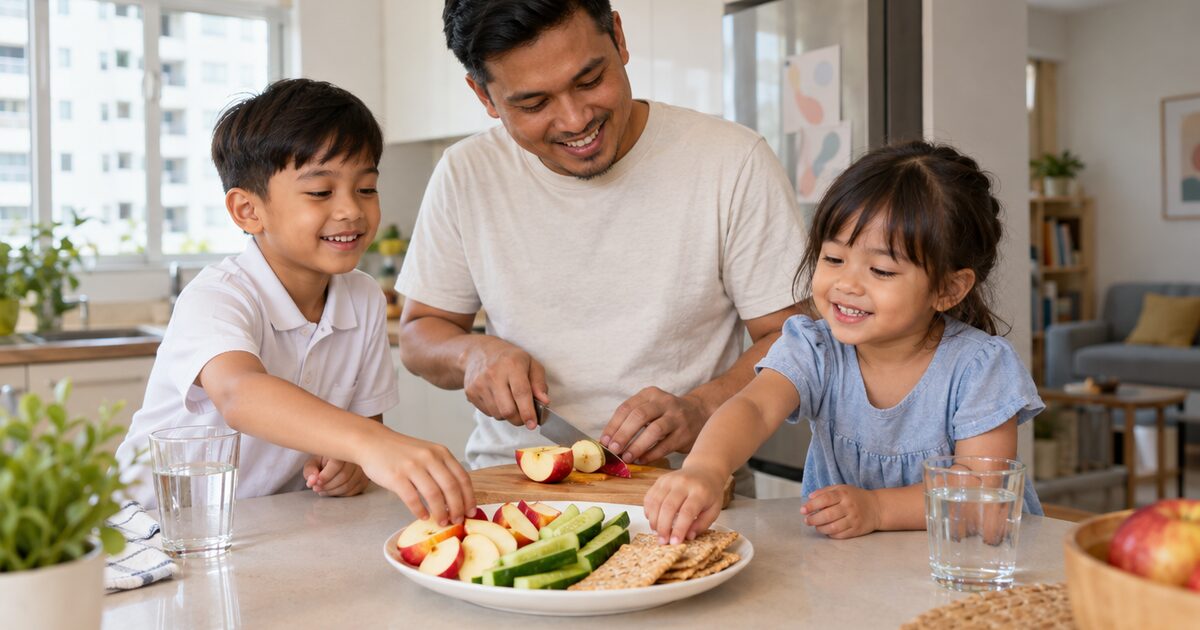
Healthy snacks for kids are small, plain foods from the same groups as a balanced meal: fruit, vegetables, wholegrains, and dairy or protein. HealthHub's advice for young children is three meals and no more than two snacks a day, served in a small bowl instead of from the packet. The Health Promotion Board's easy ideas include plain yoghurt with fruit, frozen fruit, wholegrain crackers with cheese, vegetable sticks with a small dip, and plain air-popped popcorn, with water as the usual drink. At the supermarket, look for the Healthier Choice Symbol on snacks and a Nutri-Grade A or B on drinks, and remember that the serving size on a packet is set for adults. Here are ideas, portions and label tips that work for a Singapore kitchen.
How many snacks a day?
HealthHub's portion advice for young children is to serve three meals a day and limit snacks to twice a day. Its tooth decay advice says the same, for a different reason: frequent sugary food and drinks cause decay, so keep to three main meals and two snacks. Grazing all afternoon means sugar sits on teeth for longer.
Plan snacks for a set time, such as mid-morning and after school, so your child comes to the next meal hungry. Our kids' dental care guide covers brushing and check-ups, and our fussy eaters guide helps if snacks are crowding out meals.
Easy healthy snack ideas from HPB
| Snack | How to make it | Why it works |
|---|---|---|
| Yoghurt pot | A cup of plain low-fat yoghurt topped with wholegrain cereal or fresh fruit | A quick calcium boost |
| Frozen fruit | Freeze seedless grapes, kiwifruit or strawberries | An icy treat, low in sugar and high in vitamins |
| Cheese and crackers | Wholegrain crackers with a soft cheese spread or a piece of reduced-fat cheddar | Easy to prepare and rich in calcium |
| Veggies and dip | Cucumber, celery, carrot or capsicum sticks with a small side of low-fat dressing | Vegetables they can pick up |
| Guacamole | Mashed avocado with plain tortilla chips or wholegrain crackers | Filling and quick |
| Popcorn | Air-popped and plain | A wholegrain that is low in calories and high in fibre |
| Fruit popsicles | Freshly squeezed juice, frozen, never concentrate or syrup | A cooler for hot afternoons |
For young children, cut food into bite-sized pieces, as HealthHub suggests for bento boxes. A piece of whole fruit is a better snack than a glass of juice: it takes three to four oranges to fill a glass of orange juice, Families for Life points out, and nobody eats four oranges at once.
Portions: how much is a snack?
- Pour snacks such as nuts or raisins into a small bowl or plate instead of handing over the packet.
- Use a child-sized plate, about 8 inches across, so servings look right without being too big.
- Follow My Healthy Plate for meals and bigger snacks: a quarter wholegrains, a quarter meat and others, and half fruit and vegetables.
- Let them eat slowly, since HealthHub notes it takes at least 20 minutes for the stomach to tell the brain it's full.
- Check the label's serving size. HealthHub reminds parents that an adult serving isn't a child's serving.
HealthHub's tip for a day of vegetables and fruit is two servings of each. On party days, it suggests halving hot dogs, puffs and other snacks at home, and adding an extra 20 minutes of play over the next few days. Our kids' birthday party guide has more party food ideas.
Reading snack labels in Singapore
All pre-packed food sold here must list its ingredients, net content and country of origin, but the nutrition information panel is optional, HealthHub says. When a packet has one:
- Check whether the figures are per serving or per 100g, and how big a serving is.
- Look at sugar. Added sugar gives energy but little nutrition, HealthHub says.
- Don't trust "no added sugar" claims alone. HealthHub's advice is to check the sugar figure on the panel.
What the Healthier Choice logo means
The Healthier Choice Symbol (HCS) is HPB's red pyramid logo, now on more than 4,000 products across over 100 categories, snacks included. There are 34 taglines, each with a set threshold:
| HCS tagline | What it means |
|---|---|
| Lower in Sugar | At least 25% less sugar than similar products in the same category |
| Higher in Wholegrains | At least 20% more wholegrains than similar products |
| Higher in Calcium | At least 25% more calcium than similar products |
| No Added Sugar | No free sugars, or ingredients containing them, added during processing |
| Sugar Free | 0.5g of sugar or less per 100g or 100ml |
| Lower in Sodium | Found on sauces, mixes and also on nuts and seeds |
HealthHub notes that dairy and soy products with the HCS are good sources of calcium for children. Treat the symbol as a way to compare two packets on the same shelf; a plain fruit or vegetable needs no logo.
Drinks at snack time
Water is the best choice, Families for Life says: no calories, and it prevents constipation and urinary tract infections. Singapore's tap water also contains fluoride, which helps fight tooth decay. Beyond water:
- Milk: up to three glasses a day.
- Flavoured milk and fruit juice: once or twice a week, not daily. Try mixing a quarter glass of flavoured milk into plain milk.
- Sports and energy drinks: high in sugar and sodium, and energy drinks usually contain caffeine, so skip them for children.
- Families for Life says school canteens serve only drinks with the Healthier Choice Symbol, capped at 6% sugar.
Nutri-Grade labels grade drinks from A to D by sugar and saturated fat. A has minimal sugar and no sweetener; B is above 1g to 5g of sugar per 100ml; C is above 5g to 10g; D is above 10g. Only C and D must show the label. HealthHub notes that some fruit juices and full-fat dairy drinks are graded C or D, while Healthier Choice drinks are always A or B. Our bubble tea guide shows how sugar levels work at the counter.
A simple supermarket list
You don't need special kids' products. Most of these sit in any neighbourhood supermarket:
- Fresh fruit to eat whole, plus grapes, kiwi or strawberries to freeze
- Carrots, cucumber and capsicum for sticks
- Plain low-fat yoghurt, and wholegrain cereal for topping
- Wholegrain crackers and reduced-fat cheese
- Plain popcorn kernels to air-pop
- Avocados for a quick guacamole
- Unsalted nuts and seeds, served in a small bowl and in a form that suits your child's age
- Plain milk, and water bottles for outings
Starting with a baby? Our starting solids guide covers the first foods before snacks come in.
Frequently asked questions
How many snacks should a child have a day?
HealthHub's advice for young children is three meals and no more than two snacks a day, which also limits how often sugar touches their teeth.
What are healthy snacks for kids in Singapore?
HPB's ideas include plain yoghurt with fruit, frozen fruit, wholegrain crackers with cheese, vegetable sticks with dip, guacamole with crackers, and plain air-popped popcorn.
Is fruit juice a healthy snack?
Whole fruit is better. Families for Life suggests juice only once or twice a week, and some juices are graded Nutri-Grade C or D for their sugar.
What does the Healthier Choice Symbol mean on snacks?
It marks products that meet HPB's thresholds for their category, such as at least 25% less sugar or 20% more wholegrains than similar products. Read the tagline under the logo.
What should my child drink with snacks?
Water first. Plain milk is fine, up to three glasses a day. Keep flavoured milk and juice to once or twice a week and skip sports and energy drinks.
- HealthHub (HPB) - Healthier snacks for children, reviewed 15 November 2022 (read 11 October 2026)
- HealthHub - Guilt-free healthier snacks for kids (read 11 October 2026)
- HealthHub - 5 ways to help your 4-year-old with portion control (read 11 October 2026)
- HealthHub - How can I prevent tooth decay in my child? (read 11 October 2026)
- HealthHub - 4 things parents should know about nutrition panels (read 11 October 2026)
- HealthHub - Make a healthier choice today: Healthier Choice Symbol taglines, reviewed 7 September 2026 (read 11 October 2026)
- HealthHub Nutrition Hub - Make better drink choices with Nutri-Grade (read 11 October 2026)
- Families for Life (MSF) - The best thirst-quenchers for kids (read 11 October 2026)
- HealthHub - Healthy food for kids in a bento (read 11 October 2026)
Childhood Myopia in Singapore: A Parent's Guide to Signs, Prevention and Eye Checks
A Singapore parent's guide to childhood myopia: why it is so common, early signs, outdoor and screen habits that help, e...
11 min read
Choosing a Paediatrician in Singapore: A Practical Guide for Parents
How to choose a paediatrician in Singapore: GP vs polyclinic vs private PD, cost guidance, vaccinations, first-visit tip...
12 min read
Mosquito Repellent for Kids in Singapore: A Parent's Guide to Dengue Protection
How to choose mosquito repellent for kids in Singapore by age, protect babies from dengue, cover up, use nets, clear sta...
11 min read