

Easy science experiments for kids to do at home, and what each age learns
In this article
The best science experiments for kids use things you already have at home: a bowl of water and an orange for sink or float, ice cubes and salt, a bean in a cup, a torch and a wall for shadows. They're cheap, quick and safe with an adult nearby, and they practise the same skills Singapore's schools teach. MOE's preschool framework, Nurturing Early Learners, wants children aged four to six to show curiosity about the world and to use process skills such as observing, comparing, predicting and inferring. In primary school, the science syllabus is built around five themes: diversity, cycles, systems, energy and interactions. Below are 11 experiments sorted by age, what each one teaches, and the safety rules that matter most with young children.
What children learn from experiments at each age
These stages follow MOE's preschool framework and the primary science topics as one MOE school, Hougang Primary, sets them out. Children don't need to know the words; they need to try, look and talk about what happened.
| Age | What they're learning | Skills to practise | Experiments that fit |
|---|---|---|---|
| 2 to 3 | Exploring with their senses | Observing: looking closely and noticing | Sink or float with big objects, melting ice, colour mixing |
| 4 to 6 (preschool) | Curiosity about how things work; asking why (MOE's Discovery of the World) | Observing, comparing and classifying, predicting | Sink or float with a prediction chart, walking water, growing a bean |
| 7 to 9 (P1 to P3) | P3 topics include living and non-living things, materials, magnets and plant parts | Predicting, then testing one change at a time | Magnet hunt, material sort, bean growing |
| 10 to 12 (P4 to P6) | P4 matter, light and heat; P5 the water cycle and electrical systems; P6 forces and energy | Inferring: explaining what happened from what they saw | Ice melt race, shadow tracking, water cycle in a bag, paper bridge, simple circuit |
MOE's framework describes predicting as making an informed guess from what a child already knows, and observing as using the five senses to look closely. Hougang Primary notes that the primary syllabus spirals, so the same themes come back with more depth each year. If your child asks 'why?' a lot, they're already doing the main thing the framework asks for.
11 easy science experiments with things at home
| Experiment | You need | Best from | What it shows |
|---|---|---|---|
| Sink or float | A bowl of water, an orange, then the same orange peeled, plus other fruit and toys | Age 2 to 3, with help | The peel is full of tiny air pockets that help the orange float; peeled, it sinks |
| Melting ice | Ice cubes in a tray, a sunny spot and a shady spot | Age 2 to 3 | Heat melts ice faster; compare the two spots |
| Walking water | Three cups, water, food colouring, folded paper towels | Age 4 | Water climbs through the paper and the colours mix |
| Grow a bean | A dried bean, a cup, damp cotton wool or tissue | Age 4 | Roots grow down and the shoot grows up; links to P3 plant parts |
| Colour mixing | Water, food colouring in two colours, clear cups | Age 3 | Two primary colours make a new one |
| Fizzy volcano | Baking soda, vinegar, a cup on a tray | Age 4, adult pours | Mixing the two makes gas, which pushes out as bubbles |
| Magnet hunt | One large fridge magnet, household objects | Age 6 | Some materials are magnetic and some aren't; links to P3 magnets |
| Paper bridge | Paper, two stacks of books, coins | Age 6 | Folding paper makes it stronger; a first look at structures and forces |
| Shadow tracking | Chalk or a pencil, a toy, sunlight on a balcony or corridor | Age 7 | Shadows change length and direction as the sun moves; links to P4 light |
| Ice melt race | Ice cubes, salt, sugar, a timer | Age 8 | Salt makes ice melt faster; a fair test changes only one thing |
| Water cycle in a bag | A zip bag, a little water, tape, a sunny window | Age 9 | Water evaporates, condenses and 'rains'; links to P5 water cycle |
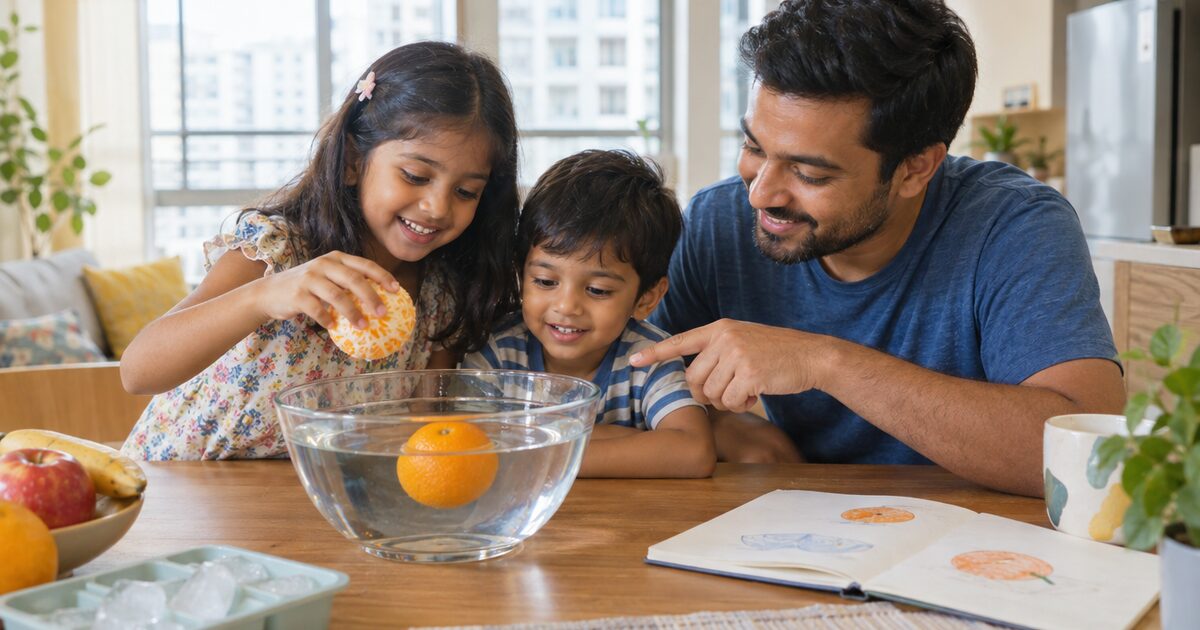
The orange experiment is the classic. Ask your child to predict first, then test: whole orange, peeled orange, a lime, an apple, a grape. Sorting the results into 'floats' and 'sinks' is the comparing and classifying MOE's framework describes. For older children, ask why a heavy-looking watermelon floats when a small grape sinks.
How to run an experiment like a scientist
- Ask a question: does salt make ice melt faster?
- Predict: ask your child what they think will happen, and why. Write it down or draw it.
- Test: change one thing only, such as salt on one ice cube and nothing on the other.
- Observe: look, listen, touch where it's safe, and time it if you can.
- Compare and explain: did it match the prediction? What might explain it?
For preschoolers, keep it to the predict, try and talk steps, and let them make a mess within limits. For primary school children, a simple notebook with the question, prediction and result builds the habits that come up again in science lessons from P3.
Safety rules for home science
- Under-threes put things in their mouths. HealthHub says small toys and objects are a choking hazard for children under three, so use large objects only.
- Never use button batteries or small magnets in experiments with young children. Singapore's Consumer Product Safety Office warns that swallowed button batteries can cause serious internal injury, and swallowing more than one magnet usually needs emergency surgery.
- Water play needs an adult at all times. HealthHub's advice is never to leave any container of water unattended.
- Keep hot water and kettles away. For burns and scalds, run cool water over the area for 20 minutes, don't use ice, and don't pull off clothing stuck to the skin (HealthHub).
- Use kitchen ingredients, never cleaning products. HealthHub says to keep cleaning products in their original containers, and to get medical help straight away if a child swallows a chemical, without giving them anything to eat or drink.
- Keep vinegar and baking soda away from eyes, and wash hands after every experiment.
For older children doing the simple circuit from the P5 topic list, use an AA battery holder, a small bulb and wires, with an adult; never button cells. Our baby-proofing checklist covers keeping batteries and chemicals out of reach for younger siblings.
More science to try in Singapore
Science Centre Singapore's Void Deck site has a DIY section with home activities, including a paper tower challenge, a fizzy dinosaur egg, a bumble bee pollinator for young children and a DIY speaker made from household waste. Its KidsSTOP gallery is designed for children aged 8 and below, and its ToTally Science programme for 2 to 3 year olds costs $65 for non-members and $60 for members. Our Science Centre and KidsSTOP family guide covers tickets and hours.
If your child is hooked, our guides to coding classes for kids and school holiday activities have more hands-on ideas.
Frequently asked questions
What is the easiest science experiment for kids?
Sink or float. Fill a bowl with water, gather an orange, a peeled orange and a few toys, and ask your child to predict which will float before testing. It works from about age two with help.
What science do preschoolers learn in Singapore?
MOE's Nurturing Early Learners framework calls it Discovery of the World. Children aged four to six learn to show curiosity, ask why things happen, and use process skills such as observing, comparing and classifying, predicting and inferring.
What topics are in primary school science?
The syllabus is organised into five themes: diversity, cycles, systems, energy and interactions. At one MOE school, P3 covers materials, magnets and plant parts, P4 matter and light and heat, P5 the water cycle and electrical systems, and P6 forces and energy.
Is the baking soda volcano safe for young children?
With an adult pouring and the mixture kept away from eyes, it's a common home experiment. Use it on a tray, and wash hands afterwards.
Are there free science activities in Singapore?
Science Centre Singapore's Void Deck website has free DIY activities to do at home, and many of the experiments above cost nothing beyond kitchen items.
- Ministry of Education - NEL framework: about Discovery of the World (read 11 October 2026)
- Ministry of Education - NEL: develop children's process skills (read 11 October 2026)
- Hougang Primary School (MOE) - Science curriculum and topics by level (read 11 October 2026)
- Science Centre Singapore - Void Deck DIY activities (read 11 October 2026)
- Science Centre Singapore - About KidsSTOP (read 11 October 2026)
- Science Centre Singapore - ToTally Science (read 11 October 2026)
- HealthHub - The toy story on safety (read 11 October 2026)
- HealthHub - Burns and scalds in children (read 11 October 2026)
- HealthHub - Keep your home free from these safety hazards (read 11 October 2026)
- HealthHub - Common childhood injuries: a child-safe home (read 11 October 2026)
- Consumer Product Safety Office - Safety tips on children's toys (read 11 October 2026)
- Consumer Product Safety Office - Safety tips on small magnets (read 11 October 2026)
How to Choose the Best Preschool in Singapore: A Parent's Guide
How to choose the best preschool in Singapore for your child: centre types, curriculum, fee ranges, ECDA subsidies, wait...
11 min read
Childcare Centres in Singapore: A Parent's Guide to Infant Care, Subsidies and Choosing the Right One
How childcare centres in Singapore work: infant care vs full-day childcare, ECDA operators, subsidies, waitlists, fees a...
10 min read
Children's Libraries in Singapore: A Parent's Guide to NLB
A parent's guide to NLB children's libraries in Singapore: kids' sections, story times, free membership, the NLB app, Li...
11 min read