

Food poisoning in children: home care, dehydration signs and when to see a doctor
In this article
- What to do when your child has food poisoning, step by step
- Is it food poisoning or a stomach bug?
- Signs of dehydration, from mild to serious
- Keep food safe at home in Singapore's heat
- Eating out and takeaway with kids
- When your child can go back to preschool or school
- Reporting food poisoning from a food outlet
- When to see a doctor
- Frequently asked questions
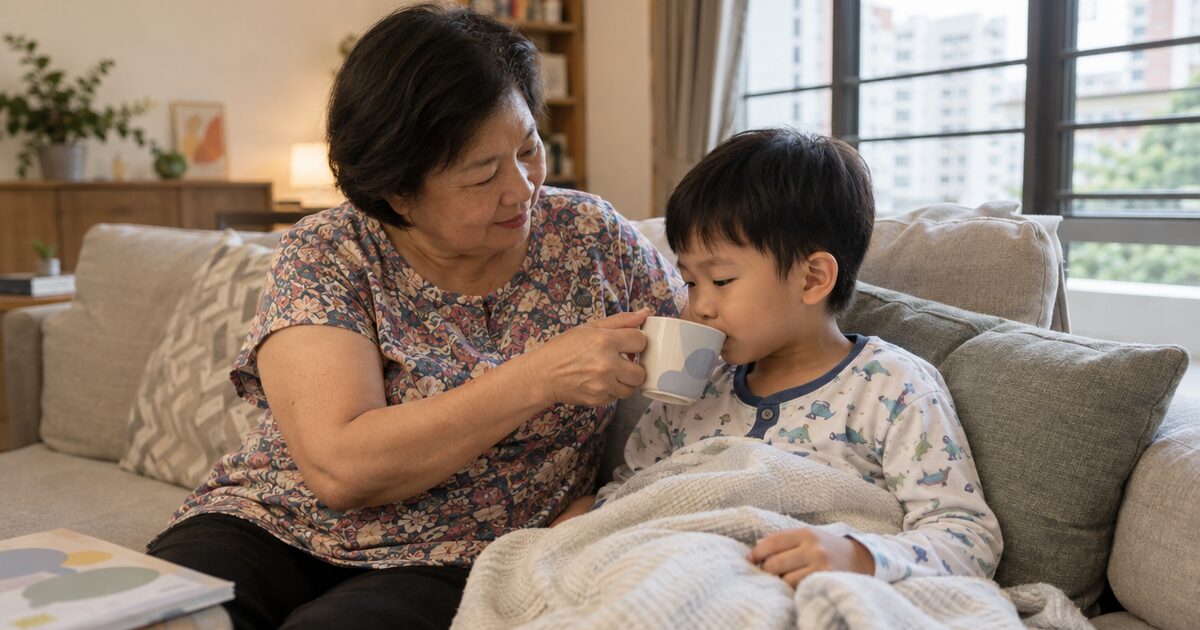
Food poisoning in children usually clears up at home within a few days, as HealthHub notes. Your main job is to keep fluids going in small, frequent sips. Babies stay on their breast milk or formula. Get a doctor fast for blood in the poo, green vomit, a child who can't keep fluids down, or one who is unusually sleepy.
What to do when your child has food poisoning, step by step
- Offer small, frequent sips, even if your child is vomiting. HealthHub says a big drink at one go is likely to bring on more vomiting.
- Go slowly after vomiting in a child over 1. KKH suggests starting with 10 ml of fluid every 10 to 15 minutes for an hour, then adding 10 ml each hour if it stays down.
- Keep feeding your baby. KKH says to keep breastfeeding and feed more often, or stay on the usual formula, not water alone. The NHS adds: don't make formula weaker.
- Use oral rehydration solution, mixed exactly as the label or your pharmacist says. KKH says it's best served cold, even frozen into ice sticks. Rice water or barley water work too. Keep sachets in your baby medicine and first aid kit.
- Skip juice, soft drinks and other sugary drinks. HealthHub says milk and high-sugar drinks may make symptoms worse, so a child over 1 gets water, rehydration solution, rice water or barley water instead.
- Don't give medicine to stop diarrhoea unless your doctor prescribes it. HealthHub says some of these medicines aren't safe in young children.
- Let appetite lead. HealthHub says not to worry if your child won't eat, because fluids matter more. Once vomiting settles, bring back rice, bread and lean meat, and leave out fatty, fried or spicy food.
- Wash your hands with soap after every nappy, toilet trip and clean-up. The NHS says to hot-wash soiled clothes and bedding and not to share towels or cutlery.
- Count wet nappies or toilet trips through the day. HealthHub lists no wee for 8 to 12 hours as a sign of severe dehydration.
- Tell grandparents or your helper the plan: what to offer, how often, and which signs mean a doctor.
Is it food poisoning or a stomach bug?
A stomach bug, or gastroenteritis, is an infection of the stomach and gut. In children it's most often a virus, passed on by close contact, HealthHub says. Food poisoning comes from eating food with germs in it. HealthHub says it's usually bacterial, from germs such as Campylobacter, Salmonella and E. coli. Either one can bring diarrhoea, vomiting, tummy pain and sometimes a fever.
One clue points to food. The American Academy of Pediatrics says that if other people who ate the same food have the same symptoms, it could be food poisoning. The care at home is the same either way. The Royal Children's Hospital Melbourne says most cases of both need no medicine, only rest and plenty of fluids.
Symptoms usually come on quickly, but they can start several days after the meal, SFA says. The timing depends on the germ:
| Germ | Often found in | Symptoms usually start |
|---|---|---|
| Bacillus cereus (vomiting type) | Rice dishes not cooled quickly | 1 to 5 hours |
| Staphylococcus aureus | Cooked meat, poultry, food handled after cooking | 2 to 6 hours |
| Salmonella | Raw meat, poultry, eggs, unwashed vegetables | 12 to 48 hours |
| Stomach viruses | Passed from person to person | 1 to 2 days |
| Campylobacter | Raw poultry and meat, unpasteurised milk, untreated water | 2 to 5 days, sometimes up to 10 |
Wondering if it was an allergy instead? See child allergy symptoms and allergy-friendly eating. For other bugs that do the rounds, see common childhood illnesses in Singapore.
Signs of dehydration, from mild to serious
Dehydration is the main problem with a tummy bug, KKH says, because your child loses fluid with every vomit and loose poo. Babies under 6 months are at higher risk, the Royal Children's Hospital Melbourne says, so take them to a doctor if they show signs of gastro.
| What you see | How serious | What to do |
|---|---|---|
| Fewer wet nappies or toilet trips, dark yellow pee, dry lips | Early signs | Offer sips more often and call your GP or polyclinic |
| Dry mouth, no tears when crying, dizzy, or no wee for 8 to 12 hours | Severe, says HealthHub | See a doctor today |
| No wee for many hours with very dry lips and tongue, or very lethargic | Urgent, says HealthHub | Go to Children's Emergency now |
| Unconscious or hard to wake | Emergency, says the Royal Children's Hospital Melbourne | Call 995 |
For what your baby's poo should look like day to day, see our baby poop guide.
Keep food safe at home in Singapore's heat
Germs in food grow fastest between 5 and 60 degrees C, SFA says, and a Singapore kitchen sits inside that range all day. These SFA habits keep cooked food out of it:
- Get cooked food into the fridge or freezer within 2 hours of cooking. SFA says to throw out cooked food left at room temperature for longer than that.
- Cool big pots fast in shallow containers.
- Keep your fridge at 4 degrees C or below, and eat leftovers within four days.
- Reheat leftovers until steaming hot, to 75 degrees C or more for at least two minutes, and only once.
- Chill cooked rice quickly. SFA says Bacillus cereus, common in rice dishes, survives cooking.
- Thaw meat in the fridge or microwave, not on the counter, and use separate chopping boards for raw and cooked food.
- Cook eggs until the yolk and white are solid for babies and young children, and cook seafood such as cockles right through.
- Use cooled, boiled water when you add water to baby food, and keep dirty nappies away from where you prepare food.
- Pack school snacks and picnic food in a cool bag with ice packs, and eat it soon. SFA says cooler bags only keep food cool for a limited time.
For milk bottles, KKH says to sterilise them by boiling or with sterilising tablets, and our guide to cleaning and sterilising baby bottles has the steps. HealthHub also recommends the rotavirus vaccine, as rotavirus is one of the commonest causes of gastroenteritis in children. Check the timing on our vaccination schedule.
Eating out and takeaway with kids
At a hawker centre or restaurant, SFA suggests a quick look before you order:
- Raw food kept apart from cooked food at the stall
- Staff using clean gloves, and not the same gloves to handle money
- The QR code on the SFA licence, which you can scan for the outlet's track record
Ask for your child's food to be cooked through and served piping hot. Buy takeaway just before you head home. SFA says young children should avoid raw or partly cooked fish and shellfish, so order those dishes fully cooked. For family-friendly spots, see our guide to hawker centres for families.
When your child can go back to preschool or school
ECDA says a child who is unwell should see a doctor and rest at home. Your child goes back after the MC ends and once there are no more symptoms. Once your child has recovered, ECDA doesn't ask for a doctor's letter.
The NHS in the UK advises staying off school until 2 days after the last vomit or diarrhoea, and out of swimming pools for 48 hours after symptoms stop. If tummy bugs keep coming home from childcare, read why kids fall sick so often at childcare.
Reporting food poisoning from a food outlet
Get your child seen first if they need a doctor, and tell the doctor what your child ate and when. To report a stall, restaurant or caterer, use SFA's online feedback form, which SFA names as the channel for food poisoning. The form asks for the outlet's name and the food bought, so note both down while they're fresh.
When to see a doctor
Your GP or polyclinic can treat mild gastroenteritis, KKH says. Go the same day, or to Children's Emergency for the urgent signs, if you see any of these:
- Blood in the poo or vomit, or green vomit (KKH)
- Vomiting everything and not keeping fluids down (KKH), or small sips not staying down for more than 6 hours (HealthHub)
- No wee or wet nappy for 8 to 12 hours, no tears or a dry mouth (HealthHub)
- Unusually sleepy, drowsy or unresponsive (HealthHub), or confused (KKH)
- Tummy pain that is severe or won't go away (KKH)
- A baby under 6 months who is vomiting or has a fever (Royal Children's Hospital Melbourne), or any illness in a baby under 3 months (KKH)
- Watery diarrhoea for more than 3 to 4 days, a high fever for more than 3 days, or no improvement after 2 days (HealthHub)
- An illness caught overseas (HealthHub)
For urgent problems, go to KKH Children's Emergency or NUH Children's Emergency. NUH says its Children's Emergency runs 24 hours at 5 Lower Kent Ridge Road, Main Building, Level 1 (read 6 Nov 2026). Call 995 for an emergency, such as a child who can't be woken or is struggling to breathe, as KKH advises.
For advice before you decide, KKH runs an online Urgent Paediatric Advice Line, a pilot open 8am to 11pm daily, for questions on diarrhoea and vomiting in children under 17. Our paediatrician map finds a clinic near you, and the fever checker helps if a fever comes with it.
Frequently asked questions
How long does food poisoning last in a child?
Most children feel better within a few days, HealthHub says. KKH says diarrhoea usually lasts 2 to 4 days and occasionally up to 10. The NHS says vomiting usually stops in 1 or 2 days.
Can I give my child medicine to stop diarrhoea?
Not unless your doctor prescribes it. KKH says adult medicines that stop diarrhoea aren't used in children because of side effects, and most children with gastroenteritis need no medicine at all.
Is food poisoning contagious to the rest of the family?
A stomach bug spreads through vomit and poo, the Royal Children's Hospital Melbourne says, and it suggests gloves and a mask for the clean-up. A shared meal can also make several people sick at once. Anyone who's ill should avoid cooking for others until their symptoms pass, SFA says.
When can my child go back to childcare after food poisoning?
After the MC ends and once your child has no more symptoms, ECDA says, and you don't need a doctor's letter. In the UK, the NHS advises waiting until 2 days after the last vomit or diarrhoea.
Should I keep breastfeeding if my baby has diarrhoea and vomiting?
Yes. KKH says to keep breastfeeding and feed more often. If your baby is being sick, the NHS suggests smaller feeds more often than usual. If you're pregnant and unwell too, read our guide to food poisoning while pregnant.
- HealthHub (Health Promotion Board), Common childhood conditions: Gastroenteritis (read 6 Nov 2026)
- HealthHub (Health Promotion Board), Stomach flu in children (read 6 Nov 2026)
- KK Women's and Children's Hospital, Diarrhoea: home care for children (read 6 Nov 2026)
- KK Women's and Children's Hospital, Emergency: using the Children's Emergency and the UPAL advice line (read 6 Nov 2026)
- National University Hospital, Children's Emergency: 24 hours, location (read 6 Nov 2026)
- Singapore Food Agency, Food safety tips (read 6 Nov 2026)
- Singapore Food Agency, A-Z on food safety (read 6 Nov 2026)
- ECDA (ask.gov.sg), Why is my child not allowed to enter the preschool when he/she only has mild symptoms? (read 6 Nov 2026)
ADHD in children in Singapore: early signs, assessment and support
ADHD in children in Singapore: how it differs from a lively preschooler, when doctors assess it, the polyclinic route an...
9 min read
Asthma in children in Singapore: signs, inhalers and what to do in an attack
Asthma in children in Singapore: the signs, reliever and preventer inhalers, using a spacer, the action plan, and when t...
8 min read
How to boost brain development in your child from 1 to 6: what works and what's marketing
Everyday ways to boost brain development in your child from 1 to 6, the brain foods sources back, and what Singapore gui...
9 min read