

How to take baby temperature: armpit steps, thermometer types by age, and what counts as a fever
In this article
How to take baby temperature at home, in one line: a digital thermometer, tucked under the arm, held until it beeps. HealthHub lists the armpit for babies under 4 weeks, and NUH recommends it until age 1. NUH counts 38 degrees C or higher as a fever. HealthHub sends a baby under 3 months with a reading of 38.0 degrees C straight to the Children's Emergency.
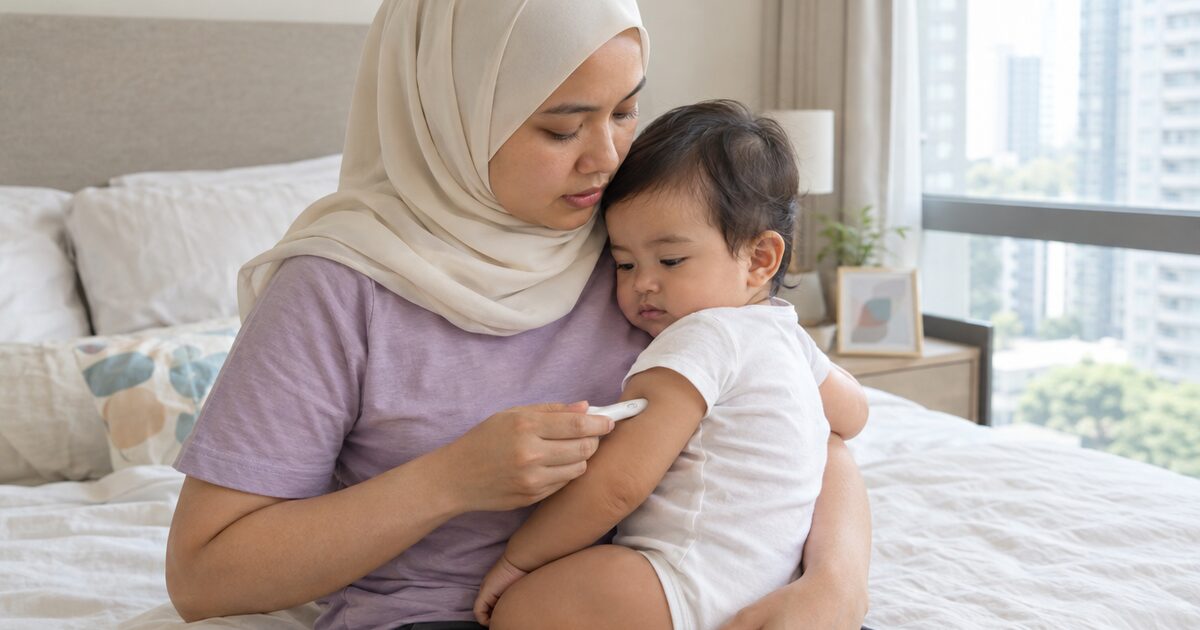
Taking your baby's temperature under the arm, step by step
- Clean the tip. The American Academy of Pediatrics (AAP) says to disinfect thermometers before and after use, with soap and water or an alcohol swab.
- Give your baby a few minutes after a bath or after being wrapped in a blanket. The NHS says either can push the reading up for a short time.
- Sit your baby on your lap and open their top so you can reach one armpit.
- Switch the thermometer on and place the tip inside the top of the armpit, as the NHS describes.
- Close the arm over the thermometer and keep it pressed to your baby's side.
- Wait for the beep. The NHS says to leave it in for as long as the leaflet says. SGH puts it at a few minutes until it beeps.
- Read the number and write it down with the time, so a grandparent or helper taking the next reading can compare. KKH's fever leaflet has a table for this, plus any medicine given. Our guide on how to give medicine to a baby covers the syringe and the dose log.
- Recheck once if the number surprises you. Wait a few minutes, then measure again the same way, as the NHS suggests.
- Clean the tip again and put the thermometer back in its case.
- Check the number against your baby's age: HealthHub says a baby under 3 months who reads 38.0 degrees C or more should go to the Children's Emergency immediately, and our baby fever guide covers older babies.
Which thermometer suits which age
Singapore's hospitals don't name brands. They name types, and HealthHub's children's page, NUH and SGH all start with a digital thermometer under the arm. They differ on when an ear thermometer is fine. HealthHub says from 4 weeks, the AAP says from 6 months, and NUH says it's most suitable from age 1.
| Thermometer type | Ages, as each source puts it | What to know |
|---|---|---|
| Digital stick, under the arm | HealthHub: the one it names for babies under 4 weeks. NUH: recommended under age 1. AAP: any age, for screening. | The AAP calls it the least accurate site. It's still where HealthHub and NUH start. |
| Digital stick, in the bottom (rectal) | HealthHub's fever page: recommended for 6 months and below. AAP: the best reading, especially under 3 months. | HealthHub's children's page calls it invasive and less convenient. Label it "rectal" (AAP). |
| Ear (tympanic) | HealthHub: 4 weeks and above. AAP: 6 months and older. NUH: most suitable from age 1. | AAP: young babies' ear canals are too narrow. SGH: a badly aimed nozzle reads falsely low. |
| Forehead scanner that touches the skin (temporal artery) | AAP: all ages. None of the Singapore pages we read gives an age. | AAP: direct sunlight, and cold after being outside, can affect it. |
| No-touch infrared forehead scanner | AAP: all ages (it's a no-touch version of the same type). | AAP: may cut the spread of germs. Check the instructions for how close to hold it. |
| Forehead strip | No source here prefers it to a digital thermometer. | AAP: fine for a quick screen, but it doesn't work as well as a digital thermometer. |
| Glass mercury | Not for any age. | SGH: no longer recommended, because of toxic mercury if it breaks. AAP: do not use one. |
If you buy one thermometer, make it a digital stick. It works under the arm from birth, which is where HealthHub and NUH start.
Ear, forehead and rectal readings
- Ear: pull the ear back, or back and up if your child is over 1, then aim the tip between the opposite eye and ear (AAP). SGH says the nozzle must point at the middle ear opening, or the reading comes out falsely low.
- Forehead: follow the box for where to slide or aim the sensor (AAP). For a no-touch scanner, the instructions also tell you how close to hold it.
- Rectal: the AAP's method is a little petroleum jelly on the tip, your baby belly down across your lap, and the tip in half an inch for a baby under 6 months. For an older child it's up to 1 inch. Stop if you feel any resistance.
- Mouth: the AAP says to wait until age 4.
What reading counts as a fever
Singapore pages don't all use one number, and most don't say which method it's for, so the table quotes each one as written. HealthHub adds that mouth, forehead and armpit readings can come out slightly lower than ear or rectal ones, so recheck with the same method each time.
| Source | What counts as a fever | Method it names |
|---|---|---|
| NUH | 38 degrees C or higher | Any thermometer. NUH recommends the armpit under age 1 and the ear from age 1. |
| HealthHub, fever in children | Above 38 degrees C | Not named. The page lists the armpit for all ages and the ear from 4 weeks. |
| HealthHub, fever (pharmacists' page) | 37.5 degrees C and above. Above 38.5 degrees C is a high fever. | Mouth or ear |
| SGH | Above 37.5 degrees C may be a mild fever. Above 38 degrees C may be a concern. | Not named |
| KKH | Gives the normal range instead: 36.5 to 37.5 degrees C | Not named |
Anything inside KKH's normal range of 36.5 to 37.5 degrees C isn't a fever, while 38 degrees C is a fever on NUH's page and the point where HealthHub's emergency rule for babies under 3 months begins. What to do once you have a fever reading is in our fever guide.
What throws a reading off
- Layers and a warm room. KKH says over-wrapping and a hot environment can lift a child slightly above normal. If confinement custom has your baby in extra layers, take them off and wait a few minutes. Our swaddle and sleep sack guide covers dressing for the heat.
- A bath. The NHS says a bath can raise the reading for a short time.
- Cold air before an ear reading. The AAP says cold outdoors gives a low ear reading and to wait 15 minutes after coming indoors. In Singapore the cold comes from aircon, so we'd give a baby the same 15 minutes after a chilly car or mall. More on heat and outings with a newborn.
- Sun on the forehead. The AAP says direct sunlight can affect a forehead reading, so measure indoors.
- A poorly aimed ear probe. SGH says it reads falsely low.
- Hot or cold drinks, for mouth readings in children 4 and up. The AAP says wait 30 minutes.
- Your hand. SGH says feeling the skin isn't an accurate way to check. Use the thermometer.
Buying and caring for a thermometer in Singapore
Thermometers are medical devices. HSA says some digital and infrared thermometers are medium-risk Class B devices that must be registered, and it keeps a list of the registered ones. HSA also asks buyers to use reliable retailers rather than internet websites, where the origin and quality can't be verified.
SGH says glass mercury thermometers are no longer recommended, and the AAP says to remove any you have at home. If you take both rectal and mouth readings in the family, the AAP says to label each thermometer so one is never used in both places.
Clean the tip before and after each use, as the AAP advises. For the rest of the first month at home, see our newborn care basics. Keep the thermometer with the rest of your baby medicine and first aid kit.
When to see a doctor
Your baby's age and behaviour matter more than the exact number. HSA tells caregivers to get medical help for any health concern, whatever the thermometer reads. See a doctor for:
- Under 3 months and 38.0 degrees C or more. HealthHub says go to the Children's Emergency immediately, and SGH says any fever at this age needs a doctor however well your baby looks.
- Under 1 month with a fever. NUH sends these babies to its Children's Emergency, and asks parents of 1 to 3 month olds to see a paediatrician as soon as possible.
- Over 41.0 degrees C at any age, which HealthHub also treats as a Children's Emergency case.
- A child who is hard to wake or very lethargic, or who keeps crying and won't settle (HealthHub).
- Breathing that stays hard and fast, skin turning grey or pale, or small purple spots like bruises (NUH).
- A fit or seizure of any kind (HealthHub, NUH).
- Much less to drink and much less urine (HealthHub), or fewer than five wet nappies a day (SGH).
- A fever that goes on for more than 3 days (SGH, NUH).
- Readings that keep climbing back to 40 degrees C despite fever medicine. NUH says see a doctor within 24 hours for this.
For a fever without these signs, start with your GP, a polyclinic, or a paediatrician from our paediatrician map. For the signs above, go to the Children's Emergency at KKH or NUH. In an emergency, call 995.
Frequently asked questions
What is the best baby thermometer in Singapore?
A digital stick thermometer used under the arm. HealthHub lists it for babies under 4 weeks, and NUH recommends it until age 1. An ear thermometer can come later. If the one you pick is a Class B device, HSA's register shows whether it's registered.
What is a normal temperature for a baby?
KKH puts normal body temperature at 36.5 to 37.5 degrees C. SGH gives 36.1 to 37.5 degrees C. SGH adds that it moves with activity and the time of day, and with how thickly your baby is dressed.
Is 37.5 a fever for a baby?
It depends on the source and the method. HealthHub's fever page counts 37.5 degrees C and above as a fever when taken in the mouth or ear. SGH says above 37.5 degrees C may be a mild fever. NUH's line is 38 degrees C. Recheck after a few minutes with the same method. Under 3 months, SGH's advice is to see a doctor for any fever, so call yours rather than wait for 38.
Can I use a forehead thermometer on my newborn?
The AAP says forehead thermometers can be used at any age. Singapore's hospital pages still name the armpit for babies under 4 weeks (HealthHub) and under 1 (NUH). A forehead scan works as a quick check. If it reads high, check under the arm straight away.
Should I take my baby's temperature in the bottom?
You can, but you don't have to. HealthHub's fever page calls rectal readings the most accurate and recommends them for babies 6 months and under. Its page on fever in children calls them invasive and less convenient, and NUH points parents to the armpit for the first year. If you'd like to use the rectal method, ask your doctor to show you once.
- HealthHub (Health Promotion Board), Fever in Children (read 5 Nov 2026)
- HealthHub (Pharmaceutical Society of Singapore), Fever (read 5 Nov 2026)
- National University Hospital, Fever (Children) (read 5 Nov 2026)
- KK Women's and Children's Hospital (SingHealth), Fever in children, with leaflet (read 5 Nov 2026)
- Singapore General Hospital (HealthXchange), A Parent's Guide to Fever in Children (read 5 Nov 2026)
- Health Sciences Authority, HSA Updates on Approved List of Class B Thermometers (read 5 Nov 2026)
- NHS, High temperature (fever) in children (read 5 Nov 2026)
- American Academy of Pediatrics, HealthyChildren.org, How to Take Your Child's Temperature (read 5 Nov 2026)
Baby blocked nose: how to clear it, and which breathing sounds need a doctor
Baby blocked nose? Saline drops, then gentle suction, as KKH and NUH advise. Plus a table of noisy breathing sounds and ...
8 min read
Baby Choking First Aid: What Every Singapore Parent Should Know
Baby choking first aid in Singapore: spot true choking, do infant back blows and chest thrusts, know when to call 995, a...
11 min read
Baby colic, reflux and gripe water: what Singapore doctors advise and when to worry
Baby colic and reflux in Singapore: what KKH, NUH and HealthHub say about gripe water and gas drops, how to soothe cryin...
12 min read