

Nursery ideas for HDB flats: a cot corner first, a toddler room later
In this article
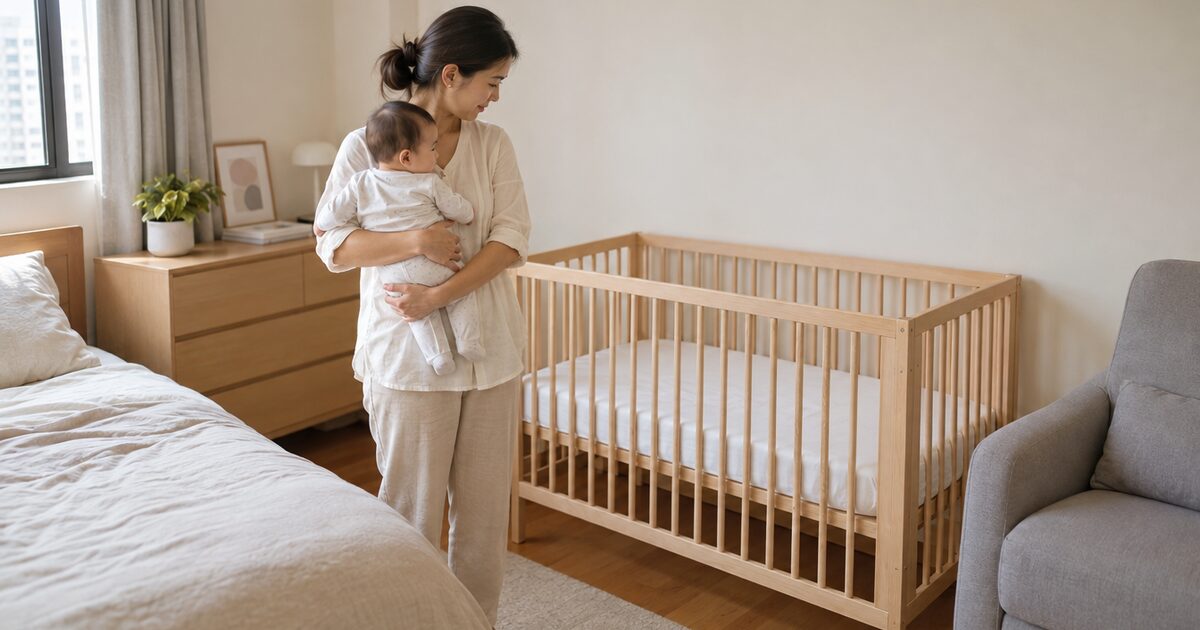
Good nursery ideas for HDB flats start in your own bedroom. HealthHub says your baby is safer in their own cot for at least 6 months, preferably a year, with the cot close to your bed. So your first nursery is a corner of the master bedroom: a cot, a chair for feeds, a changing spot and some storage. The common bedroom becomes your child's room later, when you're ready to move them.
How to set up a nursery in an HDB flat, step by step
- Pick the cot's spot first, close to your side of the bed. The rest of the corner fits around it.
- Keep that spot clear of windows and blind cords. CPSO says not to put cots, beds or playpens near a window, because children climb them to reach the cords.
- Check where the aircon blows before you settle on the spot. KKH advises a room at about 25 degrees C and a cot away from any draught.
- Keep the cot bare. HealthHub says to keep blankets, bumper pads, pillows and stuffed toys away from your baby's sleeping area, because they raise the risk of entrapment, suffocation and strangulation.
- Put a feeding chair next to the cot. HealthHub suggests a nursing chair and nursing pillow near the cot, so you can lift your baby out and feed quietly.
- Set up the changing spot with nappies and wipes within your reach. The AAP says never to leave your baby on a changing table, even for a moment, even when strapped in.
- Anchor every chest of drawers and bookshelf to the wall. If no anti-tipping kit comes with it, CPSO says to ask the retailer or buy a suitable one.
- Store heavy things on the lower shelves and in the bottom drawers. CPSO says this keeps furniture more stable.
- Use a dim lamp for feeds and run its cord out of reach. HealthHub suggests a dim night lamp only when you need it, and wires and cords kept away from your child.
- Fit window grilles and keep them locked once your baby can climb, as HealthHub advises.
Your nursery corner in the master bedroom
Put the cot nearest your bed, with the chair beside it and a low chest of drawers at the end of the same wall. You reach your baby in a step or two. The path to the door stays clear.
Small room? Pick furniture that does two jobs. A chest of drawers with a changing mat on top stores clothes below and gives you a changing spot at a height that's kind to your back. If you'd rather have a changing table, the AAP describes a sturdy one with a 5 cm guardrail on all four sides. A mat on the floor works too, and needs no furniture at all.
| Zone | What goes there | Safety check (source) |
|---|---|---|
| Sleep | Cot, firm mattress, fitted sheet | Away from windows and blind cords (CPSO). Nothing loose in the cot (HealthHub) |
| Feeding | Nursing chair, small table, dim lamp | Lamp cord out of reach, and your baby back in the cot to sleep, never on the nursing pillow (HealthHub) |
| Changing | Changing mat or table, nappies, wipes | Supplies in your reach, not your baby's. Never leave baby alone on it (AAP) |
| Storage | Chest of drawers, shelves, wardrobe | Anchored to the wall, heavy things low (CPSO) |
| Window | Curtains or blinds, grilles | Cordless, or cords held by a cleat or tension device (CPSO). Grilles locked once baby climbs (HealthHub) |
| Air | Aircon, fan | About 25 degrees C, cot out of the draught (KKH). Standing fan secured (HealthHub) |
If a helper or a grandparent puts your baby down, walk them through this corner with our nursery set-up checklist. The cot itself, from slat gaps to safety standards, is in our baby cot guide, and the full sleep set-up is in our safe sleep guide. For what your baby wears in an aircon room, see how to dress a newborn.
Furniture that stays upright
CPSO says unstable furniture and TVs are a serious tip-over risk for young children, and its checks start in the shop. Give a chest of drawers a little nudge. Pull out the top drawers and press down lightly to see if it tips. Choose one with drawer stops, so your child can't pull a drawer all the way out.
At home, fit the restraint kit and open one drawer at a time. Keep toys and the TV remote off the top, so there's nothing to climb for. If there's a TV in your bedroom, CPSO says a flat-screen should be mounted, strapped to the wall or placed on a suitable stand. Check the bolts and nuts on your furniture regularly too.
Buying a preloved dresser or changing table? Check CPSO's furniture safety alerts and recalls list before you pay, since one entry on it is a changing table and chest of drawers recalled for repairs. Our preloved baby items guide has more on buying secondhand, and the baby proofing checklist covers the rest of the flat, room by room.
Windows, blinds and light
CPSO suggests window coverings without exposed cords if you have young children at home. If your blinds have cords, fit a tension device to keep them taut, or a cleat on the wall to hold them out of reach.
For naps, HealthHub says to keep the room as dim as possible. Blackout curtains on a track darken the corner with no cord to reach.
Then the grilles. HealthHub says to install window grilles and keep them locked once your baby can climb. It also names stools and other small furniture as things a child uses to reach heights, so keep those away from the window.
On a haze day, our haze and kids guide explains NEA's readings and what to do. If you're weighing a purifier for the bedroom, see our air purifier guide.
Turning the common bedroom into a toddler room
When your child moves out of your room, the common bedroom is the natural next step. Plan it around floor space for play, with the bed or cot against an inside wall, away from the window and its cords.
Put toys and books on low, open shelves your child can reach from the floor. CPSO says toys left on top of dressers tempt children to climb, and to teach children never to climb into or hang onto drawers, shelves or cabinet doors.
A tall standing fan needs securing in case it topples, HealthHub says. It also suggests a gate across the kitchen or a playpen to keep your baby in one safe space. Our portable playpen guide has more on choosing one.
Moving from cot to bed is its own step. Our cot to bed guide covers when to move and how to fit a guard rail.
What you can skip
- A fully themed nursery room before birth. Your baby sleeps in your room for at least the first 6 months, so the spare room can wait.
- Cot bumpers, pillows and soft toys. HealthHub lists them among the loose things to keep out of the sleep area.
- A sarong cradle (yao lan) or a baby walker. HealthHub says to avoid both, because they raise the risk of falls.
- Built-in carpentry sized for a baby. Freestanding pieces you anchor now can move to the toddler room later.
When to get help
- Call 995 if your child stops breathing or struggles to breathe, is unresponsive, or has a serious injury such as a head or neck injury. HealthHub lists these as emergencies that need an ambulance.
- Go to an emergency department after a fall if your baby is under 6 months and fell from higher than 90 cm, or if your child loses consciousness, has a seizure, starts vomiting, or becomes drowsy or very irritable (HealthHub).
- See your GP or a polyclinic for minor bumps without those signs. HealthHub says a regular clinic doctor will do for less serious cases.
- If a cot, dresser or changing table you own seems unsafe, check CPSO's furniture safety alerts and recalls list and follow the steps it gives, then contact the seller about a repair or refund.
Frequently asked questions
Is a nursery in the master bedroom a good idea?
Yes, for at least the first 6 months. HealthHub says your baby is safer in their own cot in your room, close to your bed, for at least 6 months and preferably a year. Bring your baby into your bed for a feed or a cuddle, then put them back in the cot to sleep. Our co-sleeping guide covers the move to their own room.
What do I need for a baby nursery setup in Singapore?
Start with a cot, a firm mattress and fitted sheets, a chair for feeds, a changing spot and a chest of drawers you can anchor. Add a dim lamp and cordless blinds or curtains. Our nursery set-up checklist lets you tick each item off, and the baby cost estimator helps you budget.
What are some small nursery ideas for an HDB bedroom?
Keep everything on one wall and let furniture do two jobs. A changing mat on an anchored chest of drawers saves a separate table, and a mat on the floor saves furniture altogether. Keep nappies and wipes in the top drawer, within your reach, and the heavy things below.
What are good toddler room ideas in Singapore?
Leave floor space for play and put the bed away from the window. Toys go on low open shelves your child can reach. Anchor every shelf and dresser, keep the window grilles locked, and keep the tops of furniture clear so there's nothing to climb for. CPSO's furniture tips and HealthHub's child-safe home page cover each check.
Which HDB nursery ideas keep a baby safe near windows?
Start with grilles. HealthHub says to install window grilles and keep them locked once your baby is able to climb. Until then, keep the cot and anything climbable away from the window, as CPSO advises. Our baby proofing checklist covers windows across the flat.
- Consumer Product Safety Office (CPSO), Safety Tips on Furniture and TVs (read 7 Nov 2026)
- Consumer Product Safety Office (CPSO), Safety Tips on Window Coverings (read 7 Nov 2026)
- Consumer Product Safety Office (CPSO), Furniture safety alerts and recalls (read 7 Nov 2026)
- HealthHub Parent Hub (Health Promotion Board), Baby sleep: 7 safe sleeping tips (read 7 Nov 2026)
- HealthHub, Common Childhood Injuries and a Child-Safe Home (read 7 Nov 2026)
- HealthHub, Should I Take My Child to the ER? (read 7 Nov 2026)
- KK Women's and Children's Hospital (SingHealth), Caring for Your Newborn Baby (read 7 Nov 2026)
- American Academy of Pediatrics (HealthyChildren.org), Changing Table Safety (read 7 Nov 2026)
Air purifier for baby: when it helps and what to check
Do babies need an air purifier? What NEA and HealthHub say on HEPA, CADR for an HDB bedroom and ozone, plus seller price...
6 min read
Art Jamming in Singapore: A Family Guide to Painting and Art Fun
Your parent's guide to art jamming in Singapore: what it is, the best ages, studio vs cafe vs at-home, what to bring, ro...
11 min read
Baby Fairs in Singapore: A Parent's Guide to Deals, Dates and Smart Shopping
A practical guide to baby fairs in Singapore: where they run, what to buy and skip, how to spot real deals, what to brin...
10 min read