

Baby Cot Singapore: A Safety-First Buying Guide for Parents

In this article
Your baby will clock more hours in their cot than in any other piece of gear you buy, which is exactly why this is the one purchase you should approach safety-first rather than price-first or pretty-first. The reassuring news for Singapore parents is that a safe cot does not have to be the dearest one on the shop floor. What matters is that the cot meets our local safety code, pairs with a firm and well-fitting mattress, and actually fits your bedroom. This guide is built for first-time parents and anyone weighing up a preloved frame: we cover the official safety standard and how to check a cot meets it, the cot types and the two common sizes, the new-versus-secondhand question, and safe-sleep basics. For the bigger picture, our parenting tools can help you map out the wider first-year budget.
Start here: the Singapore safety standard for cots
In Singapore, baby cots are a controlled consumer product, which means they are not meant to be sold unless they meet a recognised safety standard. The local benchmark is SS 638, the Code of Practice for the Safety of Baby Cots, and oversight sits with the Consumer Product Safety Office (CPSO). Many cots sold here are also built to or tested against equivalent international standards such as the European EN 716. Before you get drawn in by a clever conversion feature or a marketplace bargain, the single most useful question to ask a retailer is simple: does this cot comply with the Singapore safety requirements for baby cots? A reputable seller will be able to answer that without hesitation.
You do not need to memorise the standard, but it helps to know what the safety rules are actually checking for, because most of them you can verify yourself in the showroom or on a friend's used cot.
The safety checks that genuinely matter
This is the section to read twice. Every point below maps to a real entrapment, fall or suffocation risk, and almost all of them you can test by hand before you buy.
- Slat spacing: The gaps between the bars must be wide enough not to trap a limb but narrow enough that a baby's head cannot slip through. Singapore guidance puts the spacing at roughly 4.5 cm to 6 cm; the underlying standard sets it at not less than 4.5 cm and not more than 6.5 cm. A handy at-home check: if a standard drink can fits through the gap, it is too wide.
- A firm, flat, snugly fitting mattress: The mattress should sit flush against all four cot walls with no gaps. The CPSO advice is to use a firm, snugly fitting mattress so a baby cannot become trapped between the mattress and the frame. As a quick test, you should not be able to fit more than two fingers between the mattress edge and the cot side.
- No raised corner posts or cut-outs: Decorative knobs, finials and shaped headboard cut-outs can catch clothing and become a strangulation hazard. Official guidance is to choose a cot without them, so look for clean, flush corners.
- A sturdy, stable base and frame: The cot should have a wide, stable base and feel solid when you give it a firm shake. No wobble, no sharp edges, no protruding bolts or screws sticking out where a baby could scratch or snag.
- Fixed sides, never a drop-side: Older drop-side cots, where one side slides down, have been linked to injuries when the moving side fails or detaches. Singapore now requires fixed-side cots, so avoid any drop-side model entirely, however cheap or charming it looks.
- An adjustable base height: Set the mattress base high while baby is a newborn to save your back, then drop it to the lowest setting once they can sit or pull up to standing, so they cannot tip or climb out.
- A bare sleep surface: Keep pillows, soft toys, bumper pads, quilts and loose bedding out of the cot for the first year. A fitted sheet on a firm mattress is the safest set-up.
The main types of baby cot
Once safety is squared away, the right type comes down to your space and how long you want the cot to last. Most cots sold in Singapore fall into a handful of clear categories.
- Standard cot: The classic full-size cot with fixed sides and an adjustable mattress base. Sturdy, long-lasting and the default choice, typically used from newborn to around two or three years.
- Convertible cot bed (3-in-1 and up): Converts from a cot into a toddler bed, and sometimes a daybed or sofa. It costs more upfront but stretches its use for years, which can pay off if you have the floor space and are not planning to pass it on.
- Mini cot: A smaller-footprint version of the standard cot. A sensible middle ground when a full-size cot will not fit but you want something sturdier and more permanent than a bassinet.
- Bassinet: A compact, lightweight sleeper for the newborn months, easy to keep beside your bed. Babies outgrow it quickly, usually within the first four to six months, so it is a short-term option rather than the main bed.
- Travel cot or playpen: Lightweight and foldable, ideal for grandparents' homes, hotels or staycations. Best treated as a second sleep space, not the everyday cot.
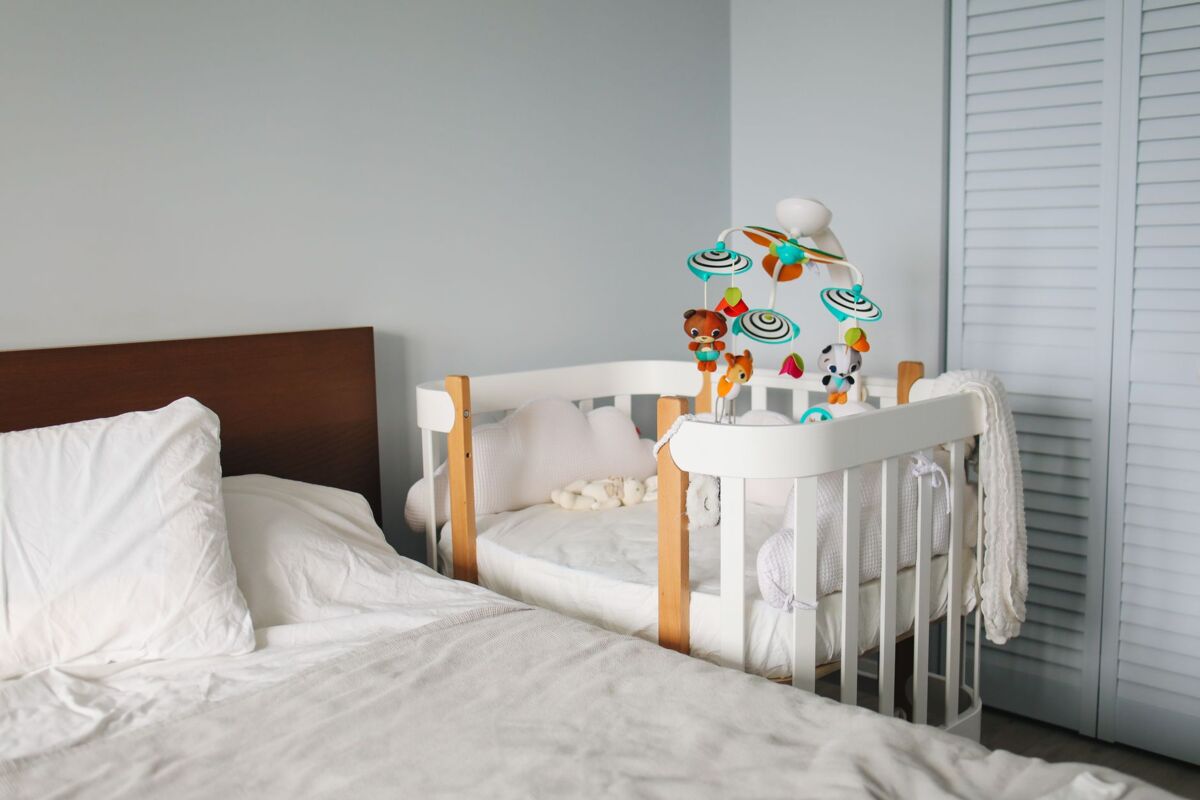
- Bedside co-sleeper: Attaches to your bed with one side lowered, so baby sleeps within arm's reach in their own separate space. Popular for night feeds and reflux, and a lifesaver in compact master bedrooms. It still counts as room-sharing, not bed-sharing, which is what current safe-sleep advice recommends.

The two common cot sizes
Cots broadly come in two footprints, and knowing which you are looking at makes comparing models far easier.
- Standard or full-size cot: Roughly 120 cm to 140 cm long internally. This is the workhorse size most families buy, with the most mattress and bedding options on the market.
- Compact, mini or space-saver cot: Noticeably shorter, often around 90 cm to 100 cm long, designed for tight nurseries and shared rooms. Lovely for an HDB bedroom, but check that replacement mattresses and sheets in that size are easy to find before you commit.
Whatever the size on the label, always buy the mattress made or sized for that exact cot. A mattress bought separately that is even slightly too small leaves a gap, and a gap is an entrapment risk.
Choosing for a smaller HDB or condo room
Local bedrooms are rarely generous, and a full-size cot can eat a serious chunk of a master bedroom or nursery. Measure first, fall in love second. A few ways to make a cot work in a tight room:
- Bedside co-sleepers and mini cots have the smallest footprint and tuck neatly beside your bed, which suits the first six to eight months of frequent night feeds.
- Convertible cot beds save you buying a separate toddler bed later, so you free up future spending even if they take a little more room now.
- Look for lockable wheels if you want to roll the cot between rooms, and check the folded dimensions of any travel cot before you buy.
- Measure the doorway and the gap beside your bed, not just the cot's footprint. A cot that fits the room but blocks the wardrobe becomes a daily annoyance.
While you are planning the nursery, it is worth thinking about the gear that lives around the cot too. Our guides to the best baby monitors in Singapore and best strollers in Singapore tackle the same small-space realities.
Buying new versus preloved
Cot frames are built to last, so a gently used one from a friend or a marketplace can be a smart, sustainable buy. The catch is that you become the safety inspector, so check it properly before you trust it with your baby.
- Confirm the cot meets a recognised safety standard and is not a recalled model. If it is an older drop-side cot, walk away regardless of condition.
- Inspect for cracks, loose joints, missing screws, peeling paint and any wobble. Make sure you can get the full assembly instructions, ideally the original ones.
- Check that all original fittings are present and that the base raises, lowers and locks securely at every setting.
- Buy a brand-new mattress sized to that exact cot, fit it, and apply the two-finger test around all four edges before the first nap.

Baby fairs and warehouse sales can be a good place to compare cots in person and ask suppliers directly about safety compliance; our roundup of baby fairs in Singapore covers when and where they run.
How much should you budget?
Prices move constantly and depend heavily on materials, brand and convertibility, so treat these as broad guidance and always confirm the current price and safety compliance before buying. As a rough map: simple standard cots and budget options tend to sit at the lower end, mid-range standard and mini cots in the middle, and feature-rich convertible cot beds at the top. Add a separate line for a new mattress, fitted sheets and a waterproof protector, since those are essential rather than optional extras.
- Entry level: Basic standard cots and travel cots, often the most wallet-friendly route, especially if you already have a hand-me-down frame and only need a new mattress.
- Mid range: Solid wood standard cots, mini cots and bedside co-sleepers with adjustable bases and decent build quality.
- Premium: Multi-stage convertible cot beds and design-led brands that grow with your child for years.
- Do not forget the extras: a firm new mattress, two or three fitted sheets and a waterproof mattress protector should be in every budget.
Safe-sleep basics that go beyond the cot
Even the safest cot only works alongside safe-sleep habits. Singapore's HealthHub guidance lines up with international advice on the essentials: Related reading: our guides to baby swaddles and sleep sacks, the best baby swings and bouncers and the best high chairs in Singapore.
- Always place your baby on their back to sleep, for naps and at night.
- Use a firm, flat mattress with a well-fitting sheet, and nothing else in the cot.
- For babies under six months, keep blankets, pillows, cot bumpers and soft toys out of the cot, as these raise the risk of sudden infant death syndrome (SIDS).
- Let your baby sleep in your room but in their own cot or co-sleeper, not in your bed.
- Never let a baby fall asleep on a sofa, armchair or nursing pillow.
Frequently asked questions
What safety standard should a baby cot in Singapore meet?
The local code of practice is SS 638, overseen by the Consumer Product Safety Office. Many cots are also built to equivalent international standards such as EN 716. Ask the retailer to confirm compliance, and check the official CPSO safety-tips page if you want to verify the current requirements yourself.
What is the safe gap between cot slats?
Singapore guidance puts slat spacing at roughly 4.5 cm to 6 cm, with the standard setting it at not less than 4.5 cm and not more than 6.5 cm. If a standard drink can passes between two bars, the gap is too wide and the cot is not safe.
How long will my baby use a cot?
Most babies stay in a standard cot until around two to three years, or until they start climbing out, at which point a toddler bed becomes safer. A convertible cot bed simply transitions with them.
Do I need a bassinet and a cot?
Not necessarily. A bassinet or bedside co-sleeper suits the newborn months in your room, while a full-size cot lasts far longer. Plenty of families skip one or the other depending on space and budget, and a co-sleeper can neatly bridge both jobs.
Are cot bumpers safe?
Current safe-sleep advice is to keep the cot completely bare, without bumpers, pillows or loose bedding, for the first year. A fitted sheet on a firm mattress is all your baby needs.
Is it safe to buy a second-hand cot?
It can be, if you inspect it carefully, confirm it meets a recognised standard, rule out drop-side and recalled models, and pair it with a brand-new, well-fitting mattress. If you cannot verify the frame's history or condition, it is safer to buy new.
For more on kitting out the early months, browse the rest of our parenting blog, including guides to baby carriers and the gear you will reach for daily.

Art Jamming in Singapore: A Family Guide to Painting and Art Fun
Your parent's guide to art jamming in Singapore: what it is, the best ages, studio vs cafe vs at-home, what to bring, ro...
11 min read
Baby Fairs in Singapore: A Parent's Guide to Deals, Dates and Smart Shopping
A practical guide to baby fairs in Singapore: where they run, what to buy and skip, how to spot real deals, what to brin...
10 min read
Best Baby Swaddles and Sleep Sacks in Singapore
How to choose safe, breathable baby swaddles and sleep sacks in Singapore's hot climate, when to stop swaddling, and wha...
9 min read