

Toddler shy with strangers: what's normal and how to help
In this article
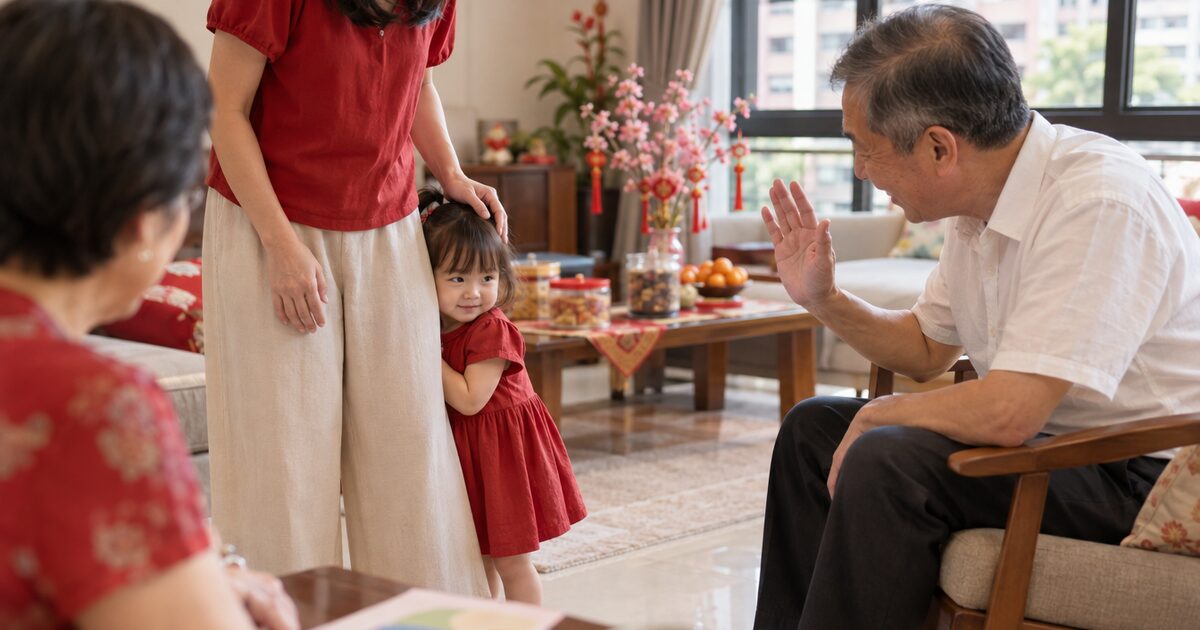
If your toddler is shy with strangers, you're seeing a normal stage of growing up. Families for Life, MSF's family council, says it's common for toddlers to feel shy, cautious or upset around people they don't know, because they feel safest with the people they trust. What helps most is time: let your child watch from your lap, let relatives come closer slowly, and offer a wave instead of a hug.
What to do when your toddler is shy with strangers, step by step
- Tell your child who they'll see before you arrive: "Ah Ma and Uncle Wei will be there. You can sit with me first." Families for Life suggests talking about what to expect before social events.
- Keep your child on your lap or holding your hand, and let them watch. Families for Life says time to observe from a safe distance helps.
- Ask relatives to start with a smile or a chat and to wait before picking your child up. Families for Life and Raising Children Network both suggest this.
- Bring in one new face at a time. Families for Life says one new person feels less overwhelming than a big group.
- Offer a choice of greeting: "Hug, high five or wave?" Families for Life says a child can say no to hugs politely and wave or high five instead.
- Name the feeling and skip the label: "You're not sure yet. That's okay, we'll stay together." Families for Life advises against calling a child shy, since labels can make them feel stuck that way.
- Pack a favourite toy or blanket, and keep your own voice relaxed and friendly. Your child takes cues from you.
- Praise small brave moments: "You waved to Auntie Siti. She was so happy." Families for Life suggests celebrating a wave or a hello.
- Teach a quiet signal for when your child needs you mid-chat: their hand on your arm, then your hand over theirs. Raising Children Network suggests it for interrupting.
Why toddlers get shy with strangers, and what's typical by age
Your child has worked out who their people are. Raising Children Network says stranger anxiety happens as a child forms a healthy attachment to familiar people, so a new face can feel wrong at first. Families for Life says your toddler might cling to you, hide behind you, cry, refuse to speak or avoid eye contact. None of it means you've done something wrong. Families for Life is clear that it doesn't reflect bad parenting or a difficult child, and most children grow more comfortable with time.
Temperament plays a part too. Families for Life says some children take longer to feel comfortable around new people, and calls being slow to warm up a natural personality trait. These children can become confident and sociable once they feel safe.
| Age | What's typical | What helps |
|---|---|---|
| Under 1 year | Wariness of new faces starts at 5 to 6 months and gets stronger at 7 to 12 months (Raising Children Network). Families for Life puts the start at 6 to 9 months. | Meet new people at home, with your baby on your lap, one or two at a time. |
| 1 to 2 years | Your child may cling, hide, cry or go quiet with new people. It often eases between 18 months and 2 years (Raising Children Network). | Let them watch first. Ask relatives to wait before picking them up. |
| 2 to 3 years | Most children start to relax with strangers by about 2 (Raising Children Network). Families for Life says most are more comfortable by 2 to 3. Toddlers may not yet know to wait their turn to talk. | Give small jobs they can do alone, like feeding themselves or tidying toys. Praise a wave or a hello. |
| 3 to 6 years | Some stay slow to warm up, which Families for Life calls a normal temperament. From 3 to 5, many can wait briefly to talk (Raising Children Network). | Talk through who you'll meet. Practise saying hello at home first. |
If the tears start when you leave rather than when someone new arrives, that's more likely separation anxiety. Our guide to starting childcare and separation anxiety covers drop-offs. For everything else 1 to 3-year-olds learn, see toddler milestones in Singapore.
Hugs, greetings and big festive visits
Chinese New Year and Hari Raya can mean many homes, many relatives and lots of arms reaching for your child in a single day. Plan for it the way you'd plan a nap. Keep the first visit quiet, give your child time on your lap at each house, and let them warm up again at the next one.
You don't need to make your child hug or kiss anyone to be polite. Families for Life says no one should force a child to give or receive kisses and hugs, even from grandparents, relatives or friends, and suggests a high five or a wave instead. If saying "gong xi fa cai" or doing salam feels too big today, a wave still counts as a greeting. Learning that their body is their own is part of body safety too, which our stranger danger and body safety guide covers.
Some relatives will feel hurt. Families for Life says you don't need to feel embarrassed when your child cries in someone else's arms. Let relatives know it's part of growing up. Raising Children Network suggests simply telling adults that your child is learning to be around new people. A line you can use: "She likes to watch first. Sit with us for a bit and she'll come round." For the visiting days themselves, see our guides to Chinese New Year and Hari Raya with kids.
Helpers, grandparents and one shared plan
Your child's safe base doesn't have to be you. Families for Life says children feel safest with the people they know and trust, and that can be the helper or grandparent who looks after them every day. At a gathering, that familiar lap works just as well.
Agree the plan with every adult who cares for your child, so your child hears the same words. Families for Life says grandparents should sing the same tune as parents and respect the rules set for the children. Three things to agree on: nobody calls your child shy in front of them, nobody insists on a hug, and a wave is a fine hello.
HDB life gives you easy practice. Say hello to neighbours in the lift or at the void deck and let your child watch. Families for Life says children pick up social skills by watching you greet neighbours and chat with relatives.
When your toddler keeps interrupting conversations
Once your child relaxes at a gathering, a new thing happens: they tug, shout or climb on you while you talk. Raising Children Network says interrupting is common because children are excited to share and still learning to pause and take turns. It says 1 to 3-year-olds may not yet understand that they should wait, while 3 to 5-year-olds can often wait briefly.
Teach the hand-on-arm signal at home first, in pretend play. You hold a toy phone, and your child practises putting a hand on your arm. When they use it, cover their hand with yours, finish your sentence, then turn to them. Keep the wait short at first. Raising Children Network says to reward the signal with your attention quickly and praise the waiting: "You waited till I finished. Thank you. What did you want to show me?"
Tell your child when it's fine to interrupt straight away: if someone is hurt or something is dangerous. If a call really can't stop, give your child a special toy or tell them how long you'll be, as Raising Children Network suggests.
When to get help
Families for Life says most toddlers gradually outgrow their fear of strangers. It's worth talking to your GP, polyclinic doctor or paediatrician if:
- Your child becomes extremely distressed around new people, or stays highly fearful for a long time (Families for Life).
- They seem anxious even in familiar places, or get more fearful over time (Families for Life).
- The fear isn't easing by 2 years, or it's getting worse (Raising Children Network). It also suggests getting help if anxiety runs in the family.
- Shyness regularly gets in the way of play, friendships or preschool and childcare activities (Families for Life). Their preschool teacher is a good person to ask as well.
- Your child rarely looks at you, turns to their name or uses social smiles and gestures like waving, with family as well as strangers. KKH lists these among the signs of autism it says can be noticed from as young as 12 months. Our guide to early signs of autism explains the next steps.
A sign on this list is a reason to ask, and only a professional can assess your child. Families for Life names a preschool educator, paediatrician or child psychologist as people who can help. To find a children's doctor near you, try our paediatrician map.
Frequently asked questions
Is a toddler scared of strangers normal at this age?
Yes. Families for Life calls fear of strangers a normal stage for many toddlers. Raising Children Network says it often eases between 18 months and 2 years, though it can last longer in children who are slow to warm up.
My toddler pushes away hugs from relatives. Should I make them hug?
No. Families for Life says no one should force a child into hugs and kisses, even from grandparents, and suggests a high five or a wave instead. Tell the relative kindly that your child is still warming up, and let your child pick the greeting.
How do I stop my toddler interrupting conversations?
Teach a signal. Your child puts a hand on your arm, and you put your hand over theirs to show you've noticed, as Raising Children Network suggests. Keep the wait short, then give them your attention and praise the waiting. Under 3, expect plenty of reminders.
At what age does stranger anxiety stop?
For most children it fades between 2 and 3. Raising Children Network says stranger anxiety starts to pass by about 2 years, and Families for Life says most children are more comfortable around people by 2 to 3, and Raising Children Network adds that a child's temperament can make it last longer. Talk to your doctor if it isn't easing by 2 or is getting worse.
Is a shy toddler a sign of autism?
Shyness with new people is a normal stage, Families for Life says. KKH's early signs of autism are different: a reduced response to their name, brief eye contact most of the time, and few social smiles or gestures. If you see these with family too, talk to your doctor.
Should I tell people my child is shy?
Try other words. Families for Life suggests avoiding the shy label, since labels can make children feel stuck that way. Say "He likes to watch first, then he joins in," so your child hears that they can join in when ready.
- Families for Life, Fear of strangers: babies and young children (toddlers) (read 6 Nov 2026)
- Families for Life, Fear of strangers: babies and young children (babies) (read 6 Nov 2026)
- Families for Life, Shyness and children (read 6 Nov 2026)
- Families for Life, Touch me not: teaching kids body safety and awareness (read 6 Nov 2026)
- Families for Life, How to grandparent in style (read 6 Nov 2026)
- KK Women's and Children's Hospital, Autistic spectrum disorder (read 6 Nov 2026)
- Raising Children Network (Australia), Stranger anxiety in babies and children (read 6 Nov 2026)
- Raising Children Network (Australia), How to teach your child conversation skills (read 6 Nov 2026)
ADHD in children in Singapore: early signs, assessment and support
ADHD in children in Singapore: how it differs from a lively preschooler, when doctors assess it, the polyclinic route an...
9 min read
Asthma in children in Singapore: signs, inhalers and what to do in an attack
Asthma in children in Singapore: the signs, reliever and preventer inhalers, using a spacer, the action plan, and when t...
8 min read
Balanced diet for toddlers in Singapore: plates, servings, sugar, tea and salt
A balanced diet for toddlers in Singapore: HPB's plate, daily servings for ages 1 to 6, hawker picks, and the advice on ...
9 min read