

Baby skincare routine in Singapore: daily steps, products by age and sun safety
In this article
A baby skincare routine in Singapore can stay short: a warm bath, a light moisturiser if the skin is dry, barrier cream at nappy changes and shade before sunscreen. SingHealth's HealthXchange puts bath water at 36 to 38 degrees C and bath time at 5 to 10 minutes. Talc and medicated oil stay out of the routine. The steps come first, then the reasons.
Baby skincare routine, step by step
- Bathe your baby in warm water, 36 to 38 degrees C, for 5 to 10 minutes. HealthXchange says hot water strips the skin's natural oils, and suggests a mild cleanser without fragrance or dyes.
- Pat your baby dry instead of rubbing, as KKH advises. Dry every crease: under the chin, around the neck, the armpits, the groin and behind the ears.
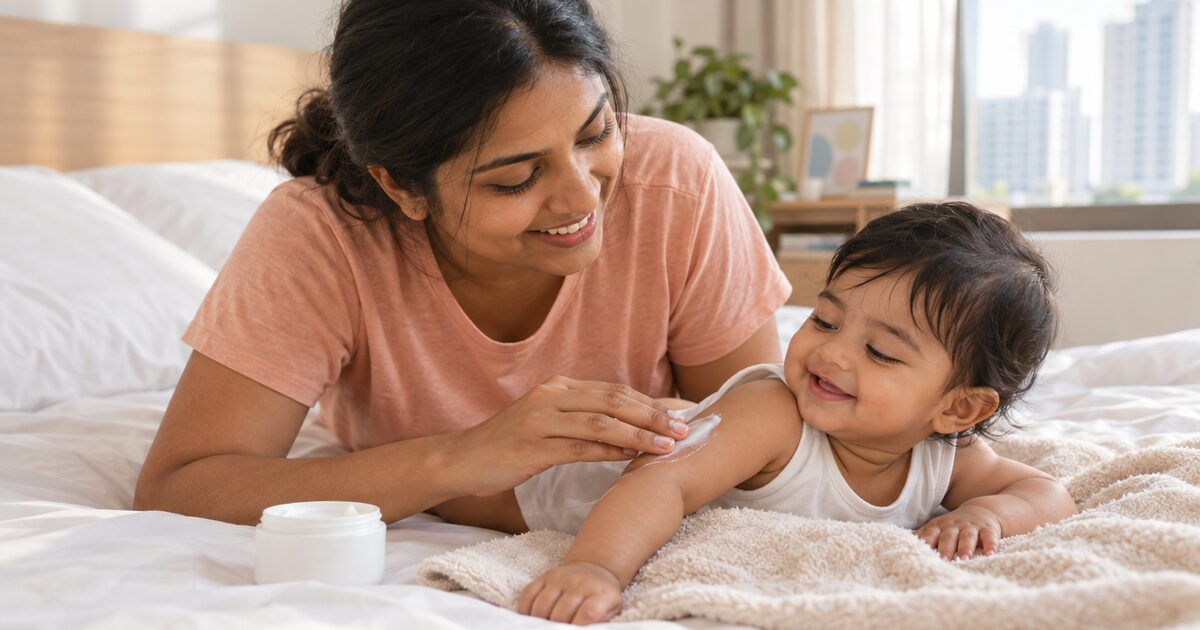
- Smooth on a thin layer of light, fragrance-free moisturiser if the skin looks dry. SingHealth says moisturiser works best straight after a bath.
- Change wet or dirty nappies promptly, clean with water and let the skin dry. Then add a thin layer of barrier cream: NUH says a fingertip's worth covers the whole bottom.
- Wipe the face with moist cotton wool and no soap, as HealthHub advises. Clean and dry the neck folds, where the AAP notes sweat and drool collect.
- Dress your baby in light, loose cotton, as the National Skin Centre (NSC) suggests. HealthHub advises a fragrance-free detergent for cloth nappies, and a change of laundry product if eczema patches appear.
- Keep a baby under 6 months in the shade. SingHealth says sunscreen is for children above six months, at SPF 30 or higher.
What your baby needs at each age
The list stays short at every age.
| Age | What you need | What to skip | Why | Source |
|---|---|---|---|---|
| Until the cord falls off (1 to 2 weeks) | Water, cotton wool, barrier cream | Medicated oil or powder on the tummy or cord | HealthHub says no medicated oil on the stump; NUH says no oil or powder on the tummy | HealthHub, NUH |
| Birth to 6 months | Mild fragrance-free cleanser, light moisturiser for dry patches, a sun hat and shade | Talc, bubble bath, antiseptic soap, sunscreen all over | Strong soaps and bubble baths aren't recommended for babies, talc isn't either, and babies under 6 months stay out of direct sun | HealthXchange, SingHealth, NHS |
| 6 to 12 months | Broad-spectrum mineral sunscreen on uncovered skin, a wide-brimmed hat, light long sleeves | Spray sunscreen | Zinc oxide and titanium dioxide rarely irritate; sprays can contain propellants not recommended for babies | AAP |
| 1 year and up | Broad-spectrum, water-resistant sunscreen of SPF 30 or higher, reapplied every two hours | A moisturiser with SPF as the only sun cover | Moisturisers with some SPF aren't enough as a standalone sunscreen | SingHealth |
Fragrance and ingredients to skip
HealthXchange calls fragrance and colourings notorious allergens, and colourings usually show on a label as CI followed by a five-digit number. If you use soap, KKH recommends a mild, fragrance-free soap substitute, and wipes that are alcohol-free and fragrance-free.
Some ingredients are worth avoiding by name. SingHealth's moisturiser guide names sodium lauryl sulphate (SLS) as an irritant to avoid. Mayo Clinic lists camphor, boric acid, phenol, benzocaine and salicylates among ingredients that can be toxic for babies.
HSA treats bath products, shampoos and sunbathing lotions as cosmetics. Sellers notify HSA before a product goes on sale, use only permitted colourants, preservatives and UV filters, and list ingredients in English. HSA doesn't approve products first, so a label that says "approved by HSA" is misleading. HSA adds that "hypoallergenic" means less likely to cause allergy, not allergy-free, and "natural" or "organic" isn't automatically safer. If a product causes a reaction, stop using it.
Is baby powder safe?
Every source we read says to leave talcum powder out. The NHS says not to use it on nappy rash, Mayo Clinic says the same, and Raising Children says to skip talc and cornstarch baby powder on a baby's skin. NUH's newborn booklet says not to put powder or medicated oil on your baby's tummy. Mayo Clinic adds that powders and oils can add to a nappy rash. These pages don't give a breathing risk as the reason, so we haven't claimed one.
If someone reaches for powder to keep sweaty folds dry, use the heat rash advice from HealthXchange instead: light clothing, cool baths, and aircon or a fan to keep the room cool. HealthHub says heat rash goes away by itself. For red skin under the nappy, our diaper rash guide covers creams and yeast rashes. Not sure which spots you are looking at? Our baby rash guide helps you tell them apart.
Sunscreen and sun safety in Singapore's UV
NEA updates Singapore's UV index every 15 minutes on its website and the myENV app. It rates 8 to 10 as very high and 11+ as extreme, and says UV is highest between 11am and 3pm. SingHealth's quick check: if your shadow is shorter than you, find shade.
Under 6 months, shade comes first. SingHealth says babies below six months should be kept away from direct sunlight. The AAP suggests a shaded pram, a wide-brimmed hat and light long sleeves. If you're caught with no shade, it allows a little sunscreen on small areas such as the face.
From 6 months, SingHealth says children should use sunscreen daily: broad-spectrum, water-resistant and at least SPF 30. For sensitive skin it suggests physical blockers, since chemical blockers carry a higher risk of contact allergy. The AAP says mineral sunscreens with zinc oxide or titanium dioxide suit babies best, in a cream, lotion or stick. Skip sprays: SingHealth says not to spray near the nose and mouth, so your child doesn't breathe it in.
Put it on at least 15 minutes before you go out. Reapply every two hours, or sooner after water play or heavy sweating, and use it on cloudy days too. These rules cover sunscreen for kids in Singapore from 6 months up. For outings, heat and haze, see our guide on when a newborn can go outside.
Massage oils and confinement customs
HealthHub suggests a light massage after the bath, before bed, to calm your baby and signal sleep. The NHS says to check that any oil or lotion you use is suitable for babies. Go light in hot weather: HealthXchange lists heavy creams and ointments that block sweat ducts among causes of heat rash.
If an elder offers medicated oil for your baby's tummy, Singapore health advice is to leave it off. HealthHub says no medicated oil on the cord stump or in the belly button, and NUH's booklet says no medicated oil or powder on a baby's tummy. Check any label for camphor or salicylates, which Mayo Clinic says can be toxic for babies. If your baby swallows some, KKH lists suspected poisoning as a Children's Emergency case.
Check your baby's G6PD result before a traditional remedy. KKH says all newborns are screened through cord blood. For babies with G6PD deficiency, KKH and NUH list henna on the skin and mothballs at home among things to avoid, and KKH advises against herbal and traditional remedies.
Keeping a newborn away from aircon is a custom KKH lists as a myth. It says there's no harm in a fan or aircon if you and your baby are comfortable, and it may help prevent heat rash. Our confinement guide covers the other customs.
Baby skin in aircon
A KKH neonatologist told HealthXchange that a baby can stay in an air-conditioned room all day if it's set at 22 to 24 degrees C, not 18 to 19. NSC lists sudden changes of room temperature among things that worsen eczema, so avoid big jumps between a cold room and the heat outside.
If your baby's skin turns dry, moisturise straight after the bath. For eczema-prone skin, KKH suggests a fragrance-free moisturiser two to three times a day, even on skin that looks normal. Our baby eczema guide covers flare-ups and creams.
When to see a doctor
Most baby rashes are mild and clear on their own, HealthXchange says. Get your baby checked if you see any of these:
- A temperature above 37.5 degrees C, or an unusual rash. KKH lists both as reasons to go to the polyclinic or Children's Emergency.
- Any fever in a baby under 3 months, which KKH treats as a Children's Emergency case.
- A rash with a high fever, a stiff neck or drowsiness, or one that spreads fast with bleeding gums or nose. SingHealth says go to the emergency department.
- Swelling of the face, lips or tongue, or trouble breathing. SingHealth says to call 995 for difficulty breathing.
- Any sunburn in a baby under 1 year. The AAP says to call the doctor right away, and calls a severe sunburn in a baby a medical emergency.
- A rash that looks infected (tender, or draining pus), or heat rash that hasn't cleared after 3 days of home care or gets worse over 24 hours, as the AAP advises.
- Redness or watery discharge around the belly button, which KKH lists as a reason to get checked.
- A nappy or newborn rash that won't settle. NUH says to seek care if a nappy rash persists, and KKH's skin clinic reviews newborn rashes that haven't improved after a few weeks.
For a lingering rash on a baby who is otherwise well, see your GP or polyclinic, which KKH says is faster and cheaper. For a fever under 3 months, a swallowed product or a severe sunburn, go to KKH Children's Emergency or NUH Children's Emergency, and call 995 in an emergency. Our paediatrician map lists clinics near you, and the baby fever guide covers temperatures.
Frequently asked questions
What is a good baby skincare routine in Singapore?
A 5 to 10 minute warm bath, a pat dry, a light fragrance-free moisturiser if the skin is dry and barrier cream at nappy changes. Add cotton clothes and shade. The NHS says a daily bath isn't needed, but it's fine if your baby enjoys it.
Is baby powder safe for babies?
The sources we read say to skip it. The NHS, Mayo Clinic and Raising Children advise against talcum powder, and NUH says to keep powder off a baby's tummy. For sweaty folds, cool the room instead.
From what age can babies use sunscreen in Singapore?
From 6 months. SingHealth says children above six months should use sunscreen daily and younger babies should be kept away from direct sunlight. Before then, use shade, a hat and light long sleeves.
What sunscreen is best for kids in Singapore?
SingHealth recommends a broad-spectrum, water-resistant sunscreen of SPF 30 or higher. For babies and sensitive skin, pick a mineral formula with zinc oxide or titanium dioxide, in a lotion or stick. Reapply every two hours and after water play.
Does my baby need moisturiser every day?
Only if the skin is dry. Raising Children says to use a non-perfumed moisturiser on dry skin, and KKH's Dr Mark Koh says a light cream after the bath helps the skin barrier mature. Babies with eczema need more: KKH suggests two to three times a day.
Can I use medicated oil on my baby?
Singapore's health sources say no. HealthHub says no medicated oil on the cord stump or in the belly button, and NUH's booklet says no medicated oil or powder on a baby's tummy. For massage, use an oil or lotion made for babies.
- HealthXchange (SingHealth, with KKH Paediatric Dermatology), Treatment for rash, eczema and other baby skin conditions (read 6 Nov 2026)
- SingHealth, Sunscreens and sun-safe practices (read 6 Nov 2026)
- National Environment Agency, Ultraviolet index (read 5 Nov 2026)
- HealthHub (Health Promotion Board), Care of your newborn: to have and to hold (read 5 Nov 2026)
- National University Hospital, Hello Baby: a guide for new parents (PDF) (read 5 Nov 2026)
- HealthHub (Health Sciences Authority), Cosmetic products (read 6 Nov 2026)
- HealthXchange (SingHealth, with KKH Neonatology), Haze and newborn babies (read 5 Nov 2026)
- American Academy of Pediatrics, HealthyChildren.org, Baby sunburn prevention tips (read 6 Nov 2026)
Baby blocked nose: how to clear it, and which breathing sounds need a doctor
Baby blocked nose? Saline drops, then gentle suction, as KKH and NUH advise. Plus a table of noisy breathing sounds and ...
8 min read
Baby Choking First Aid: What Every Singapore Parent Should Know
Baby choking first aid in Singapore: spot true choking, do infant back blows and chest thrusts, know when to call 995, a...
11 min read
Baby colic, reflux and gripe water: what Singapore doctors advise and when to worry
Baby colic and reflux in Singapore: what KKH, NUH and HealthHub say about gripe water and gas drops, how to soothe cryin...
12 min read